Independent comparisons. We may earn from shop links. More info

Folding Japanese saw vs fixed blade

Updated: 21 October 2026

You already know you want a pull saw, and the open question is the hinge. A folding Japanese saw vs fixed blade is a bag question as much as a cut question: the folder covers its teeth among other tools, and it gives up stiffness and a little length to do it. A fixed plate stays straighter through a long session and needs a sheath or a hook so it does not live loose in the toolbox. This page stays on that one trade-off. Pitch and country of origin are in the [folding Japanese saw buying guide](/hub/power-saws/folding-japanese-saw/sub/folding-japanese-saw-buying-guide). The stroke is in [how to use a folding Japanese saw](/hub/power-saws/folding-japanese-saw/sub/folding-japanese-saw-how-to-use). Prices for the five folders are on the [folding Japanese saw comparison](/hub/power-saws/folding-japanese-saw). Peter F. used listing rows and published guidance, not a lab cut, with reviews dated up to 6 October 2026.

You already know you want a pull saw, and the open question is the hinge.

Our top picks

On this page

What the fold is for

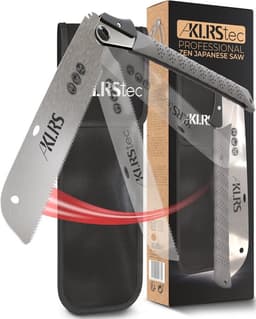
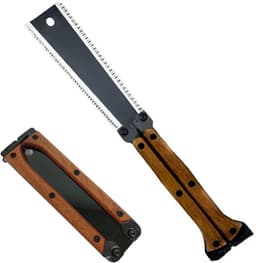
The fold exists so the teeth are not loose in a tool bag. English Garden's pruning-saw guide puts it plainly: fixed blades are longer and faster when you have room to swing, and folders are shorter, reach tighter forks, and cover the teeth. They also prefer a lock that holds both open and closed. The folder is the answer in a mixed bag, provided the closed lock actually holds. In this set the covers are not all the same. The KLRStec is the bag saw: 240 mm, 240 g, and a nylon pouch at £29.99, with 4.4 from 553 reviews. Buyers say they chose it because it folds into that pouch. The SUIZAN F-003 has no pouch. It folds to about 155 mm, with a 120 mm blade, and the closed handle is the only guard. HAISHANG, Adiwo, and Sukodon are double-edge folders. Both edges sit inside wooden scales when the catch is shut. That is a real cover, and it is not a sheath you can hang on a belt hook the way a fixed pruning saw often does. A pouch still wears. KLRStec reviews mention a pouch that thins after a few years, and teeth that do not always seat in the handle groove. Check the closed lock before the saw shares a bag with screws and a chisel.

What you give up

You give up a continuous spine. A folder has a pivot, a shorter stroke, and a plate that flexes more than a fixed ryoba of the same length. Bartlett's Silky comparison, a US shop page so the prices there are not ours, describes the mechanism: folders suit a pocket and occasional use, and the pivot flexes; fixed scabbard saws suit people who draw the saw one-handed all day. The flex helps in a tight fork. It shows up when you want the fiftieth kerf to stay straight. The pivot can fail. KLRStec reviews include a lock button that is easy to press by accident, a knurled nut that loosens, and occasional reports of a missing pin or a weak joint. SUIZAN reviews say the lock holds if you set it, and that a push bends the 0.7 mm plate. A fixed blade has no button to knock into the wrong angle. It can still bend if you twist it in a bind, but it does not fold shut on your fingers mid-stroke. Length goes with the hinge. The longest confirmed folder here is 240 mm. A fixed pruning saw or a bench ryoba is often longer because nobody had to hide the plate in a handle. On a run of deep cross-cuts, that shorter stroke is the limit you feel by lunchtime. Who each folder is for is on the best folding Japanese saw page. None of them becomes a fixed saw.
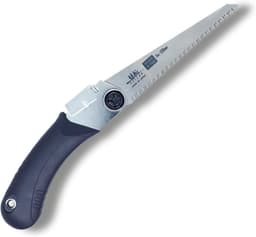
SUIZAN SUIZAN folding saw 120 mm

Testsieger

SUIZAN SUIZAN folding saw 120 mm
9.4/10about £22.80

Bench, dovetails, and a real ryoba

None of these five is a dozuki, and none is a rip-and-cross ryoba. Woodsmith's guide treats a dozuki's rigid spine as the saw you learn joinery on, and a ryoba as the general bench saw with rip teeth on one edge and cross-cut teeth on the other. HAISHANG and Adiwo print 13 TPI and 14 TPI, two fine pitches sitting close together, not a rip side and a cross-cut side. A butterfly folder is not a ryoba just because it has two edges. You will not dovetail cleanly with this set. A joinery folder does exist: Classic Hand Tools lists a Gyokucho Fugaku folding dozuki, 240 mm, 0.3 mm, made in Miki, at £42.95 including VAT. That saw is outside our five. A dozuki's back holds the plate straight for a shoulder line. A pruning folder's hinge does the opposite. KLRStec reviews mention dowels and light joinery offcuts, which is occasional use, not a bench dozuki you pick up all day. Keep a fixed pull saw on the bench, sheathed or hung, if dovetails, tenons, or long rips are the work. Use the folder when the saw leaves the bench. A fixed ryoba in a mixed toolbox leaves the teeth bare. A folder on a dovetail hinges, and the teeth are the wrong pattern.

A condition, not a winner

Choose a folder from this set when the saw shares a bag with other tools and the cuts are occasional: pruning in a tight fork, a camping offcut, a dowel on site. Choose a fixed pull saw when you cut all day and you can hang or sheath the plate. Inside the folders, the KLRStec is the one with 240 mm and a pouch, if you will live with the lock notes. The SUIZAN is the pocket saw made in Japan, with no pouch and a 120 mm plate. The double-edge folders cover their teeth by closing, and they stay short. A shared tool bag points to a folder from this set. Daily bench joinery points to a fixed pull saw, not these listings. A climbing saw you draw one-handed from a scabbard is a third case, and it is not what these amazon.co.uk folders are for.

Common questions

Will a folder cut as straight as a fixed ryoba?
Not through a long session. The pivot and the thinner, unsupported plate flex, so the kerf wanders if you twist or rush. A fixed ryoba has no hinge and usually a longer stroke. For a short cross-cut in a branch or a dowel, reviewers still describe a clean line once the pull stroke is familiar. For shoulders and repeated bench cuts, the fixed saw stays the straighter tool.
Is the hinge a weak point?
It can be. KLRStec reviews mention a lock button that shifts the angle, a nut that loosens, and sometimes a missing pin or a weak joint. SUIZAN's lock is described as firm if you set it and check the screw. A fixed blade has no pivot to lose a pin. The hinge is still worth having when the alternative is a bare plate in a bag, and it is not worth having when the saw never leaves the bench.
Do I still need a sheath?
You need something that covers the teeth. A folder with a proven closed lock, or the KLRStec's pouch, is that cover. A fixed saw needs a sheath, a scabbard, or a hook. If the pouch has worn through, or the teeth do not seat in the handle, you are back to needing a separate guard. Closed and locked is the test, not the word folding on the title.
Can I dovetail with these five?
These five are pruning and general folders, not dozukis. Two edges at 13 and 14 TPI are not rip and cross-cut. A folding dozuki, such as the Gyokucho at Classic Hand Tools for £42.95, is the joinery folder, and it is not in this comparison. Use a fixed dozuki or that kind of backed saw for dovetails. Use these listings for bag and garden cuts.
What should live in a tool bag?
A folder with the teeth covered: the KLRStec if you want 240 mm and a pouch and will check the lock, or the SUIZAN if 120 mm and a pocket fold are enough. The double-edge saws belong in the bag only if the catch holds shut. Leave a fixed ryoba on the bench unless it has its own sheath. A bare plate among chisels is how people get cut.
When is the fixed saw the worse idea?
When it has to travel in a mixed bag with no sheath. The teeth stay exposed, and a pruning plate is long enough to catch a hand. A folder is the worse idea when you need a stiff joinery cut, a one-handed draw from a climbing scabbard, or a full day's rip and cross-cut. Match the hinge to the bag, and leave the bench saw fixed.

Related pages

Sources

Public sources used for this comparison, taken from the research digest. Listings were captured with reviews dated up to 6 October 2026. Prices, stars and review counts are the amazon.co.uk figures for this set.

  1. HSE PUWER overview (retrieved 6 October 2026)
  2. HSE L22, PUWER approved code of practice (retrieved 6 October 2026)
  3. Consumer Rights Act 2015, section 22 (retrieved 6 October 2026)
  4. RHS tree pruning guide (retrieved 6 October 2026)
  5. Silky Fox Gomboy (retrieved 6 October 2026)
  6. Knivesandtools UK, how to use a pull saw (retrieved 6 October 2026)
  7. SUIZAN folding saw manual, F-003 (retrieved 6 October 2026)
  8. Z-Saw stroke notes (retrieved 6 October 2026)