Independent comparisons. We may earn from shop links. More info

Folding Japanese saw buying guide

Updated: 21 October 2026

You have five amazon.co.uk listings open and the titles shout past the spec tables. One saw is sold as 300 mm, another prints a teeth row of 3, and SK5 sits beside an origin line that says China. This folding Japanese saw buying guide confirms the blade length, the pitch, the lock, and whether a spare is named. Shelf prices and stars are on the [folding Japanese saw comparison](/hub/power-saws/folding-japanese-saw). This page does not crown a pick. A recommendation with a condition is on the [best folding Japanese saw](/hub/power-saws/folding-japanese-saw/sub/folding-japanese-saw-best) page. Peter F. compared the listings, with reviews dated up to 6 October 2026. There was no lab test. A qualifying purchase can earn a commission at no extra cost to you.

You have five amazon.co.uk listings open and the titles shout past the spec tables. One saw is sold as 300 mm, another prints a teeth row of 3, and SK5 sits beside an origin line that says China.

Our top picks

On this page

Length and folded size

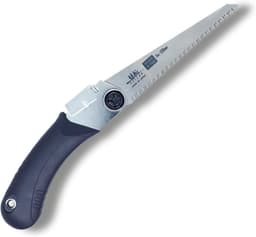
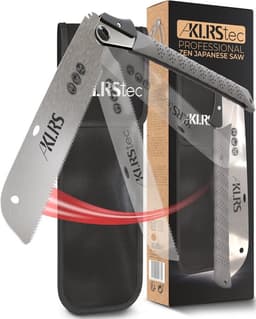
A folding saw is two sizes at once. The blade length is what meets the wood. The folded length is what fits a pocket or a tool bag. The SUIZAN F-003 prints a 120 mm blade and 155 mm folded, at about 118 g in the spec table and 125 g in the bullets. The KLRStec prints 240 mm and 240 g, with a nylon pouch, which is a site saw rather than a shirt-pocket saw. The HAISHANG blade-length field says 14 cm, and the 6.3 inch line in the bullets is the folded size, so do not add those two figures together. The Adiwo bullets claim a fold to 16.5 cm and a 0.6 mm plate, while the spec table leaves the cutting length blank and the dimensions row reads 10 × 1 × 15 cm. The Sukodon title says 300 mm. The spec table has no blade length, and one detailed review measured about 14–15 cm of cutting edge and about 30 cm with the saw open. Treat the title as unconfirmed.

Pitch, steel, and origin

Tooth pitch is teeth per inch. A lower number takes a bigger bite. A higher number leaves a finer kerf and clogs sooner if the gullets are small. HAISHANG and Adiwo both print 13 TPI and 14 TPI on opposite edges. Those are two fine pitches, not a coarse pruning tooth beside a finish tooth. A catalogue rule of thumb, from maker tables such as Takagi's folding range rather than a test of these ASINs, puts coarse folders nearer 8–10 TPI and fine carpenter folders nearer 12–15. KLRStec's teeth row says 3. That is not 3 TPI, and the listing never prints a pitch. Sukodon prints 1.6–1.9 TPI in one bullet and 13–15 TPI in another. A long review reads the finer figure, so leave the coarse line as a conflict. SK5 and SK85 are carbon tool-steel names, not a country. Only the SUIZAN prints Japan. The other four print China. Where thickness is printed, the Adiwo is 0.6 mm and the SUIZAN is 0.7 mm. Thin is normal. A kink from a push is the stroke, on how to use a folding Japanese saw.
SUIZAN SUIZAN folding saw 120 mm

Testsieger

SUIZAN SUIZAN folding saw 120 mm
9.4/10about £22.80

Lock, pouch, and a spare blade

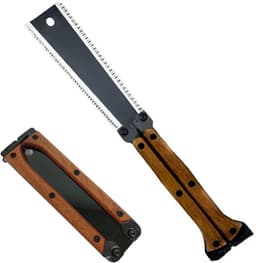
The fold is only a guard if it stays shut, and the cut is only safe if it stays open. English Garden's pruning-saw notes prefer a lock in both positions. KLRStec claims a safety lock and two angles, with 45° in the spec table, plus a nylon pouch. Reviews also say the button is easy to press by accident, so the angle shifts, and that the knurled nut loosens. A few reports mention a missing pin or a weak joint. You get 240 mm and a pouch, and a latch to prove with your thumb before the first stroke. SUIZAN claims two positions and the maker's manual tells you to check the screw and the stopper. There is no pouch. HAISHANG, Adiwo, and Sukodon hide both edges inside wooden scales. Replace a kinked plate rather than bending it back. SUIZAN says the F-003 is compatible with a replacement and does not include one. KLRStec reviews say spares are sold separately. The other three do not name a spare. A lock that arrives without its pin is a fault: under the Consumer Rights Act 2015 you have 30 days to reject goods that are not as they should be. A plate bent by pushing a pull saw is the stroke, not that right.

How the five listings sit on that checklist

Read the spec table before the title. KLRStec at £29.99 is the only confirmed 240 mm plate, with a pouch and no printed pitch. SUIZAN at £22.80 is the 120 mm saw made in Japan, with a named spare that is not in the box. HAISHANG at £9.99 has a 14 cm blade field and 13 and 14 TPI, and the fullest review file under £10. Adiwo at £6.59 repeats that pitch pair, with 17 reviews and no blade length in the table. Sukodon at £12.98 remains a short folder until you measure the plate, because the 300 mm title is unconfirmed. None of those rows picks a winner. Reach plus a pouch points one way. A pocket saw whose origin line says Japan points another. Collars, and the point where a tree surgeon takes over, sit on the folding Japanese saw for pruning page.

Common questions

What blade length do I need for a 10 cm post?
SUIZAN's beginner guide, the maker's rule of thumb and not a test of these listings, says the blade should be about two to three times the thickness of the stock. A 10 cm post on that rule wants about 210–240 mm of plate. In this set that is the KLRStec's printed 240 mm, not the 120 mm SUIZAN or the HAISHANG's 14 cm field. A short folder will start a kerf. It will not give you a full stroke through a post that thick.
Is 13/14 TPI coarse or fine?
Thirteen and 14 teeth per inch are fine pitches. HAISHANG and Adiwo print that pair on opposite edges, so you are choosing between two close finish teeth, not between a pruning tooth and a joinery tooth. Maker catalogues put coarse folding saws nearer 8–10 TPI. Fine gullets clog in sappy green wood if you rush the stroke. If you wanted a fast cut on a thick limb, this pair is the wrong end of the scale, though it is the right end for a clean kerf on small dry wood.
Does SK5 mean the saw was made in Japan?
SK5 and SK85 are carbon tool-steel names. Country of origin is a separate row. Only the SUIZAN listing in this set prints Japan. KLRStec, HAISHANG, and Adiwo can say SK5 and still print China, and the Sukodon title says SK85 while the origin row also says China. Buy the country line you can read, and treat the steel name as a grade claim rather than a factory address.
Should I buy a saw with no replacement blade?
You can, if you accept that a kinked plate ends the tool. SUIZAN names a compatible blade and does not include it. KLRStec reviews say spares exist and are not in the box. HAISHANG, Adiwo, and Sukodon do not name a spare in this capture. If you push a thin pull saw until it bends, replace the plate. Do not bend it back into line.
Walnut or beech on the Sukodon — which row do I trust?
Neither row has been settled on the listing. The title says walnut. The materials row says beechwood. Both are left as printed, and this capture does not include a note that decides it. Wood species changes the look of the handle more than the cut. It does not fix the larger conflict, which is a 300 mm title against a review that measured about 14–15 cm of cutting edge. Match the saw to the plate you can confirm, and treat the timber name as unresolved.

Related pages

Sources

Public sources used for this comparison, taken from the research digest. Listings were captured with reviews dated up to 6 October 2026. Prices, stars and review counts are the amazon.co.uk figures for this set.

  1. HSE PUWER overview (retrieved 6 October 2026)
  2. HSE L22, PUWER approved code of practice (retrieved 6 October 2026)
  3. Consumer Rights Act 2015, section 22 (retrieved 6 October 2026)
  4. RHS tree pruning guide (retrieved 6 October 2026)
  5. Silky Fox Gomboy (retrieved 6 October 2026)
  6. Knivesandtools UK, how to use a pull saw (retrieved 6 October 2026)
  7. SUIZAN folding saw manual, F-003 (retrieved 6 October 2026)
  8. Z-Saw stroke notes (retrieved 6 October 2026)