Independent comparisons. We may earn from shop links. More info

Folding Japanese saw for pruning

Updated: 21 October 2026

Secateurs have just crushed a stem instead of cutting it, or a pair of loppers has stalled halfway through a side branch in a UK garden. A folding Japanese saw for pruning is the next tool once the wood is past that point, and it is the wrong tool once the branch is over your head or the tree is bigger than you can control. This page is about where the cut goes and when you stop. The pull stroke itself is on [how to use a folding Japanese saw](/hub/power-saws/folding-japanese-saw/sub/folding-japanese-saw-how-to-use). Which listing to buy sits on the [best folding Japanese saw](/hub/power-saws/folding-japanese-saw/sub/folding-japanese-saw-best) page and in the [folding Japanese saw comparison](/hub/power-saws/folding-japanese-saw). Peter F. followed RHS and review notes dated up to 6 October 2026. Nobody here measured a maximum branch for these five saws.

Secateurs have just crushed a stem instead of cutting it, or a pair of loppers has stalled halfway through a side branch in a UK garden.

Our top picks

On this page

When the saw replaces secateurs

The RHS pruning guide draws a practical line: branches under about 2.5 cm in diameter are secateurs or loppers, and thicker wood comes off with a saw, back to a union. That 2.5 cm figure is a diameter, not a length of blade. BBC Gardeners' World frames a pruning saw as the tool from about 5 cm upward. Those are two publishers' rules of thumb, not one British Standard, so do not merge them into a single limit. Use the RHS line to leave the secateurs behind, and treat a short folder as already near its comfortable work once the limb is several centimetres thick. A crushed stem from blunt secateurs is the moment to fetch the saw, not to squeeze harder. A folder still has to fit in the fork. English Garden notes that folding pruning saws are shorter and reach tighter crotches, while a fixed blade is longer if you have room to swing. If the branch is a trunk, stop. A 120 mm plate will not cross a mature stem in a controlled way. Green wood also packs fine teeth. HAISHANG and Adiwo print 13 and 14 TPI, which are finish pitches, so sap will clog those gullets on a sappy limb. A coarse pruning tooth is a different saw.

The collar, not a flush cut

The branch collar is the slight swelling where the branch meets the stem or a larger limb. The RHS says the final cut sits just outside that collar, not flush with the bark, and not so far out that you leave a peg. A flush cut takes the collar away. New Forest guidance says you do not need to paint the wound as a seal. On a light branch you can often cut once, just outside the collar. On a heavy limb the RHS sequence is three cuts. Undercut about 20 cm out from the collar so the bark cannot tear when the branch drops. Then overcut a little further out so the weight falls away. Then make the final cut just outside the collar. If you skip the undercut, the falling limb strips bark down the stem. Support the offcut only when it is light enough that it will not twist the saw. Take about one fifth of the canopy in a year, which is the RHS guidance, not a by-law. A hard crown reduction on a large tree is not a Saturday job with a 14 cm folder. If you are unsure which limb is structural, stop.
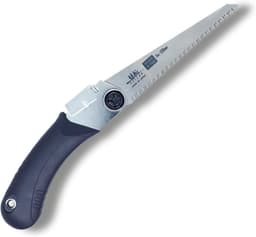
SUIZAN SUIZAN folding saw 120 mm

Testsieger

SUIZAN SUIZAN folding saw 120 mm
9.4/10about £22.80

What a 120 mm and a 240 mm saw are for in a garden

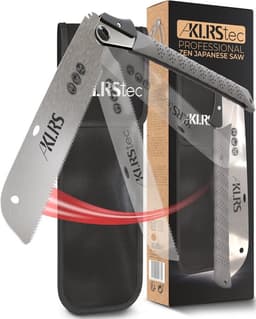
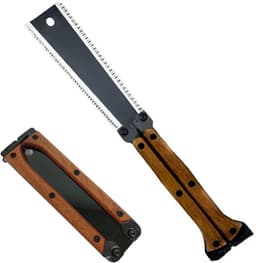
These sizes are descriptions from listings and reviews, not a rated cutting capacity. A UK review of the 120 mm SUIZAN mentions a clean cut on a 2.5 cm branch, which sits on the RHS line where secateurs give up. Other notes talk about side growth and wisteria, and several buyers say the saw is smaller than they pictured. A 120 mm plate is for shoots and small side wood, not a limb you have to walk around. HAISHANG reviews, on a saw whose blade-length field says 14 cm, mention shrubs around 3 inches and one 4 inch ash limb. Quote those as what individual buyers did, not as a rated capacity. The KLRStec's confirmed 240 mm gives a longer stroke for thicker side wood, and it is still a hand saw with a hinge. Sukodon's title says 300 mm, and a review measured about 14–15 cm of edge, so do not plan a large limb around that title. If the plate you own is too short, the buying guide is the checklist for length.

When you put the saw down

Stop when the cut is directly overhead. Silky Fox says not to cut above your head and to plan where the branch will fall. A short folder does not make an overhead cut safer. Stop near power lines. The SUIZAN manual says not to use the saw near them, and to wear eye protection. Gloves matter when you change a blade, because the teeth are bare once the plate leaves the handle. Stop when the tree is large, the crown needs a real reduction, or the limb could hit a road, a greenhouse, or a neighbour's roof. The RHS says to use a qualified person for a large tree. Anyone can advertise tree work. The Arboricultural Association's advice is to use the ARB Approved Contractor directory, to treat a logo on a van as advertising rather than proof, and to get three quotes. If you are employed to prune, PUWER 1998 still expects a suitable saw and someone who has been shown the lock and the pull. The saw stays in the shed when the branch is above you.

Common questions

Secateurs, loppers, or this saw?
Use secateurs or loppers under about 2.5 cm diameter, which is the RHS line, and a saw once the wood is thicker than that. Loppers bridge the gap on straight stems you can reach with two hands. A folding saw earns its place in a tight fork and on anything the loppers crush or stall in. It does not replace secateurs on pencil-thick growth, where a fine 14 TPI plate is slower than a bypass blade.
Where is the branch collar?
It is the swollen ring of wood where the branch joins the stem or a parent limb. Cut just outside it. Do not cut flush to the bark, and do not leave a long peg. On a heavy branch, undercut about 20 cm out, overcut a little further so the weight drops, then make the final cut at the collar. Skipping the undercut lets the falling limb tear a strip of bark.
Do I paint the cut?
You do not need to paint the wound as a seal. RHS practice and New Forest tree-pruning guidance both leave a clean cut unpainted. Paint can trap moisture against the wood. A tidy collar cut matters more than a tin of sealant. If the tear has already run down the stem, painting will not put the bark back.
Can a 120 mm saw take a thick limb?
A UK review describes the 120 mm SUIZAN on a clean 2.5 cm branch. That is an anecdote, not a maximum printed on the listing. HAISHANG buyers mention shrubs around 3 inches and one 4 inch ash limb, again as reviews. A thick, heavy limb needs a longer plate or a staged cut, and often a different person. Do not invent a millimetre rating these pages never give.
Is it safe above my head?
No. Do not cut directly overhead, and plan the drop before you start. Silky Fox states that limit for this kind of folding saw. A branch you cannot hold or steer can take the saw, and your balance, with it. Use a qualified arboriculturist when the work is in the crown. A folding design only covers the teeth in the bag. It does not change where you should stand.
How much of the crown can I remove this year?
The RHS suggests no more than about one fifth of the canopy in a year. That is guidance for the tree's recovery, not a statute with a fine attached. Spreading a reduction over several years beats one hard cut with a short saw. If the shape you want removes more than that, or you cannot tell which limbs are structural, stop and ask a qualified person.
Who do I call for a large tree?
Use the Arboricultural Association's ARB Approved Contractor directory, and take three quotes. A logo on a van is not the same check. The RHS points large-tree work at a qualified arboriculturist. Ask what they will cut, how the timber will come down, and whether the price includes waste. Do not hire on the strength of a saw brand alone.

Related pages

Sources

Public sources used for this comparison, taken from the research digest. Listings were captured with reviews dated up to 6 October 2026. Prices, stars and review counts are the amazon.co.uk figures for this set.

  1. HSE PUWER overview (retrieved 6 October 2026)
  2. HSE L22, PUWER approved code of practice (retrieved 6 October 2026)
  3. Consumer Rights Act 2015, section 22 (retrieved 6 October 2026)
  4. RHS tree pruning guide (retrieved 6 October 2026)
  5. Silky Fox Gomboy (retrieved 6 October 2026)
  6. Knivesandtools UK, how to use a pull saw (retrieved 6 October 2026)
  7. SUIZAN folding saw manual, F-003 (retrieved 6 October 2026)
  8. Z-Saw stroke notes (retrieved 6 October 2026)