Independent comparisons. We may earn from shop links. More info

How to use a fine tooth saw

Updated: 21 October 2026

You have marked a length of skirting, or a dowel that has to finish close to a face, and the first centimetre is the part that usually wanders. A fine tooth saw, whether you push a 350 mm toolbox saw or pull a short Japanese plate, cuts cleanly only if the start is light and the offcut is supported. This page is the stroke. It does not rank the ten listings in the [fine saw comparison](/hub/power-saws/fine-saw). Peter F. used public UK technique notes and the review themes already in that comparison, read on 19 October 2026. It is not a lab test. A qualifying purchase can earn a commission at no extra cost to you.

You have marked a length of skirting, or a dowel that has to finish close to a face, and the first centimetre is the part that usually wanders.

Our top picks

On this page

Mark, support, waste side

Knife the line, or use a sharp pencil if a knife would show on the finished face, and decide which side of the line is waste. The kerf has width. If you saw down the middle of a pencil line, the piece that stays is already short. Put the teeth on the waste side and let the plate just kiss the line. Support the work so it cannot hop. A clamp on a bench is the sure version. Stand so you can look along the plate, not from the side. DIY Doctor’s point is simple: a drift of a few millimetres is enough for the set of the teeth to bind. Force is how a thin tooth snaps. Skirting wants the last 20–30 mm supported, which is the BuildWiz figure for the end of the cut. These teeth are sharp enough to cut skin in a tool bag. Fit the guard, sleeve or covers before the saw goes away. A fabric glove near a fine tooth is a poor promise, and a bare thumb used as a guide has to stay off the teeth.

Starting a push saw and a pull saw

Hold the weight of the saw. John Lloyd’s shared rule is that you guide the plate, you do not lean on it. On a western toolbox saw, the usual start is a short backward stroke so the teeth score a groove, with almost no downward pressure. An alternative Lloyd describes is a light push at the toe, still with the weight of the saw in your hand. Either start is a nick, not a cut. Your thumb can rest on the timber beside the line as a fence for that nick, and it comes away once the groove exists. A pull saw starts at the heel. Wonkee Donkee’s sequence puts the heel of the blade on the line, low, and the first strokes are gentle pulls. Pressure belongs on the pull, not on a push back into the kerf. If you shove a thin pull plate forward, you kink it. Push saw: light backward nick, then push. Pull saw: heel on the line, then pull.
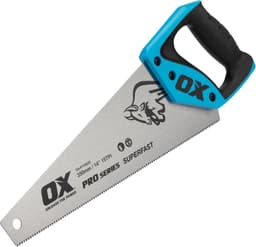
OX OX Pro toolbox saw 350 mm

Testsieger

OX OX Pro toolbox saw 350 mm
8.4/10about £7.43

The stroke that does the work

Axminster’s hardpoint notes put the plate at about 45° to the face for a general cut, using the whole length of the teeth, with light pressure. A 350 mm saw used only in the middle wears a short patch of teeth and makes the plate harder to steer. A western saw cuts as you push. A pull saw cuts as you draw it towards you. Loading the return stroke is how the kerf closes on the plate. If the saw binds, you are twisting, or the gullets are full. A fine tooth clogs sooner than a 7 TPI panel saw, especially in green wood. Withdraw the plate and clear the dust. On a pull saw that has stuck, ease the wood apart a little and free the plate. Forcing a thin plate breaks teeth, and Axminster’s conclusion is to replace the saw, not to file a hardpoint.

The last part of the cut

The tear happens in the last 20–30 mm, when the offcut drops and the fibres break out of the face you wanted to keep. Support that end and slow the stroke. Let the last fibres part under the weight of the saw. Cutting from the show face, with the waste supported, keeps the break-out on the side that will be hidden or planed. If you are trimming a dowel level with a finished surface, this general stroke is not enough, because a saw with set will scratch the face. That job is on the flush cut saw page. Stop when the tooth is wrong. A 15 TPI toolbox saw in wet logs will clog. A 6 inch pull saw on a metre of architrave will wander. Call a joiner when the cut shortens a stair, a joist or a stud, or when a slip would ruin a fitted handrail. An employer who issues saws still owes instruction under PUWER 1998. Stop if the material may be asbestos cement. The choice between push and pull is on Japanese pull saw vs handsaw.

Common questions

Do I start a western saw by pulling or by a light push?
Either, as long as the first strokes only nick the waste side of the line. The usual western start is a short backward stroke that scores a groove. John Lloyd also describes a light push at the toe. In both cases you hold the weight of the saw. The cutting strokes come after the groove exists. A heavy first push is how the plate jumps out of the line.
Where do I put a pull saw on the first stroke?
Put the heel of the blade on the waste side of the line, with the plate low, and draw it towards you with almost no pressure. Wonkee Donkee keeps pressure on the pull only. Do not start by pushing the thin plate into the timber. That is the stroke that kinks it. Once a shallow groove is there, lengthen the pull and still ease off as the plate goes forward.
What angle should the plate be?
About 45° to the face is the Axminster figure for a general hardpoint cut, using the full length of the teeth and light pressure. A very flat plate skates. A very steep plate bites a short patch of teeth and is harder to keep on the line. If the saw binds, you have usually twisted a few millimetres off that line. Stand over the plate and correct the twist before you add force.
Why does the saw bind after a few centimetres?
The set of the teeth needs a kerf slightly wider than the plate. Twist the saw, and that kerf closes on the steel. Gullets packed with dust do the same thing, and a fine tooth fills sooner than a coarse one. Ease the wood, clear the dust, and lighten the return stroke. On a stuck pull saw, do not ram the plate. Free it, then decide whether the tooth was too fine for that section.
How do I stop the last corner tearing on skirting?
Support the last 20–30 mm so the offcut cannot drop, and let the final strokes stay light. Cut on the waste side, from the face you want to keep, so any break-out is on the hidden side. A clamp or a block under the end is more reliable than a free hand near the teeth. If the arris still lifts, the tooth may be too coarse for that moulding, which is a buying question, not a harder push.
What do I do if a hardpoint tooth snaps?
Stop. A missing tooth scratches the next pass, and filing an induction-hardened tooth is not the repair. Axminster’s guidance is to replace the saw rather than force a thin plate. None of the pull saws in this comparison lists a spare blade in the box, even where a screw-in blade is claimed. Fit the guard and retire that blade. Do not keep cutting with a gap in the tooth line.
When should I stop and fetch a different saw?
Stop when the timber or the building element is the wrong job for that tooth. Green logs and deep rips clog a 15 TPI saw. A short pull saw is the wrong tool for a long straight rip. A kinked plate will not track. Fetch a joiner if the cut changes a stair, joist, stud or fitted handrail. Also stop if you suspect asbestos cement. Changing saws is cheaper than forcing the one in your hand.

Related pages

Sources

Public UK sources and the amazon.co.uk listings compared on this page. Prices captured 19 October 2026.

  1. RS hand saws guide (retrieved 19 October 2026)
  2. Axminster hardpoint guide (retrieved 19 October 2026)
  3. BuildWiz hand saw guide (retrieved 19 October 2026)
  4. HSE PUWER overview (retrieved 19 October 2026)
  5. HSE L114 (retrieved 19 October 2026)
  6. Consumer Rights Act 2015, section 9 (retrieved 19 October 2026)
  7. International Timber, western and Japanese saws (retrieved 19 October 2026)
  8. Draper 80874 (retrieved 19 October 2026)