Independent comparisons. We may earn from shop links. More info

How to use a reciprocating saw

Updated: October 2026

You have the saw on the floor and a pallet or a pipe waiting, and the first cut is the one that kicks. How to use a reciprocating saw is mostly the minute before the trigger: the pack is off while the blade is in your fingers, the shoe is on the work, and you stop when the blade turns blue or the motor smells hot. The Products Compared editorial team wrote this on 15 October 2026 from United Kingdom reviews on twelve amazon.co.uk saws. A qualifying purchase through our links can earn us a commission at no extra cost to you. The model you bought is on the [cordless reciprocating saw comparison](/hub/power-saws/cordless-reciprocating-saw).

You have the saw on the floor and a pallet or a pipe waiting, and the first cut is the one that kicks.

Our top picks

On this page

Fit the blade with the pack off

Take the battery off before the blade is in your hand. Portable tools are supposed to resist an accidental start under the Supply of Machinery (Safety) Regulations 2008. A safety lock does not change that. Several kits here describe a lock with a middle position that lets the switch start the saw, which is a reason for the pack to be on the bench. Seat the blade and tug it. Tooth pitch is on the buying guide: about 5–10 teeth per inch for wood and 10–24 for metal, as Plumbing Superstore’s rule of thumb.

Let the shoe take the load

Rest the shoe on the work before you pull the trigger. Einhell reviewers found the vibration dropped once the shoe was pressed to the timber. With the blade in open air the saw kicks as the teeth catch. Start slowly so the teeth scribe a groove, then bring the speed up. DCS367 reviews praise that variable start and also say low speed is not a locked maximum. If DEKOPRO’s slider is screwed tight, set it with the pack off. The DCS367’s four-position clamp lets the blade face forward, sideways or back. Turn it with the pack off, then put the shoe back on the work. One-handed overhead cuts in DeWalt reviews stay short.
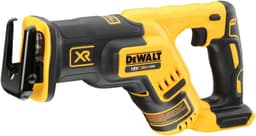
DeWalt DeWalt DCS367N-XJ compact XR

Testsieger

DeWalt DeWalt DCS367N-XJ compact XR
7.1/10about £141.98

Wood, then metal, with pauses

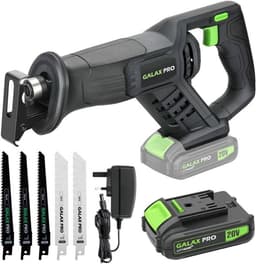
Wood is the kinder cut when the blade is coarse and the offcut can fall clear. Einhell and GALAX PRO reviewers took apart furniture, MDF and pallets. Forcing a thin, damp branch pinches the blade. Support the far side, or cut from both sides when the kerf can close. Metal needs a finer blade and short passes. A DEKOPRO reviewer paused on exhaust baffles so the tool could cool. A blue blade is a stop. GALAX PRO’s included metal blades were called useless, so a shop blade belongs in that kit before a metal job. Gas, a live cable, or timber that might be holding the house up is a stop.

When to put it down

The Health and Safety Executive puts reciprocating saws in a typical band of 7–27 m/s² for employers. The action value is 2.5 m/s² A(8) and the limit is 5.0. Those figures are not a reading from these twelve saws. Reviews say something plainer: short sessions, and a break when your grip numbs. At work, the employer owns the assessment. Smell or smoke is a fault, not a running-in period. More than one cupeohome review describes the motor smoking on small wood. Stay on the ground for branches. A ladder story is a warning on the pruning page, not a method. If the box had no battery at all, the bare tool or kit page is why that saw will not start.

Common questions

Do you take the battery out to change the blade?
Take it off before your hand is on the blade, including on saws with a safety lock. One Fledukten reviewer did that. A lock with a middle position that lets the trigger start is a reason to remove the pack. The 2008 machinery regulations treat accidental starting as a design duty, not as a promise that the lock will save a finger.
What is the shoe for?
It bears on the work so the blade is guided and the vibration has somewhere to go. Einhell reviewers reduced the shake by pressing the shoe down. A DEKOPRO review needed an Allen key on a tight slider, with the pack off. If the shoe cannot touch the timber, the blade wanders and the saw kicks as soon as a tooth bites.
Why does the saw kick when you start?
The teeth catch before the shoe is planted, or the offcut pinches the blade. Set the shoe on the work, support the waste, and pull the trigger slowly until a groove starts. Thin, damp branches are a known pinch point in Einhell reviews. A free blade in open air will snatch on the first bite.
How do you cut metal without bluing the blade?
Use a finer metal blade, keep the passes short, and feather the trigger. DeWalt reviews overheated blades when low speed could not be held as a set speed. A DEKOPRO reviewer paused on exhaust baffles. A blue blade is a stop. GALAX PRO’s supplied metal blades were poor in reviews, so a shop blade belongs in that kit first.
Is vibration normal?
Einhell, both DeWalts, the XIAZIR and the Keo reviews all mention shake, so a buzz on a short cut is expected. Stop when your hands numb, or when you need a break after a few minutes, which is what one DCS367 reviewer reported. HSE’s 7–27 m/s² band is a workplace range, not a reading from these Amazon pages.
What if the motor smells?
Stop and take the pack off. cupeohome reviews describe motors smoking on small wood, including on first use. That is a fault, not a technique and not a running-in smell. Citizens Advice explains the route for faulty goods. Let the saw cool before you try to restart it.
Can you use it one-handed overhead?
DeWalt reviews describe short one-handed work in tight spaces, and they also describe vibration that ends the session. Keep the shoe on the work and give the offcut somewhere to go. A branch from a ladder is a different job and belongs on the ground. A limb you cannot reach from the ground is a professional’s cut.

Related pages

Sources

Public UK sources and the amazon.co.uk listings in this comparison. Listings captured 15 October 2026. Page updated October 2026.

  1. HSE, PUWER overview (retrieved 15.10.2026)
  2. HSE, hand-arm vibration assessment (retrieved 15.10.2026)
  3. HSE, Control of Vibration at Work Regulations (retrieved 15.10.2026)
  4. Supply of Machinery (Safety) Regulations 2008, Schedule 2 (retrieved 15.10.2026)
  5. GOV.UK, Supply of Machinery (Safety) Regulations 2008: Great Britain (retrieved 15.10.2026)
  6. BSI, BS EN 62841-2-11:2016+A11:2024 (retrieved 15.10.2026)
  7. Bosch DIY UK, Keo (retrieved 15.10.2026)
  8. Plumbing Superstore, reciprocating saw buyer’s guide (retrieved 15.10.2026)