Independent comparisons. We may earn from shop links. More info

Convector heater vs fan heater

Updated: October 2026

You have seen fan heater on a Trotec title, or you hope a convector will cost less per hour than a fan heater of the same size. A convector heater vs fan heater choice is about how the air moves, how soon the room feels warm, and how much noise you will sit with. It is not a cheaper kilowatt-hour. The [Trotec convector comparison](/hub/portable-heaters/trotec-convector) lists the four TCH models. This page stays with the mechanism. The Products Compared editorial team used the Centre for Sustainable Energy's room-heater advice, Ofgem's price cap, and the Trotec manuals, on 16 October 2026. We did not meter these heaters in a lab.

You have seen fan heater on a Trotec title, or you hope a convector will cost less per hour than a fan heater of the same size.

Our top picks

On this page

What each heater does to the air

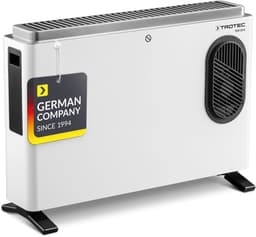
A Trotec TCH convector has an element that warms the air next to it. That air rises, cooler air comes in at the bottom, and the room fills by a slow current. The Centre for Sustainable Energy describes a convector, often called a panel heater, in the same way: it warms nearby air, the air circulates, and it takes a little longer. A fan heater blows air across an element and pushes that air into the room. You feel the blast on your legs or your desk within a short time. The far corner still depends on the watts and on how well the room holds heat. Same watts do not mean the same sensation. A 2,000 W fan heater and a 2,000 W convector can both be resistance heaters. The fan heater feels faster because it moves the warm air to you. The convector feels slower because you are waiting for the current to turn over. The Trotec UK shop says pleasantly warm air flows immediately after you switch a TCH 18 E on. Treat that as the shop's wording. It is not a timed warm-up, and it does not make the convector into a fan heater. None of these TCH models stores heat in oil. When you switch a plain convector off, it goes cold.

The TCH 18 E title and the turbo models

The TCH 18 E amazon.co.uk title says fan heater. The English manual does not describe a fan. Reviews say there is none. If you buy that model expecting a directional blast and a fan note, you will get a quiet convector with stages of 750 W, 1,250 W and 2,000 W. The missing fan is not a fault you can switch on. It is a title that does not match the manual. For a home office where you want heat without a motor, that mismatch can still leave you with the heater you wanted, as long as you knew it was a convector. The TCH 23 E and the TCH 25 E add a turbo. On the TCH 23 E the listing says you can switch that fan on at both 1,000 W and 2,000 W. Reviews call it small, weak or rattly. It is a blower on a convector, not a ceramic fan heater with a strong jet. Leave it off and the heater behaves more like the plain TCH 18 E. Leave it on and you get a little more air movement and the rattle some reviewers mention. There is no decibel figure for that turbo in the sources we used, so this page will not invent one. Plug and watts sit on the Trotec convector buying guide.

The hourly cost at the same watts

Electric resistance heat is the same full-power cost at the same watts. The Centre for Sustainable Energy's room-heater table makes that point with its own assumption. CSE lists a 2 kW convector and a 2 kW fan heater at the same 55 pence an hour, using 26 pence per kilowatt-hour. That 55 pence is CSE's table. It is not the Ofgem figure for this winter, and it is not a Trotec measurement. For a UK hour at the cap, use Ofgem's average Direct Debit rate of 26.32 pence per kilowatt-hour from 1 October to 31 December 2026, for England, Scotland and Wales. At that rate, 2,000 W costs 52.64 pence an hour at full power. A 450 W element, the TCH 1 E shop figure, is about 11.8 pence an hour at full power. Northern Ireland is outside this cap. A thermostat cuts the time the element stays on. It does not make a convector's kilowatt-hour cheaper than a fan heater's. If the convector runs longer because the room feels slow to warm, the bill can be higher, not lower. A lower stage, such as 750 W or 1,250 W on the TCH 18 E, costs less per hour because the watts are lower.

Which job fits which heater

Choose the plain TCH convector when you will sit in the room for a while and you want the heat quiet. A box room or a desk in the evening is the example: you set the dial, you leave the turbo off if the model has one, and you accept that the far side of the room catches up slowly. The TCH 18 E is that quiet box, once you ignore the fan word in the title. It goes cold when you switch it off, so it will not keep the room warm after you leave. Choose a fan heater when you want a short, noisy blast at a chair, a drying job you are watching, or a room you will leave again in twenty minutes. The fan heater of the same 2,000 W is not cheaper per hour while both run flat out. It is faster to the person in the airstream, and it is louder. The TCH 23 E or TCH 25 E turbo is only a weak step toward that blast. Safety does not pick a side. Electrical Safety First gives both types a UK three-pin plug, at least one metre from anything that can burn, no unattended use, and no extension lead. Clearances are on the how to use a Trotec convector page. This page does not crown one of the four.

Common questions

Does a convector heat a room more slowly than a fan heater?
It usually feels slower. A convector warms nearby air and waits for that air to rise and circulate. A fan heater blows warm air at you, so the spot in the blast feels warm sooner. The Centre for Sustainable Energy says a convector takes a little longer. Same watts do not remove that difference. The Trotec shop line about air flowing immediately is not a measured warm-up time.
Is a Trotec convector quieter?
A plain TCH, including the TCH 18 E, has no fan in the manual and reviews say there is no fan, so it is the quiet one. The turbo on the TCH 23 E and TCH 25 E is a small blower that reviews call weak or rattly. There is no decibel figure for these ASINs. Which? meters noise on the heaters it tests, and those readings are not Trotec numbers. Leave the turbo off if quiet is the point.
Does the TCH 18 E have a fan?
No. The English manual does not describe a fan, and reviews say there is none. The amazon.co.uk title still says fan heater. You get stages of 750 W, 1,250 W and 2,000 W and a mechanical thermostat, not a blower. If you need air thrown across the room, this is the wrong model, however the title is written.
What is the turbo on the TCH 23 E?
A small fan you can switch on at 1,000 W or at 2,000 W. Reviews call it small and weak, and some call it rattly. It is not a ceramic fan heater. You can leave it off and use the convector on its own. The TCH 25 E title also names a turbo. Neither turbo has a noise figure in the sources used here.
Which is cheaper to run at 2 kW?
Neither, while both run at full power. CSE prints 55 pence an hour for a 2 kW convector and a 2 kW fan heater on its own 26 pence assumption. Ofgem's average Direct Debit rate of 26.32 pence per kilowatt-hour, from 1 October to 31 December 2026 in England, Scotland and Wales, is 52.64 pence an hour at 2 kW. Those are different sums. A thermostat changes how long the element stays on, not the price of the unit.
Will a convector keep heating after I switch it off?
A plain TCH goes cold when you switch it off. It does not store heat in oil. An oil-filled radiator can keep releasing heat after the element stops, and that is a different heater. The turbo, if you had it on, stops with the fan. Do not expect the case to heat the room for the rest of the evening.
When is a fan heater the better tool?
When you want a short blast at a person or a small zone, and you will accept the noise. A 2,000 W fan heater is not cheaper per hour than a 2,000 W convector while both run flat out. It is faster in the airstream. A TCH turbo is only a weak substitute. If you will sit for hours and want quiet, the plain convector is the better job, with the plug and the clearances still to check.

Related pages

Sources

Public sources from the research digest, last checked on 16 October 2026. Shelf prices and star lines are the amazon.co.uk figures in the display file.

  1. Trotec TCH 18 E / 19 E English manual (retrieved 16 October 2026)
  2. Trotec UK shop: TCH 18 E convector (retrieved 16 October 2026)
  3. Trotec UK shop: TCH 1 E convector (retrieved 16 October 2026)
  4. Trotec TCH 23 E English manual (retrieved 16 October 2026)
  5. Trotec TCH 25 E / 26 E manual (retrieved 16 October 2026)
  6. Ofgem: energy price cap, 1 October to 31 December 2026 (retrieved 16 October 2026)
  7. Electrical Safety First: portable heaters (retrieved 16 October 2026)
  8. Water Regs UK: protection against freezing (retrieved 16 October 2026)