Independent comparisons. We may earn from shop links. More info

How to use a Trotec convector

Updated: October 2026

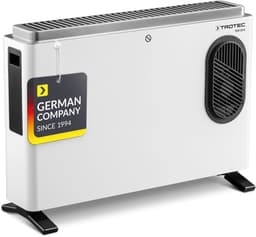
You already have a Trotec TCH on the floor, and the easy mistake is to plug it in beside a curtain. How to use a Trotec convector comes down to the feet, the clearances, the dial, and what a cut-out is for. The [Trotec convector comparison](/hub/portable-heaters/trotec-convector) is the model table. This page is the sequence once the box is open. The Products Compared editorial team took the steps from the TCH 18 E English manual, Electrical Safety First's portable-heater advice, and the amazon.co.uk listings, on 16 October 2026. We did not run a lab test.

You already have a Trotec TCH on the floor, and the easy mistake is to plug it in beside a curtain. How to use a Trotec convector comes down to the feet, the clearances, the dial, and what a cut-out is for.

Our top picks

On this page

Feet, floor and clearances

Fit the feet before you switch the heater on. On the TCH 18 E listing the feet are included and have to be assembled. A convector stood on its bare base can tip on a hard floor. Use a firm, level floor. The TCH 18 E manual forbids high-pile carpet. A thick pile can block the underside and can let the case sink until a curtain or a sofa is closer than you think. If the only place you have is a deep rug, move the heater or move the rug. The distances below are from the TCH 18 E manual, not a guess applied to every model as if each booklet had been quoted in full. That manual wants 100 cm above the heater and 50 cm to the sides, the rear and the front. Electrical Safety First uses a simpler line for portable heaters in general: at least one metre from anything that can burn. Take the larger gap when the two differ. The manual also forbids covering the heater, using it outdoors, and wall mounting. Drying washing on the case is the same mistake as covering it.

Dial, smell and the turbo

The thermostat is a mechanical dial. Which?, writing in September 2026 about cheaper convectors in general, says those dials rarely show degrees Celsius and are rarely fully accurate. Trotec was not in that test. You will not see 21 °C on the knob. Set it, wait, and move it if the room overshoots. The Trotec UK shop says warm air flows immediately after you switch a TCH 18 E on. That is the shop's sentence, not a measured warm-up time. A plain convector warms nearby air and that air rises. It goes cold when you switch it off. It does not store heat in oil. A new heater can smell the first time the element gets hot. Run it with the windows slightly open and with nothing on the case. If the smell is sharp, keeps returning after the first runs, or comes with scorching or a damaged cable, unplug it and stop. The turbo is only on the TCH 23 E and the TCH 25 E. On the TCH 23 E it can be switched on at both 1,000 W and 2,000 W. Reviews call that fan small, weak or rattly. Leave it off if you wanted a quiet convector. How a real fan heater differs is on the convector versus fan heater page.

Cut-out, leaving the room, and when to stop

Overheat protection is described in the manuals and listed, in one form or another, on these listings. It is a backstop. If the heater cuts out, switch it off, unplug it, and let it cool before you look for the cause. The usual cause is the gap you already measured: a curtain, a cover, a deep carpet, or a heater pushed into a corner tighter than the TCH 18 E distances. If it trips again after it has cooled and the gaps are right, stop using it. Electrical Safety First says not to leave a portable heater unattended while it is in use or while you are asleep. Switch off when you leave the room unless the heater was designed for unattended use. These pages do not quote the TCH manuals as unattended frost stats. About 8.7 A at 2,000 W belongs in a wall socket with a 13 A fuse. Do not run it from a coiled extension reel. Call a professional if the cable is damaged, if you need a fixed heater in a bathroom, or if the cut-out trips again after a cool-down. Plug choice, if you are still deciding which model to buy, stays on the Trotec convector buying guide.

Do not hang it or dry washing on it

The TCH 25 E listing says floor mount, and a wall-mount question on that page is asked and not answered. Do not hang any of these because a room-type field or a product photograph looks tidy on a wall. Electrical Safety First says not to dry clothes on a portable heater. A towel on the case is how the overheat cut-out gets used as a lesson. Keep the overhead gap clear as well. IP20 on the TCH 1 E and TCH 18 E, and IPX0 on the TCH 23 E and TCH 25 E, are not bathroom ratings. Do not site any of them beside a bath or shower, even where the room-type field lists Bathroom. The TCH 18 E manual also says the heater is only suitable for well insulated spaces or occasional use. That is a limit on the room, not a permission to tuck it into a cupboard.

Common questions

Do I have to fit the feet before I switch it on?
Yes. On the TCH 18 E listing the feet are in the box and have to be assembled. Standing the heater on the bare base makes a tip more likely, and a tip on a hard floor is a poor way to discover the clearances. Fit them, then check the gaps, then plug in. The TCH 18 E manual also forbids high-pile carpet, covering the case, outdoor use and wall mounting.
How much space does the TCH 18 E need around it?
The TCH 18 E manual specifies 100 cm above and 50 cm to the sides, the rear and the front. Electrical Safety First says at least one metre from anything that can burn. Use the larger gap when they differ. Those 100 cm and 50 cm figures are from that manual, not a clearance we measured on the other three models. A curtain across the top is the gap people usually get wrong.
Can it stand on a thick carpet?
The TCH 18 E manual forbids high-pile carpet. A deep pile can block the underside and can let the case sit closer to furniture than the clearance numbers assume. Use a firm floor. If the only spot is a thick rug, move the rug or move the heater. A thin hard floor still needs the side, rear, front and overhead gaps.
Why does a new convector smell?
The element can smell the first time it gets hot. Run it with nothing on the case and with a little fresh air, and do not cover the grille to hide the smell. If the smell stays sharp, comes back after the first runs, or arrives with a scorched mark or a damaged cable, unplug it and stop. A shop line about warm air flowing straight away is not a measured warm-up time.
What does the dial actually set?
A position on a mechanical knob, not a temperature in degrees. Which? says cheaper convector dials rarely show degrees Celsius and are rarely fully accurate. That is a general point, not a Trotec lab score. Set it, wait, and nudge it if the room overshoots. The heater goes cold when you switch it off. It does not keep releasing stored heat the way an oil-filled radiator can.
What should I do if it cuts out?
Switch it off, unplug it, and let it cool. Look for a curtain, a cover, a deep carpet or a gap tighter than the TCH 18 E manual's 100 cm above and 50 cm around. If it trips again after a cool-down with those gaps clear, stop using it and get a competent person to look. Do not keep resetting it through the evening. A damaged cable is a stop as well.
Should I leave the turbo on?
Only the TCH 23 E and the TCH 25 E have a turbo, and on the TCH 23 E you can switch it on at 1,000 W or at 2,000 W. Reviews call it small, weak or rattly. Leave it off if you wanted quiet heat. It is not a fan heater. The TCH 18 E has no fan in the manual, despite a title that says fan heater, so there is no turbo to leave on.

Related pages

Sources

Public sources from the research digest, last checked on 16 October 2026. Shelf prices and star lines are the amazon.co.uk figures in the display file.

  1. Trotec TCH 18 E / 19 E English manual (retrieved 16 October 2026)
  2. Trotec UK shop: TCH 18 E convector (retrieved 16 October 2026)
  3. Trotec UK shop: TCH 1 E convector (retrieved 16 October 2026)
  4. Trotec TCH 23 E English manual (retrieved 16 October 2026)
  5. Trotec TCH 25 E / 26 E manual (retrieved 16 October 2026)
  6. Ofgem: energy price cap, 1 October to 31 December 2026 (retrieved 16 October 2026)
  7. Electrical Safety First: portable heaters (retrieved 16 October 2026)
  8. Water Regs UK: protection against freezing (retrieved 16 October 2026)