Independent comparisons. We may earn from shop links. More info

How to use a fan heater safely

Updated: 21 October 2026

The room is cold, so the temptation is to point the heater at the sofa and leave it. How to use a fan heater safely is a short sequence: a flat surface, a metre from anything that can burn, a wall socket, and the switch off when you leave or go to bed. That applies to a 500 W plug-in ceramic and to a 2 kW box. The models in our [mini fan heater comparison](/hub/portable-heaters/mini-fan-heater) are portable fan heaters, not bathroom appliances. Fire-service guidance was read on 19 October 2026. No lab test was run. A qualifying purchase can earn a commission at no extra cost to you.

The room is cold, so the temptation is to point the heater at the sofa and leave it.

Our top picks

On this page

Where it stands

Put the heater on a hard, level floor. Hertfordshire Fire and Rescue asks for a metre from curtains, a sofa, a coat or a duvet. A foot under a desk is not a metre. Keep the grille clear. Do not stand a tip-switch heater on a deep rug. If it cuts out, move it. Do not wedge the base. Socket height is on the heater for under a desk page.

How it is plugged in

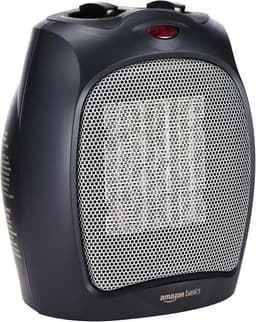
Use a wall socket. Humberside Fire and Rescue, in its November 2025 winter note, says to plug a portable electric heater into the wall. Electrical Safety First rules out extension leads. A coiled reel heats the cable. If the factory lead does not reach, move the heater. A 2,000 W fan heater is about 9 A at 230 V. The Dimplex that states 3,000 W also states 13 A, so it goes in a wall socket on its own. If the plug is a European two-pin, return it. One Amazon Basics review describes that surprise on a model line that says UK. The order of those buying checks is the mini fan heater buying guide.

When it must go off

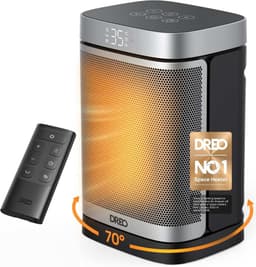
Switch it off when you leave the room, and before you sleep. Electrical Safety First is plain about unattended and overnight use. Do not dry a towel, a coat or bedding on the grille. A timer on the Russell Hobbs or the Dreo is not permission to sleep with the heater running. A thermostat click can be the element cycling at the set point. Some Pro Breeze reviewers say it does not switch off at all. A cut-out soon after 3 kW, which reviewers report on the Dimplex, is the heater protecting itself. Turn it down or give it space. Do not bypass the cut-out, and do not cover the heater to muffle the noise.

When to unplug and stop

Unplug if you see sparks, scorch marks, a melting case, or a smell that is still there after the first hour. A brief new-heater smell, with you in the room, can pass. A burning-plastic smell by the third use, reported on the Dimplex desk heater, is a return. Do not open the case or bridge a tip switch. If the circuit fails with the heater unplugged, call an electrician. A portable heater does not go in a bathroom. IP21 on the Dimplex desk listing is not a zone rating.

Common questions

How far from curtains should a fan heater sit?
A metre, measured to the curtain, the sofa, the bed and any laundry, not just to the wall. Hertfordshire Fire and Rescue uses that distance for portable heaters. Under a desk, a coat on the chair is inside that metre more often than people expect. If you cannot keep the gap, do not switch the heater on in that spot.
Can I leave a fan heater on overnight?
No. Switch it off when you go to bed, even if the listing claims a timer or a thermostat. Electrical Safety First says portable heaters are not for unattended or overnight use. A timer that brings the heater back on in an empty room is the same problem. If you need heat while you sleep, the charity mentions oil-filled radiators as a lower-risk type, which is a different appliance.
Can I dry a towel on it?
No. Do not hang a towel, clothes or bedding on the grille or in front of it. Hertfordshire includes clothes-drying among the things that start heater fires. The fan needs a clear path. A bathroom towel rail is a different product, and a portable fan heater is not a substitute for one.
Can I use an extension lead?
No. Plug it into a wall socket. A 2 kW heater is about 9 A, and the 3 kW Dimplex is listed at 13 A. Both are too much for a coiled lead. If the factory lead does not reach, move the heater closer to the socket rather than adding cable.
Why does it switch itself off?
It may be the thermostat reaching the set temperature, which is normal, or a safety cut-out because the grille is blocked, the heater has tipped, or the high setting is more than the unit will hold. The Dimplex 3 kW draws complaints that the high setting cuts out after a short time. Give it space and use a lower setting. If it cuts out on a rug, move it. Do not defeat the switch.
It smelled the first time. Do I unplug it?
Watch a light new-heater smell for a few minutes with the room ventilated and nothing near the grille. Unplug if the smell is sharp, if it is still there after the first hour, or if you see haze, sparks or a plug that is too hot to touch. A burning smell on a later use is a fault. The same stop applies in a bathroom: Electrical Safety First and Humberside say a portable heater does not belong there, and IP21 on the Dimplex desk listing is not an approval.

Related pages

Sources

Public UK sources for the plug, bathroom use, fire clearance, BS 1363 plug failures and the unit rate. Listing prices, stars and review counts are the amazon.co.uk figures in this set.

  1. Electrical Safety First — Portable heaters (retrieved 21 October 2026)
  2. Electrical Safety First — Bathrooms (retrieved 21 October 2026)
  3. Hertfordshire Fire and Rescue — Portable heater safety (retrieved 21 October 2026)
  4. Humberside Fire and Rescue — Winter electrical fire safety 2025 (retrieved 21 October 2026)
  5. OPSS — Alpha plug-in fan heater 2403-0079 (retrieved 21 October 2026)
  6. OPSS — Portable fan heater sold via OnBuy 2212-0176 (retrieved 21 October 2026)
  7. Ofgem — Energy price cap unit rates and standing charges (retrieved 21 October 2026)
  8. BSI — BS EN 60335-2-30 room heaters (retrieved 21 October 2026)
  9. SELECT — BS 7671 section 701, bath or shower (retrieved 21 October 2026)