Independent comparisons. We may earn from shop links. More info

Electric heater running cost

Updated: 21 October 2026

You are about to leave a 2 kW heater on and you want the cost in pence first. The electric heater running cost is kilowatts times hours times your unit rate, not the words energy saving on the box. At Ofgem’s average Direct Debit rate for England, Scotland and Wales, from 1 October to 31 December 2026, electricity is 26.32 pence per kWh. A true 2 kW draw for a full hour is about 53 pence. A thermostat that rests the element costs less. The listings are on the [energy saving electric heater comparison](/hub/portable-heaters/energy-saving-electric-heater). Products Compared did not meter a house. A qualifying purchase can earn a commission at no extra cost to you.

You are about to leave a 2 kW heater on and you want the cost in pence first. The electric heater running cost is kilowatts times hours times your unit rate, not the words energy saving on the box.

Our top picks

Ballu Ballu 2000 W Wi-Fi panel

Best overall

Ballu Ballu 2000 W Wi-Fi panel
6.2/10about £149.99
Dreo Dreo Atom 316 white

Rank 2

Dreo Dreo Atom 316 white
8.6/10about £42.49
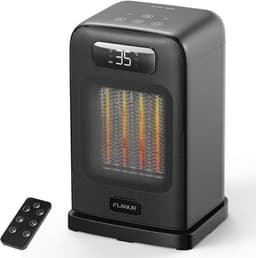
FLANUR FLANUR AT-SH26

Best value

FLANUR FLANUR AT-SH26
8.0/10about £39.98
On this page

The sum, and the October 2026 rate

Ofgem’s cap for that quarter is 26.32 pence per kWh for electricity on Direct Debit, and 7.97 pence per kWh for gas, as averages for England, Scotland and Wales. The standing charge is 54.83 pence a day and stays out of the hourly figure. Northern Ireland is outside this Great Britain cap. Use the rate on your bill if you have it. Two kilowatts times 26.32 is 52.64 pence, about 53 pence, if the element never switches off. Three such hours are about £1.58.

What the heaters in this set cost at full power

At 26.32 pence per kWh a full hour is about 53 pence at 2,000 W and about 39 pence at 1,500 W. The Ballu and the Devola’s turbo sit on the 2,000 W row. The Atom 316 sits on the 1,500 W row. Trusted Reviews recorded 0.51 kWh in one eco hour on an Atom 316 in their room, about 13 pence at this rate, not your evening. The DR-HSH014 prints 1500 against a 2,000 W title, so read the plate before you pick a row. Which step to choose is the buying guide.
Ballu Ballu 2000 W Wi-Fi panel

Testsieger

Ballu Ballu 2000 W Wi-Fi panel
6.2/10about £149.99

One room against gas central heating

Gas on the same cap averages 7.97 pence per kWh. Energy Saving Trust’s comparison is that electricity costs about four times as much as gas for heating. A boiler is not 100 per cent efficient, so 7.97 pence is not the price of warmth in the room. One occupied room on a plug-in heater can cost less than heating the whole house. A fan left on for hours can cost more than the boiler on a low setting. A 2 kW heater for about eight hours at full power is about £4.20. At 2 kW a panel matches a fan. The panel heater vs fan heater page is that choice.

What this does not include

The standing charge is 54.83 pence a day. Putting it into every hour would invent a cost the heater did not cause. A fix can sit off the cap, and Economy 7 charges a different rate by time of day, so a night hour and an evening hour are not both 26.32 pence. Northern Ireland is outside this England, Scotland and Wales average. If the portable heater is an extra on top of the boiler, add the hours. The only reduction this page will stand behind is a lower wattage, or fewer minutes with the element on, at the rate on your bill.

Common questions

How much is a 2 kW heater per hour?
About 53 pence for a full hour at 26.32 pence per kWh, which is 2 times 26.32. Three full hours are about £1.58. That is the October to December 2026 Direct Debit average for England, Scotland and Wales, standing charge excluded, element on the whole time. A thermostat that rests the heater costs less. Your own tariff may differ.
How much is 1.5 kW?
About 39 pence for a full hour at the same rate. That is the Atom 316’s listed output, and the FLANUR’s higher step. A 1,250 W Devola low setting is about 33 pence, and 950 W is about 25 pence. These are full-power hours, not an ECO average.
Does ECO halve that?
No. ECO on these listings steps the wattage or rests the element when the room is warm enough. It does not change the price of a unit. A 60 per cent on-time would be a scenario you chose, not a result measured here. The Ballu’s “up to 37%” is a listing claim, not a row in this table.
Is a panel cheaper per hour than a fan?
Only if it uses fewer watts or runs for less time. A 2,000 W panel and a 2,000 W fan heater are both about 53 pence for a full hour at this rate. The Ballu is the fanless 2,000 W panel. The Devola can sit at 1,250 W without the fan, which is a cheaper hour because it is fewer watts.
Is one room cheaper than gas central heating?
Sometimes. Electricity is much dearer per unit than gas, and Energy Saving Trust still treats direct electric heat as expensive for a whole home. One room, for a short time, with the other rooms unheated, can cost less than running the boiler for the house. A fan left on for many hours can cost more. Shut the door if the portable is the heat you meant to buy.
Does the standing charge belong in the hourly figure?
No. The standing charge on this cap is 54.83 pence a day, and you pay it whether or not the heater runs. The hourly figure is only the units the heater adds. Put the standing charge in the daily total once, not into every hour.
What if I am on a fix, Economy 7, or in Northern Ireland?
Use the unit rate on your bill. A fix can sit off the cap. Economy 7 charges a different rate by time of day, so a night hour and an evening hour are not both 26.32 pence. Northern Ireland is not covered by this England, Scotland and Wales average. The method stays kilowatts times hours times your rate.

Related pages

Sources

Public UK sources for the unit rate, room-heater cost, the plug and clearance, and the ML-9001 safety report. Listing prices, stars and review counts are the amazon.co.uk figures in this set. Retrieved 21 October 2026.

  1. Ofgem — Changes to the energy price cap, 1 October to 31 December 2026 (retrieved 21 October 2026)
  2. Centre for Sustainable Energy — Room heaters (retrieved 21 October 2026)
  3. Energy Saving Trust — Electric heating (retrieved 21 October 2026)
  4. Which? — Are electric heaters eco friendly? (retrieved 21 October 2026)
  5. Electrical Safety First — Portable heaters (retrieved 21 October 2026)
  6. BS EN 60335-2-30:2009+A13:2022 — room heaters (retrieved 21 October 2026)
  7. The Electrical Equipment (Safety) Regulations 2016 (retrieved 21 October 2026)
  8. OPSS — Product safety report: fan heater ML-9001 (2511-0255) (retrieved 21 October 2026)