Independent comparisons. We may earn from shop links. More info

Panel heater vs fan heater

Updated: 21 October 2026

You are choosing between a quiet panel and a small fan heater. A panel heater vs fan heater decision, for the listings in this set, starts with the watts. At the same kilowatts, a full hour costs the same. The fan warms the air faster and you hear it. The panel is the Ballu, which has no fan. The Devola sits between them: a convector on the low step, a fan only on turbo. The [energy saving electric heater comparison](/hub/portable-heaters/energy-saving-electric-heater) holds the prices from amazon.co.uk on 19 October 2026. Products Compared did not measure these heaters. A qualifying purchase can earn a commission at no extra cost to you.

You are choosing between a quiet panel and a small fan heater. A panel heater vs fan heater decision, for the listings in this set, starts with the watts. At the same kilowatts, a full hour costs the same.

Our top picks

Ballu Ballu 2000 W Wi-Fi panel

Best overall

Ballu Ballu 2000 W Wi-Fi panel
6.2/10about £149.99
Dreo Dreo Atom 316 white

Rank 2

Dreo Dreo Atom 316 white
8.6/10about £42.49
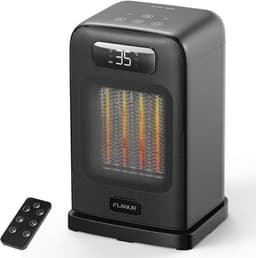
FLANUR FLANUR AT-SH26

Best value

FLANUR FLANUR AT-SH26
8.0/10about £39.98
On this page

Same kilowatts, same full hour

The Centre for Sustainable Energy prices a 2 kW convector and a 2 kW fan heater the same for a full hour, because both turn electricity into heat. Which? says no electric room heater is automatically more sustainable. In this set the Ballu is a fanless 2,000 W panel at £149.99, and the Devola is 1,250 W on low and 2,000 W on high. At Ofgem’s 26.32 pence per kWh, from 1 October to 31 December 2026, a full 2,000 W hour is about 53 pence. The table is on the electric heater running cost page. “Up to 37%” on the Ballu is a listing claim. The hours decide, not the type.

What a fan does that a panel does not

A PTC ceramic heater in this set is a fan heater. Ceramic is the element, not a third category that beats a panel on the bill. The white Dreo Atom 316 is 1,500 W with a noise claim of 34 dB, at 4.6 from 10,476 reviews. People say it is quieter than an old fan heater. Good Housekeeping’s meter on an Atom 316 read about 41.8–45.7 dB. The FLANUR AT-SH26 adds 70° oscillation and a 950 W step, at £39.98, and reviewers still hear it. Oscillation does not add watts. A panel is slower when you want the air warm in minutes.
Ballu Ballu 2000 W Wi-Fi panel

Testsieger

Ballu Ballu 2000 W Wi-Fi panel
6.2/10about £149.99

The two quiet-room options in this set

The Ballu is the fanless option: 2,000 W, 230 V, 5.75 kg, thermostat 5–30 °C, with feet or a wall and an app claimed. There is no decibel figure because there is no fan. Amazon.co.uk shows 4.8 from 60 reviews, and 13 texts in this set are from the United Kingdom. Tip-over protection is not stated. £149.99 is the price of silence plus a schedule, not cheaper electricity. The Devola DVCH2WH is a floor convector at £59.99, listed at 230 V. Low is 1,250 W without the blower. Turbo is 2,000 W plus the fan, at 4.5 from 92 reviews. One reviewer reported a hot plug and a fishy smell. Stop if that happens. Devola’s page lists 6.6 kg and the amazon attribute says 5.42 kg.

When to pick which

Choose the white Atom 316 or the FLANUR when you want the air warm in minutes. The Atom is the top pick for that short burst. The FLANUR is the best value when you also want 950 W and a sweep. Choose the Ballu when you will leave heat on in one shut room and you will use the app. Do not choose it to save 37 per cent. Choose the Devola when you want 230 V and a quiet 1,250 W step, with the fan only on turbo. Skip both types for a bathroom. No IP rating is stated. How to place whichever you buy is on the how to use an electric heater efficiently page.

Common questions

Is a panel cheaper to run than a fan heater?
Not at the same watts. A 2,000 W Ballu and a 2,000 W fan heater cost the same for a full hour with the element on, about 53 pence at the October 2026 GB average unit rate. A panel is cheaper only if it draws less, or if the thermostat rests it. The Ballu’s “up to 37%” line is a listing claim.
Which is quieter in a bedroom?
The Ballu, because it is fanless. The Devola’s low step is described as silent in a bullet, with no decibel figure, and turbo adds a fan. Every PTC model here is a fan. The 34 dB claims were not measured here, and Good Housekeeping’s Atom 316 reading was higher than 34 dB in their test.
Which heats a cold room faster?
The fan heater. That is why the Atom 316 and the FLANUR exist, and why the Devola has a turbo. A panel warms a room more slowly, which suits a room you will sit in for hours. One Atom 320 review reported about 5 degrees in under 30 minutes. That is a single review, not a lab result.
Is the Devola a panel or a fan?
It is a convector. The low setting is 1,250 W without the blower. Turbo is 2,000 W with the fan. It is not the fanless Ballu, and it is not a desk-sized PTC heater. The white model in this set is the DVCH2WH at £59.99.
Does the Ballu need a wall?
No. The listing offers feet as well as wall mounting, and reviews mention wheels. It weighs 5.75 kg, so you can move it, and it is still a long panel rather than a desk heater. Wall mounting needs suitable fixings and clear space in front.
Why do ceramic heaters get called more efficient?
Because the word ceramic is doing marketing work. In this set the ceramic heaters are the fan heaters, with a PTC element. They do not use fewer units than a panel of the same watts. ECO is a control that steps the power. It is not a different kind of electricity.
Can I use either in a bathroom?
No. No IP rating is stated on the Ballu, the Devola, or the fan heaters here. A bathroom named in a bullet is not a moisture rating. Keep both types out of wet rooms. A fixed bathroom heater is an electrician’s job.

Related pages

Sources

Public UK sources for the unit rate, room-heater cost, the plug and clearance, and the ML-9001 safety report. Listing prices, stars and review counts are the amazon.co.uk figures in this set. Retrieved 21 October 2026.

  1. Ofgem — Changes to the energy price cap, 1 October to 31 December 2026 (retrieved 21 October 2026)
  2. Centre for Sustainable Energy — Room heaters (retrieved 21 October 2026)
  3. Energy Saving Trust — Electric heating (retrieved 21 October 2026)
  4. Which? — Are electric heaters eco friendly? (retrieved 21 October 2026)
  5. Electrical Safety First — Portable heaters (retrieved 21 October 2026)
  6. BS EN 60335-2-30:2009+A13:2022 — room heaters (retrieved 21 October 2026)
  7. The Electrical Equipment (Safety) Regulations 2016 (retrieved 21 October 2026)
  8. OPSS — Product safety report: fan heater ML-9001 (2511-0255) (retrieved 21 October 2026)