Independent comparisons. We may earn from shop links. More info

Energy saving electric heater: how to choose one

Updated: 21 October 2026

You are comparing boxes on amazon.co.uk whose titles all say energy saving, and the unit rate on your bill will not change because a bullet says ECO. An energy saving electric heater in this set is a mains room heater with a thermostat, a timer, or a lower wattage step, so you heat the room you are in. The [energy saving electric heater comparison](/hub/portable-heaters/energy-saving-electric-heater) is the grid of twelve listings, with prices and review counts from the amazon.co.uk files on 19 October 2026. This page is the order of the checks. Products Compared did not run a lab test. A qualifying purchase can earn a commission at no extra cost to you.

You are comparing boxes on amazon.co.uk whose titles all say energy saving, and the unit rate on your bill will not change because a bullet says ECO.

Our top picks

Ballu Ballu 2000 W Wi-Fi panel

Best overall

Ballu Ballu 2000 W Wi-Fi panel
6.2/10about £149.99
Dreo Dreo Atom 316 white

Rank 2

Dreo Dreo Atom 316 white
8.6/10about £42.49
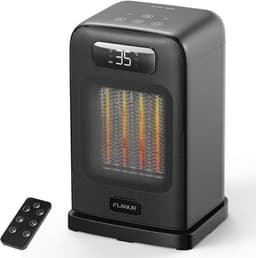
FLANUR FLANUR AT-SH26

Best value

FLANUR FLANUR AT-SH26
8.0/10about £39.98
On this page

What energy saving can and cannot mean

A resistance heater turns electricity into heat, so the cost follows kilowatts and hours. The Centre for Sustainable Energy and Which? say so. At the same watts, a fan and a panel cost the same for a full hour. The Ballu’s “up to 37%” is a listing claim, not a cheaper unit rate. Ofgem’s Direct Debit average for England, Scotland and Wales, from 1 October to 31 December 2026, is 26.32 pence per kWh. Worked pence are on the electric heater running cost page. The WGOE at £22.79 uses model ML-9001, which matches an OPSS report about a plug that failed BS 1363. The report’s Amazon identifiers are not this ASIN.

Watts and more than one step

A 2,000 W hour is about 53 pence at that rate if the element never rests. The FLANUR AT-SH26 at £39.98 names 950 W and 1,500 W. The Dreo towers name 900 W, 1,100 W and 2,000 W. The Devola names 1,250 W on low and 2,000 W on high. For a desk, 1,500 W is the white Atom 316’s step. Fan versus panel is not an efficiency split. The panel heater vs fan heater page takes that choice.
Ballu Ballu 2000 W Wi-Fi panel

Testsieger

Ballu Ballu 2000 W Wi-Fi panel
6.2/10about £149.99

Thermostat, ECO, and the timer

A useful thermostat shows degrees, usually 5–35 °C, or 5–30 °C on the Ballu. Which? notes that a sensor next to the element can overshoot. The LEBKOVL starts at 15 °C. The WGOE states no degree range. ECO moves between watt steps as the room nears the set point. It does not change the tariff. A UK review of the DR-HSH003 says the idle shut-off returns to about 12 hours after you switch off at the wall. The Ballu’s app is what £149.99 pays for, and only if you open it.

Plug, voltage field, and wet rooms

UK mains are 230 V. Use a BS 1363 plug in a wall socket, not an extension lead, and keep about a metre from curtains. Electrical Safety First also says not to leave a portable heater on overnight. The Atom 320 and the DR-HSH014 show 120 V in the structured fields. The gold Atom 316’s bullet says 220–240 V. Trust the rating plate. No listing in these twelve states an IP rating.

Common questions

Does ECO mode mean the heater uses less electricity?
ECO means the heater can drop to a lower wattage step, or rest, when the room is near the temperature you set. It does not mean a cheaper unit rate, and it does not mean the Ballu’s “up to 37%” has been measured. If the door is open, or the heater is too small, ECO stays near full power. Compare kilowatts and hours, then the control.
Should a small bedroom be 1,500 W or 2,000 W?
For one person in a small bedroom or at a desk, 1,500 W is the step the Atom 316 and the FLANUR are sold for. A 2,000 W step is for a colder or larger room, and it costs more for every full hour the element is on. The lower steps, 950 W on the FLANUR and 900 W or 1,100 W on the Dreo towers, are how you avoid leaving 2,000 W selected all evening. These are shopping bands, not a heat-loss survey.
What is a useful thermostat on a cheap heater?
A useful thermostat shows degrees, so you can set a temperature and see the heater stop. Ranges of 5–35 °C, or 5–30 °C on the Ballu, are the pattern in this set. A listing that only says it monitors temperature does not give you that stop. The sensor can still overshoot if it sits on the element.
Does a countdown timer warm the room before I get home?
No. A countdown switches the heater off after the hours you chose. UK reviews of the Devola say that is what its 24-hour timer does. The Ballu listing claims schedules in the app, which only help if you use the app. Read the manual before you add a plug-in timer, because a cut-out on some heaters resets when the power comes back.
Can any heater in this set go in a bathroom?
No IP rating is stated on any of these twelve listings. A bathroom mentioned in a bullet or a room-type list is not a moisture rating. Keep them out of bathrooms and other wet rooms. A fixed bathroom heater, on a suitable circuit, is work for an electrician.
What should I check on the plug before first use?
Use a wall socket, not an extension lead. The plug should be a UK three-pin type marked BS 1363, with a full-length earth pin. Then read the rating plate for voltage. If the amazon.co.uk field says 120 V, as it does on the Atom 320 and the DR-HSH014, do not guess. If the plug runs hot or smells fishy, unplug it.
Is a Wi-Fi panel worth it if I will only turn a dial?
No. The Ballu at £149.99 is priced around an app, a remote and Alexa. If you will only turn a control on the case, a fan heater with a degree thermostat does that job for less. Wi-Fi is worth considering when you want a schedule the countdown timers in this set do not provide, and when you will set that schedule.

Related pages

Sources

Public UK sources for the unit rate, room-heater cost, the plug and clearance, and the ML-9001 safety report. Listing prices, stars and review counts are the amazon.co.uk figures in this set. Retrieved 21 October 2026.

  1. Ofgem — Changes to the energy price cap, 1 October to 31 December 2026 (retrieved 21 October 2026)
  2. Centre for Sustainable Energy — Room heaters (retrieved 21 October 2026)
  3. Energy Saving Trust — Electric heating (retrieved 21 October 2026)
  4. Which? — Are electric heaters eco friendly? (retrieved 21 October 2026)
  5. Electrical Safety First — Portable heaters (retrieved 21 October 2026)
  6. BS EN 60335-2-30:2009+A13:2022 — room heaters (retrieved 21 October 2026)
  7. The Electrical Equipment (Safety) Regulations 2016 (retrieved 21 October 2026)
  8. OPSS — Product safety report: fan heater ML-9001 (2511-0255) (retrieved 21 October 2026)