Independent comparisons. We may earn from shop links. More info

Infrared heater vs fan heater

Updated: October 2026

You want to know which type uses less electricity for one chair or one small room. An infrared heater vs a fan heater is not a saving hidden in the name. At the same watts the meter does not care that one listing says infrared. The difference is who feels warm, and whether the air stays cold. The radiant rows are the ten listings in our [electric infrared heater comparison](/hub/portable-heaters/electric-infrared-heater), captured on amazon.co.uk on 15 October 2026. Products Compared did not lab-test them against a fan. A qualifying purchase can earn us a commission at no extra cost to you. Fan heaters sit in the [fan heater comparison](/hub/portable-heaters/fan-heater).

You want to know which type uses less electricity for one chair or one small room. An infrared heater vs a fan heater is not a saving hidden in the name.

Our top picks

On this page

The meter sees watts

A plug-in resistance heater turns the electricity it draws into heat. The Energy Institute puts it plainly: a 2 kW hour is 2 kWh whether the heater is a fan, a halogen bar or a panel. The government’s infrared heating report states the same relationship, 1 kWh of heat per 1 kWh of electricity. A radiant share often cited around 40–70% is about how the heat leaves the appliance, not a second supply of energy. Ofgem’s Direct Debit price for 1 October to 31 December 2026 is 26.32p per kWh in England, Scotland and Wales. A true 2,000 W hour is about 53p, on a fan or on a bar. A true 600 W hour is about 16p. A 400 W quartz setting costs less per hour only because the watts are lower. A lower bill needs fewer watts or fewer hours. The type name does not change the sum.

Who gets warm

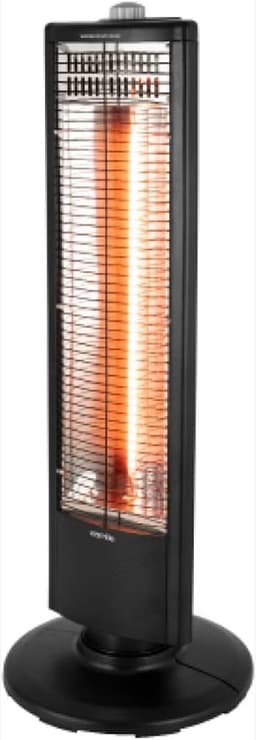
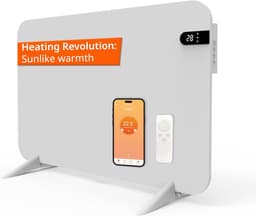
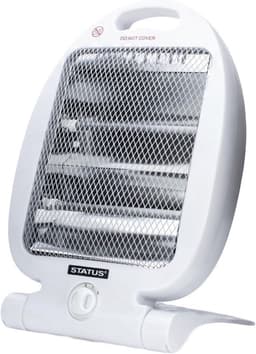
A fan heater moves air, so a short burst can take the chill off a small room, and you hear the fan. A bar, a tower or a panel warms what it faces and leaves the air cooler. The Energy Institute describes a halogen as heat for someone nearby. Energy Saving Trust says you may feel warm in line of sight while the air is cooler, with a condensation risk. The Centre for Sustainable Energy adds that a cold room can mean damp. None of the ten rows here has a fan. The Warmlite is 500 W and 1,000 W, and UK reviews say you must sit close because the heat is a beam. The 450 W Könighaus reviews say warmth is felt only very close to a panel that gets very hot, and several people returned it as too weak for a room. STATUS and SONBION are fast local bars, not a way to lift the air in a lounge. Radiant heat is comfort in the beam. It is not stored heat after you switch off.

When to choose which

For an hour at a desk, a quartz bar or the Warmlite is the nearer tool, if you sit in the beam and you keep the clearance on the how to use an electric infrared heater page. The low setting is 500 W, about 13p an hour at 26.32p per kWh. A STATUS or SONBION does the same short job with a glow, and with the tube failures those files repeat if you leave them on for days. For air that has to move, a fan is what the Energy Institute points to, plugged into the wall. A 300–600 W panel will not stand in for a 2,000 W fan. Use the fan when the small room has to feel less cold and you can tolerate the noise. Panel against quartz stays on the electric infrared heater buying guide. A patio bar is the wrong tool here.

The claim to ignore

Ignore a 98% efficient line as a lower bill. One Byekalt UK review says an up to 98% line is not different from other resistance heaters, and the Energy Institute treats that sort of claim as comfort rather than fewer watts. A 1,000 W infrared hour and a 1,000 W fan hour are the same 1 kWh. Ignore cheaper than gas too. Energy Saving Trust says electricity costs much more than gas for the same energy, and these plug-in heaters do not replace a boiler. A halogen looks cheaper in some articles only because it is often fewer watts than a 2 kW fan. Choose radiant heat when you are what needs to be warm. Choose a fan when the air does.

Common questions

Does infrared use less electricity than a fan heater?
Not at the same watts. A 2 kW hour is 2 kWh on a fan or a bar. At 26.32p per kWh from 1 October to 31 December 2026, that hour is about 53p in England, Scotland and Wales. The Energy Institute and the government’s infrared report both treat plug-in electric heat as 1 kWh of heat per 1 kWh of electricity. A lower bill comes from fewer watts or fewer hours, not from the word infrared.
Why does a 400 W quartz heater cost less per hour?
Because 400 W is less than 2,000 W. At 26.32p per kWh, 400 W is about 11p an hour and 2,000 W is about 53p. It does not heat the room the way a 2 kW fan does. In this set the STATUS bullets include 400 W and 800 W, and the heat-output field says 3,000 W, so budget the setting you can reconcile, not the field.
Will a panel warm the whole room?
Do not expect it to. The 450 W Könighaus reviews say heat is felt only very close to the panel, and several buyers returned it as too weak for a room. Energy Saving Trust says you may feel warm in line of sight while the air stays cooler. A few hundred watts is not a whole-house system. A panel is for the person in front of it. A fan is what moves the air.
Which is quieter?
The radiant heaters in this set have no fan listed, so they do not make fan noise. UK reviews call the Könighaus panels quiet, and the SONBION quieter than a fan heater. The Warmlite’s oscillation is quiet enough for a television on some units and noisy on others. Quiet is a real difference. It does not mean a silent panel uses fewer watts than a fan of the same rating.
Which is better at a desk for an hour?
A quartz bar or the Warmlite, if you sit in the beam and you switch it off when you leave. The low setting is 500 W, with no fan. A fan is the better tool when the air in the whole small room has to move, and it will be louder. A 300–600 W panel will not replace a 2 kW fan for that burst. Keep a metre from papers, and do not leave the glow on overnight.
Can infrared replace the boiler?
No. These are plug-in heaters for a person or a short burst. Energy Saving Trust says electricity costs much more than gas for the same energy, and a heat pump uses less electricity for the same heat. A few hundred watts, or a 1,000 W tower, will not hold a house through a cold week. A 98% efficient line does not change that.

Related pages

Sources

Public UK sources for infrared heat, the plug, bathroom zones and clearance. Listing prices, stars and review counts are from amazon.co.uk on 15 October 2026.

  1. Energy Saving Trust — Infrared heating explained (retrieved 15 October 2026)
  2. Ofgem — Energy price cap, 1 October to 31 December 2026 (retrieved 15 October 2026)
  3. Electrical Equipment (Safety) Regulations 2016 (retrieved 15 October 2026)
  4. Electrical Safety First — Portable heaters (retrieved 15 October 2026)
  5. London Fire Brigade — Portable heaters, gas fires and open fires (retrieved 15 October 2026)
  6. IET — Section 701, locations containing a bath or shower (retrieved 15 October 2026)
  7. Approved Document P — Electrical safety in dwellings (retrieved 15 October 2026)
  8. Energy Institute — Electric heaters compared (retrieved 15 October 2026)