Independent comparisons. We may earn from shop links. More info

5kW vs 3kW heater

Updated: October 2026

You are choosing between a 5 kW fan heater and a 3 kW heater. 5kW vs 3kW heater is a socket decision first. The 5 kW listings in this comparison need 400 V three-phase. A heater that can live on a BS 1363 plug tops out around 3 kW, and even that is a heavy load if it runs for hours. The four 5 kW rows are on the [5kW fan heater comparison](/hub/portable-heaters/5kw-fan-heater). Products Compared used UK electrical guidance and the amazon.co.uk files, checked 19 October 2026. We did not meter a workshop. A qualifying purchase can earn us a commission at no extra cost to you.

You are choosing between a 5 kW fan heater and a 3 kW heater. 5kW vs 3kW heater is a socket decision first. The 5 kW listings in this comparison need 400 V three-phase.

Our top picks

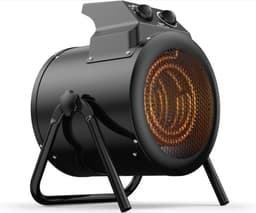
Bimson Power Bimson Power BP-EC5

Best overall

Bimson Power Bimson Power BP-EC5
7.6/10about £112.10
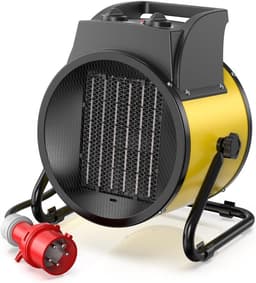
DAHTEC DAHTEC BGP1506-05

Best value

DAHTEC DAHTEC BGP1506-05
6.4/10about £58.00
DAHTEC DAHTEC IFHO2-50H silver

Alternative

DAHTEC DAHTEC IFHO2-50H silver
5.8/10about £101.15
On this page

When the 5 kW heater is the one that works

Choose the 5 kW heater when a red industrial socket is already on the wall, or an electrician is pricing that socket as a real job. All four listings say 380–415 V or 400 V and will not run from a household socket. The connector is a red five-pin BS EN 60309 plug, commonly 16 A. At 400 V a balanced 5 kW load is about 7.2 A per phase. Activair prints 7.4 A per phase for its 5 kW BX5. The voltage, not that current, is what a 13 A socket cannot supply. Who fits a dry 400 V workshop is on best 5kW fan heater.

When the 3 kW heater is the one that plugs in

Choose a heater at or under 3 kW when the only outlet is a 13 A socket. 13 A times 230 V is 2,990 W, and Electrical Safety First lists fan heaters at up to 3,000 W. Tombling puts about 3 kW on a BS 1363 plug, and a blue industrial plug on single-phase kit above that. A 3 kW heater that runs for hours is a sustained load. The IET’s September 2025 note on a 3 kW immersion calls sustained full power a poor match for a BS 1363 connection unit, around 2.7 kW unless the accessory maker says otherwise. That article is about immersions. It is a reason not to add a second 3 kW heater to the same ring. Tombling describes a ring as roughly two 3 kW heaters before the 32 A breaker.
Bimson Power Bimson Power BP-EC5

Testsieger

Bimson Power Bimson Power BP-EC5
7.6/10about £112.10

Heat and cost, with the condition

Buy the 5 kW three-phase fan heater if the matching red socket is there, or if an electrician is already pricing one. Otherwise buy a heater at or under 3 kW for a 13 A plug. On the Ofgem Direct Debit rate of 26.32 pence per kWh for England, Scotland and Wales from 1 October to 31 December 2026, a full hour is about £1.32 at 5 kW and about £0.79 at 3 kW, before the 54.83 pence standing charge. That is not a Northern Ireland rate, and the 5 kW hour exists only if the socket exists.

Who needs an electrician

A new red outlet is not a DIY adaptor. Once you are staying in the 5 kW class, the plate and the IP line are the buying guide. The building, including an open roller door, is the garage page.

Common questions

Can I put a 5 kW heater on a normal plug with an adaptor?
No. The four 5 kW listings here all refuse a 220–240 V household socket. At 230 V, 5 kW is about 21.7 A, and a BS 1363 plug is fused at 13 A, about 2,990 W. An adaptor does not change the voltage or the fuse. The heater wants a red 400 V three-phase connector, commonly 16 A. If that outlet is absent, the 5 kW class is the wrong purchase.
Is 3 kW the most a 13 A socket should feed?
It is the top of the arithmetic. 13 A times 230 V is 2,990 W, and Electrical Safety First lists fan heaters up to 3,000 W. Above that, on 230 V, sellers such as Tombling move to a blue industrial plug, and a 400 V heater moves to red. A patio-heater FAQ treats the 13 A socket as about 3 kW in total. Use one heater that matches the plug, not a stack of them on a gang board.
Is a 3 kW heater already close to the limit if it runs for hours?
Yes, it sits at the top of a 13 A plug for as long as the element is on. The IET’s September 2025 note on a 3 kW immersion calls sustained full power a poor match for a BS 1363 connection unit, with a practical comment around 2.7 kW unless the maker of the accessory says otherwise. That article is about immersions, not a ban on fan heaters sold with a 13 A plug. It is a reason to avoid a second large heater on the same ring.
Which is cheaper to run for an hour?
At full output, 3 kW uses fewer units. On the Ofgem Direct Debit rate of 26.32 pence per kWh for England, Scotland and Wales from 1 October to 31 December 2026, an hour is about £0.79 at 3 kW and about £1.32 at 5 kW. The standing charge is extra. A thermostat that cycles, a business tariff, or a Northern Ireland price will not match those illustrations. The cheaper hour is irrelevant if the 5 kW heater cannot be plugged in.
Which heats a workshop faster?
The 5 kW element can deliver more heat per hour while it runs, which is the point of the class in a workshop that has 400 V. A 3 kW heater is slower at filling a large cold volume, and it is the one that can run from a 13 A socket. Open doors, leaks and a high ceiling shrink both advantages. Faster only counts after the socket matches the plate.
Do I need an electrician for the 5 kW and not for the 3 kW?
You need an electrician if the garage has no red three-phase outlet and you still want the 5 kW heater, because that outlet is not a DIY adaptor. A 3 kW heater supplied with a BS 1363 plug is the class meant to go into an existing 13 A socket, provided the ring is not already full. Heat-damaged plugs, tripping breakers, and any new circuit are still electrical work on either class.

Related pages

Sources

Public UK sources for the supply limit, clearance, marking, and the unit rate. Listing prices, stars, and review counts are the amazon.co.uk figures in this set, checked 19 October 2026.

  1. Ofgem — Energy price cap unit rates and standing charges (retrieved 19 October 2026)
  2. Electrical Safety First — Ratings of electrical appliances (retrieved 19 October 2026)
  3. Electrical Safety First — Portable heaters (retrieved 19 October 2026)
  4. GOV.UK — Electrical Equipment (Safety) Regulations 2016 (retrieved 19 October 2026)
  5. Tombling — Electricity supply for heaters (retrieved 19 October 2026)
  6. HSE — Fire safety (retrieved 19 October 2026)
  7. RC15 — Recommendations for portable heaters in the workplace (retrieved 19 October 2026)
  8. BEAMA — IP ratings guide (retrieved 19 October 2026)