Independent comparisons. We may earn from shop links. More info

How to use a 5kW fan heater

Updated: October 2026

You are about to switch on a 5 kW three-phase fan heater in a workshop. How to use a 5kW fan heater, for the units in this comparison, starts with the plug you already have and the booklet in the box. It does not start with drilling a new outlet. Installing a red 400 V socket is an electrician’s job. The listings are on the [5kW fan heater comparison](/hub/portable-heaters/5kw-fan-heater). Products Compared used UK safety guidance and the amazon.co.uk files, checked 19 October 2026. We did not run one of these heaters. A qualifying purchase can earn us a commission at no extra cost to you.

You are about to switch on a 5 kW three-phase fan heater in a workshop. How to use a 5kW fan heater, for the units in this comparison, starts with the plug you already have and the booklet in the box.

Our top picks

Bimson Power Bimson Power BP-EC5

Best overall

Bimson Power Bimson Power BP-EC5
7.6/10about £112.10
DAHTEC DAHTEC BGP1506-05

Best value

DAHTEC DAHTEC BGP1506-05
6.4/10about £58.00
DAHTEC DAHTEC IFHO2-50H silver

Alternative

DAHTEC DAHTEC IFHO2-50H silver
5.8/10about £101.15
On this page

Before you switch it on

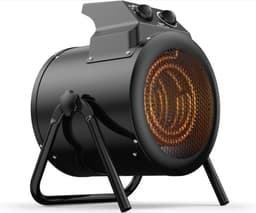
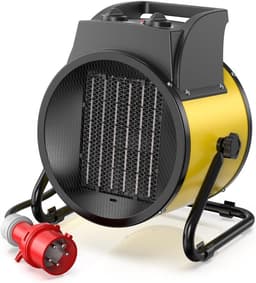
Match the plug before you look at the thermostat. These heaters are sold for 380–415 V or 400 V three-phase. If the plate says 400 V and the wall offers only a 13 A square pin, stop. Do not fit an adaptor, and do not treat a blue single-phase plug as the red five-pin connector. On the Bimson, the metal legs arrive unfitted. The three UK reviews call the fitting straightforward. Fit them so the heater stands on its own feet, and check both grilles are clear. The yellow DAHTEC bullets say not to cover the unit. A hot plug, a discoloured flex, or a breaker that trips is a stop, not a running-in period.

Where it stands and what must not touch it

Electrical Safety First’s advice is a level surface, at least one metre from combustibles, and no clothes drying. That page is for household heaters, so the 400 V plug still has to be right first. A Sealey 2 kW booklet says 1 m from the air outlet for textiles. A Draper 2 kW manual says 2 m from the outlet grille. Those are other models. Follow the booklet you unpacked. One Bimson reviewer wanted space in front so the fan can throw the heat. Do not dry gloves on the grille. The yellow listing says not to use it in damp areas and prints no IP code. The IFHO2 pages state IP24 and still say indoor.
Bimson Power Bimson Power BP-EC5

Testsieger

Bimson Power Bimson Power BP-EC5
7.6/10about £112.10

When it cycles off

A thermostat and an overheat cut-out feel similar and are not. The Bimson page prints 5–75 °C and the yellow DAHTEC prints 5–85 °C. The silver IFHO2 prints a maximum of 25 °C on that colour only, beside a 70 °C heat-output field, so a short cycle may be the setpoint. If the cut-out trips, clear both grilles and let it cool. Do not bypass it. A hot plug or a breaker that trips on 5 kW is not thermostat behaviour. Do not open the heater to hunt for the cut-out.

When you leave the workshop

When you leave, switch the heater off. RC15, the workplace note on portable heaters, wants them off at the end of work rather than left on a timer in an empty unit. If you are an employer, update the fire-risk assessment before the heater sits near vapour, dust, or anywhere people sleep. How that building decision sits next to a 13 A heater is on 5kW vs 3kW heater.

Common questions

How far from the wall and from combustibles should it stand?
Electrical Safety First says at least one metre from combustibles for a portable heater, on a level surface. A Sealey 2 kW booklet says 1 m from the air outlet for textiles, and a Draper 2 kW manual says 2 m from the outlet grille. Those distances are for those models. Use the booklet in your box, leave the inlet and the outlet clear, and do not site it immediately below a socket. One Bimson reviewer also wanted room in front so the fan could throw the heat.
Can I dry gloves on it?
No. Electrical Safety First says not to dry clothes on a portable heater, and the yellow DAHTEC bullets say not to cover the unit. Gloves, rags and overalls on the grille block the airflow and sit against a hot element. That is how the overheat cut-out earns its keep, or how something scorches if the cut-out is defeated. Dry kit on a rail away from the outlet.
Why does it cut out after a few minutes?
Either the thermostat has reached the setting, or the overheat device has opened because the airflow is blocked. Check the setpoint first, including the 25 °C maximum printed only on the silver IFHO2. Then clear the grilles, move the heater into open air, and let it cool. Do not bypass the cut-out. If the plug smells or the breaker trips, stop and have the supply checked.
Can I run it from an extension lead?
Electrical Safety First tells you to avoid extension leads with portable heaters. These 5 kW units are also on a 400 V plug, so a household extension reel is the wrong object twice: wrong voltage, and a coiled lead that can overheat. Use the outlet the heater is built for, with the lead unkinked. If the red socket is across the workshop, that is a reason to ask an electrician about the outlet position, not a reason to add a reel.
When do I stop and call an electrician?
Stop if there is no three-phase outlet, if the plug or socket is heat-damaged, or if a breaker trips and you cannot point to a blocked grille. Fitting a new 400 V point, and judging whether the building supply can take it, is the electrician’s work. An employer also needs the fire-risk assessment updated before a portable heater is used near vapour, dust, or sleeping risk. Do not open the heater to hunt for the cut-out.

Related pages

Sources

Public UK sources for the supply limit, clearance, marking, and the unit rate. Listing prices, stars, and review counts are the amazon.co.uk figures in this set, checked 19 October 2026.

  1. Ofgem — Energy price cap unit rates and standing charges (retrieved 19 October 2026)
  2. Electrical Safety First — Ratings of electrical appliances (retrieved 19 October 2026)
  3. Electrical Safety First — Portable heaters (retrieved 19 October 2026)
  4. GOV.UK — Electrical Equipment (Safety) Regulations 2016 (retrieved 19 October 2026)
  5. Tombling — Electricity supply for heaters (retrieved 19 October 2026)
  6. HSE — Fire safety (retrieved 19 October 2026)
  7. RC15 — Recommendations for portable heaters in the workplace (retrieved 19 October 2026)
  8. BEAMA — IP ratings guide (retrieved 19 October 2026)