Independent comparisons. We may earn from shop links. More info

Salt chlorinator or chlorine floater

Updated: 16.10.2026

You are stood between a bag of pool salt and a tub of tablets, and both adverts sound finished. One calls the pool saltwater. The other calls a floater automatic. This page is the salt chlorinator or chlorine floater choice: what each route adds, what it costs to start in this set, and one recommendation with a condition. The wider row is the [pool chlorinator](/hub/pool-care/pool-chlorinator) comparison. The Products Compared editorial team wrote this from the amazon.co.uk captures and from SPATA, PWTAG and retailer notes on 16 October 2026. There was no lab test. A qualifying purchase through our links can earn a commission at no extra cost to you.

You are stood between a bag of pool salt and a tub of tablets, and both adverts sound finished. One calls the pool saltwater. The other calls a floater automatic.

Our top picks

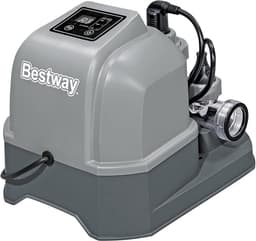
Bestway Bestway Hydrogenic 6 g/h

Best overall

Bestway Bestway Hydrogenic 6 g/h
10.0/10about £186.54
FENRIR FENRIR 5 inch floater

Preis-Tipp

FENRIR FENRIR 5 inch floater
9.0/10about £5.99
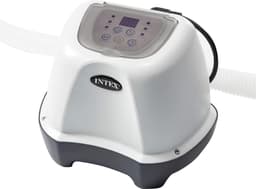
Intex Intex CG-26664

Rank 3

Intex Intex CG-26664
8.8/10about £118.56
On this page

Both routes are chlorine routes

A salt cell makes chlorine. SPATA’s factsheet describes electrolysis turning salty water into sodium hypochlorite, at around 3,000 mg/l of salt. HiLife Pools says a salt pool still uses chlorine, pH tends to rise, and salt can affect metals. Intex 26670 states 12 g/h even where a nearby title says chlorine-free. Those grams per hour are the chlorine the cell claims to produce. A floater holds tablets in a basket. It does not make a disinfectant. You still test free chlorine. PWTAG’s note is the reason: pH changes how much of that residual is active, on a salt pool and on a tablet pool. Flow and plug, if you have not measured the pool, are the pool chlorinator buying guide.

When the floater is the one to buy

Buy a floater when there is no return pipe and the volume is small enough to watch. A paddling pool or a small frame pool is that case. FENRIR is £5.99, rated 4.5 from 2,439 reviews. OBOVO and CMXOAJ are £6.99. The floater’s case is a low starting bill and no electrician. UK reviews of FENRIR describe lids that open and tablets that fall out. A trichlor puck on vinyl can spot-bleach the liner. CMXOAJ’s crush-a-3-inch-tablet line is a reason to buy 1 inch tablets. A floater is a weak buy when you already have a return and you are only avoiding salt because a title said chlorine-free.
Bestway Bestway Hydrogenic 6 g/h

Testsieger

Bestway Bestway Hydrogenic 6 g/h
10.0/10about £186.54

When the salt cell is the one to buy

Buy a salt cell when the pump flow meets the listing and the metalwork can live with salt. Bestway’s 6 g/h unit states up to 26,498 litres and at least 1,249 litres per hour, at £186.54. Intex 26670 states 12 g/h, at least 2,650 litres per hour and about 3 kg of salt per cubic metre, at £301.32. CG-26664 states 230 V at £118.56 and omits litres and grams per hour, so it joins this route only after the manual agrees. Use pool sodium chloride under BS EN 16401:2013, not table salt or seawater. SPATA asks you to check metals and bonding around 3,000 mg/l. A UK review says 26670 arrived with a euro plug. Weighing salt and testing the next day is how to use a pool chlorinator.

One recommendation, with the condition

Choose the floater if there is no plumbing and you will test and keep the lid shut. FENRIR at £5.99 has the largest UK review count among the holders, and the lid complaints are in that same record. Choose a salt cell if the listing’s flow matches your pump and the pool is salt-safe. Where the cap is printed, Bestway 6 g/h at 26,498 litres is the easier check. Where the listing prints 230 V and omits litres, CG-26664 waits on the manual. An inline feeder is the third route in one sentence. Hayward CL200 puts tablets on the return at £129.40, with no UK review in the file, and CL0200EURO’s trade capacity does not transfer.

Common questions

Which is cheaper to start?
The floater is cheaper on day one. FENRIR is £5.99 and the other holders are £6.99, before tablets. A salt cell here starts at £118.56 for CG-26664 and runs to £186.54 for Bestway 6 g/h and £301.32 for Intex 26670, before pool salt. Tablets are a running cost. Salt is a bag at the start plus top-ups. This capture does not support a set number of years to pay the cell back.
Which needs a pump?
The salt cell needs flow at the rate the listing states. Bestway 6 g/h asks for at least 1,249 litres per hour. Intex 26670 asks for at least 2,650 litres per hour. A floater needs the pool and a tablet. If your pump is below the cell’s minimum, the floater or an inline feeder is the match until the pipework changes. CG-26664 prints no flow figure, so you still have to find one before you switch it on.
Will a floater hold a steady residual?
It holds a residual while the vent, the tablet size and the water cooperate, and only if you test. UK reviews describe fast dissolve and tablets that left the basket when the lid opened. A wide-open vent on a small pool can push free chlorine up within a day. Cyanuric acid from stabilised tablets can climb over the season. A cell is steadier only when runtime and salt are right. Neither route deletes the test kit.
What salt do I add?
Add pool-grade sodium chloride, the type BS EN 16401:2013 covers. Follow the kilograms on your cell. Intex 26670 prints about 3 kg per cubic metre, in line with SPATA’s 3,000 mg/l description. Do not pour that figure onto a cell that prints a different dose, or none. Leave table salt and seawater out. Dissolve the salt with the pump on and the cell off, then test.
What happens if tablets fall on the liner?
A tablet on vinyl can bleach a pale spot. UK reviews of FENRIR include lids that opened and tablets that fell out, so this is a reported failure, not a rare story. Lift the puck out and check the lid before the floater goes back. A salt cell removes that accident because there is no puck. It does not remove the test. If the mark is already in the liner, the holder will not undo it.

Related pages

Sources

Public UK sources from the research digest, retrieved 16 October 2026. Prices, stars, and review counts are the amazon.co.uk captures for these ASINs.

  1. HSE, swimming pool safety management (retrieved 16.10.2026)
  2. HSE, HSG179, health and safety in swimming pools (retrieved 16.10.2026)
  3. HSE, using biocides safely (retrieved 16.10.2026)
  4. HSE, biocide product types (retrieved 16.10.2026)
  5. PWTAG TN60, free chlorine and pH (retrieved 16.10.2026)
  6. SPATA, salt chlorinators factsheet (retrieved 16.10.2026)
  7. BSI, BS EN 16401:2013, sodium chloride for electrochlorinators (retrieved 16.10.2026)
  8. Sunshine Pools, Bestway Hydrogenic 6 g/h (retrieved 16.10.2026)