Mustard algae swimming pool treatment: UK cautions
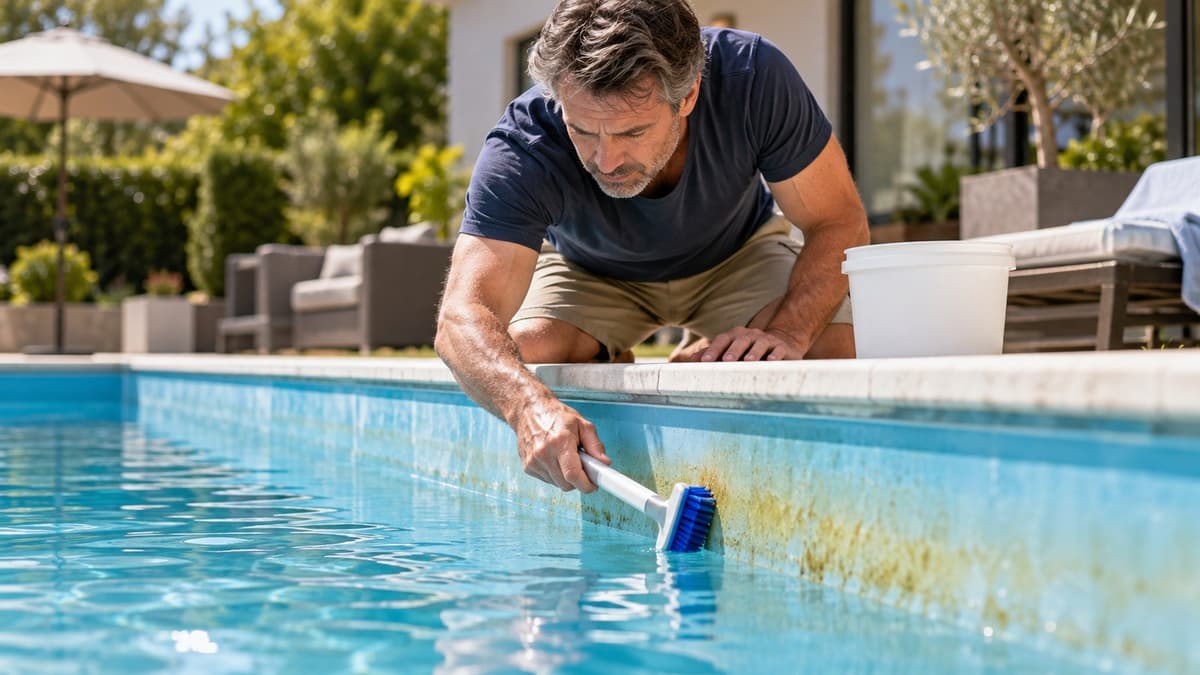
Mustard algae swimming pool treatment in Britain: what a yellow film may mean, why sodium bromide changes the residual, and what the Yellow Treat card omits.
On this page
A mustard algae swimming pool problem is easy to turn into a chemistry problem of your own making. You see a yellow film that ordinary chlorine has not shifted, find a specialist powder online and assume it is a stronger green-water algaecide. It is not. The product evidence available to a UK buyer is largely American, and a sodium-bromide treatment can change the residual you are maintaining.
Decide whether the yellow deposit really calls for specialist treatment, whether the bottle supplies usable British instructions, and whether you can accept bromide in the water chemistry. A large Amazon review count does not answer that. A purchase through our links can earn a commission at no extra cost to you.
In short
Do not treat yellow film as ordinary green water, and do not identify it from colour alone. Yellow Treat is listed on amazon.co.uk, yet the card we examined omitted its active ingredient and dose, and its written reviews were American. The US label identifies sodium bromide and requires superchlorination. Read the label you receive, and get advice if compatibility or chlorine demand is unclear.
Yellow film is not the same job as green water
This guide concerns a yellow or mustard-coloured film that has persisted despite ordinary chlorination, not a pool that has simply turned green. If the water is green, use the pool algae treatment comparison to assess products intended for that broader job rather than jumping straight to sodium bromide.
A yellow deposit is not a diagnosis by itself. Dirt, staining and biological growth can look similar from the pool edge, and this research has no visual test that proves mustard algae. Brush the affected surfaces, note whether the film returns, and review what has already gone into the pool. Appearance alone does not justify a specialist dose.
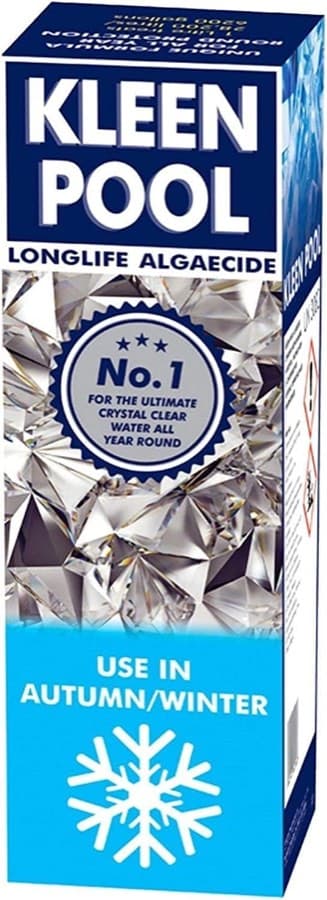
A product that clears a green garden pool is not automatically relevant here. The comparison's leading general algaecide is Kleen Pool 1 litre, about £17.95, with 4.6 from 585 United Kingdom reviews. The title claims that litre treats 28,000 litres and lasts six months. Its Amazon card does not name the active ingredient, and this research does not establish it as a treatment for a persistent yellow film. A sodium-bromide powder and that liquid are not the same bottle at two strengths.
What the UK Yellow Treat listing actually shows
The amazon.co.uk card for United Chemical Yellow Treat was £47.74 in the October 2026 snapshot. Its title described a two-pound pack and the form was powder, while the star line showed 4.3 from 2,002 reviews. Those are storefront facts, not proof of formulation, suitability or a British treatment record.
The Amazon card did not state the active ingredient, a dose or a pool volume, and its structured fields were internally inconsistent: one weight field said 0.28 g and a unit field used millilitres for a powder. The two-pound title is the useful pack description. Do not calculate a dose from the conflicting fields.
Every written review in the raw file was headed Reviewed in the United States. Some described success against mustard or yellow algae after brushing and shock. One reported staining, a lost chlorine reading and an eventual drain. That complaint is a warning, not a predicted outcome, and the 2,002 reviews are not a UK sample.
Why sodium bromide changes the treatment
The US Environmental Protection Agency label dated 9 August 2024 identifies Yellow Treat 2 as 67.60 per cent sodium bromide. An older safety data sheet gives 88.8 per cent, so those percentages must not be merged or used interchangeably. Formulations and documents can differ. The controlling instruction is the current label attached to the exact product you possess.
Sodium bromide is not itself the whole treatment described by the US label. That document directs you to add the product and then superchlorinate. The oxidiser activates bromide into a bromine sanitising residual, which is why the process is not equivalent to pouring in an ordinary liquid algaecide and carrying on with an unchanged chlorine routine.
The Pool Water Treatment Advisory Group discusses sodium bromide plus hypochlorite as a proprietary bromine system for large, heavily used leisure pools, where the bromide level is maintained. That is not a domestic dose for a garden pool. Adding bromide can leave an ongoing chemistry relationship, because bromide can be reactivated and oxidiser demand may change.
Read the label before you copy a US dose
The current US label gives five ounces per 10,000 US gallons and then calls for superchlorination. That is evidence of how the US-labelled formulation is directed, not a dose for a British garden pool. The amazon.co.uk card in our snapshot prints neither that dose nor the active ingredient. This article will not convert it into grams and litres as though the missing UK-facing instructions had been supplied.
Before any treatment, read the physical label for the formulation, the dose, the pool-volume basis and the follow-up. Compare every warning with your sanitiser and equipment instructions, and confirm you can manage the residual rather than dosing before a weekend away.
Do not fill gaps with American review routines. Brushing, shock and a second dose in a US comment do not show that the pool, label or chemistry matches yours, and they do not turn a US pesticide registration into a Great Britain authorisation. The Health and Safety Executive is the authority for biocides in Great Britain. A US EPA registration does not establish the British status of a marketplace offer. If the card and the physical label leave the product or the instructions incomplete, do not improvise.
A cautious treatment decision
If the pool is broadly green, cloudy or neglected without a distinct recurring yellow film, investigate general algae control, circulation and the sanitiser routine instead. A product compared for normal green-water use may fit that problem. Yellow Treat is positioned by its American evidence around mustard or yellow algae.
If a persistent yellow film is the specific problem, record pool volume, the existing sanitiser, recent products and any installed treatment equipment before you buy. The UK research does not clear sodium bromide combinations with a salt chlorinator, UV or ozone. That absence is not a ban. Compatibility has to come from the relevant labels or the equipment manufacturer, not from an assumption.
If you already own Yellow Treat, follow the container, not the incomplete Amazon card. Do not dose from the 0.28 g field, the millilitre unit count or an American comment. Stop if the active ingredient or the directions are missing, damaged or do not match the product advertised. The US label still couples the powder with superchlorination. No readable matching label means no defensible dose.
When to stop and get help
Pause before treatment if you cannot confidently identify the deposit, calculate the pool volume or reconcile the product with chemicals already added. Dose and compatibility depend on them. Adding a specialist powder to uncertain water can make later troubleshooting harder because you no longer have a clear starting point.
Get advice from a pool-water professional or the product supplier if the label does not address your sanitiser or equipment. This is particularly relevant for salt chlorination, UV or ozone, because the UK sources used here provide no garden-pool compatibility clearance. Ask a precise question that names the product, formulation, pool volume and equipment rather than asking whether it is safe in the abstract.
Stop if the pool will not hold the expected sanitiser residual. One American review ended with a drain, which does not make draining the first response. Establish what was dosed and get advice on the actual water, rather than adding more chlorine or more Yellow Treat without understanding the demand. This research gives no threshold at which a UK domestic pool must be emptied.
Peter F. checked the October 2026 amazon.co.uk listing, its review geography, the current US EPA label, the Pool Water Treatment Advisory Group's discussion of sodium-bromide systems and the Health and Safety Executive's British biocide framework. We did not test the product or your pool water.
Common questions
Is yellow dust on a pool wall definitely mustard algae?
Will an ordinary chlorine shock remove mustard algae?
Is Yellow Treat available on amazon.co.uk?
Can sodium bromide make it difficult to hold chlorine?
Can I use Yellow Treat with a salt chlorinator, UV or ozone?
How many Yellow Treat doses should I use?
Do the 2,002 Yellow Treat reviews represent UK buyers?
Should I use a mustard-algae treatment for ordinary green water?

Peter F. is the editor for DIY & tools at productscompared.co.uk. Comparisons in this category are checked against amazon.co.uk listings, review evidence and public UK sources.
Related articles

Green pool water: what to do before a second bottle
Work out what to do first when a garden pool turns green.
Algaecide or chlorine: which does your pool need?
See why sanitiser and algae control are not interchangeable jobs.
Pool algaecide biocide label: checks before you dose
Check a UK pool algaecide label for the dose and authorisation, and do not treat an Amazon card as approval.