Hot tub algae: tell green water from white biofilm

Learn how to separate hot tub algae from suspected white biofilm, avoid pool-sized dosing mistakes and choose only a product whose label covers your spa.
On this page
You lift the cover and find either green water or pale material drifting after a fresh fill. Those sights may look like one chemical problem, but treating them as interchangeable is how a small hot tub receives a swimming-pool-sized pour. Hot tub algae calls for a product and dose that match a spa; suspected white biofilm calls for caution about what you are actually seeing.
This distinction matters especially with a Lay-Z-Spa or another compact tub. A product card built around 28,000 litres does not become a spa instruction merely because both vessels hold water. Start with the symptom, the tub's real volume and the bottle label, not the size of the bottle.
In short
Green water and white flakes are not the same diagnosis. If you use an algae-control product, choose one whose label explicitly covers hot tubs or spas, then dose for the actual water volume. Keep following the tub maker's separate sanitiser, cleaning and filtration instructions.
A hot tub is not a small swimming pool
A hot tub may be physically smaller than a garden pool, but the practical difference is not just scale. Product instructions are written for named vessels and measured water volumes. "Four-person tub" tells you how the product is marketed, not how many litres are present when it is filled to the working line. Find that volume in the tub manual before you interpret any dose.
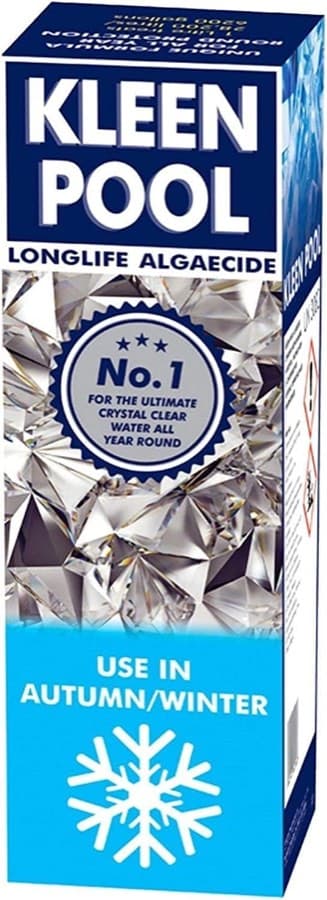
This is where pool-focused cards create a trap. The Kleen Pool 1 litre listing says it treats 28,000 litres and lasts six months, while its vessel field names swimming pools. The available card does not confirm hot-tub use; a hot tub appears as a customer question. That is not enough evidence to divide the whole bottle informally or to pour it into a Lay-Z-Spa.
The Clearwater CH0006 card is the other kind of evidence: it names hot tubs and spas, but the online listing still does not supply the millilitre dose. Read the spa dose on the physical label rather than estimating a capful. A rough pour that looks small beside a one-litre bottle may be large relative to a compact tub.
Green water and white biofilm are different messes
Green water is the clearer algae signal in the evidence available here. UK reviews of Clearwater include an account of a small amount clearing a tub that was going green. That does not establish a universal amount, a clearing time or a guaranteed result. Other reviews describe water remaining green even after treatment.
White material needs a different description. One Clearwater reviewer reported white material after a hot-tub fill and interpreted it as biofilm. That is a user's identification, not a laboratory result, so it would be misleading to state that every white flake is biofilm or algae. Record what you can actually see: white flakes, film, slime or cloudy water, and whether it appeared after filling.
A fresh fill does not settle the question. Replacing water changes the water, but the research does not prove that it cleans every surface or component associated with the tub. If pale material returns, consult the maker's cleaning and sanitiser process rather than repeatedly treating it as green-water algae. "Cloudy hot tub" is a symptom, not a product dose.
Which listing actually names hot tubs?
The Clearwater 1 litre algaecide is the relevant comparison product for a spa because its UK listing explicitly names hot tubs and spas. The same bullets also name paddling pools and larger above-ground pools, and describe the liquid as both preventing build-up and removing algae. At the research snapshot it was £9.55, with 4.5 out of 5 from 7,537 amazon.co.uk reviews.
The listing omits a millilitre dose and a treat-volume figure. It says the dose depends on how much water you have and is printed on the bottle, so you cannot finish a volume calculation from the card alone. Reviews of clearing, of water that stayed green, of a leak from a closed bottle and of foam do not amend that label.
Choose this listing only if the delivered bottle gives a clear dose for your spa and its measured litres. Our pool algaecide comparison sets it beside the pool-focused options.
Why a 28,000-litre pool dose is the wrong pour
The Kleen Pool card shows why a package claim stays attached to its scale. Its title says one litre treats 28,000 litres and lasts six months. It names swimming pools, not spas, and it does not give a separate small-tub dose. "Can this be used in a hot tub?" as a listing question is not a manufacturer instruction.
Do not solve that gap with mental arithmetic. Even if you know the spa volume, a proportional calculation assumes the same product use, concentration, application method and vessel approval. The research does not establish those assumptions. It would be false precision to publish a made-up number for a four-person tub.
Kleen Pool's UK reviews mainly describe garden pools closed for winter or kept circulating: half a bottle in a 15 ft Intex pool before autumn closure, and one stated 10,000-litre pool that cleared after a chlorine shock the previous day with the pump left running. Those accounts do not turn the 28,000-litre title into spa guidance.
Do not use a whole bottle, a fraction of one or a six-month claim in a hot tub unless the physical label explicitly covers that vessel and volume. If it does not, choose a product with compatible instructions rather than improvising.
Sanitiser still has to be there
Algaecide does not replace the sanitiser system specified for your hot tub. The listings discuss algae control, while the tub maker's process governs the sanitiser, circulation and maintenance expected for that model. An algae-control bottle may address green growth, but it is not proof that the rest of the water-care routine can stop.
Public pool guidance gives useful context without becoming a private-spa prescription. PWTAG mentions BCDMH bromine tablets in spa pools and advises extra vigilance where skin irritation is reported. That supports careful adherence to instructions, but it does not provide a dose for your domestic Lay-Z-Spa. Follow the tub manufacturer and the sanitiser label rather than borrowing an operator regime.
HSE guidance for spas used by the public is written for operators, not a garden tub, so those duties are not a domestic treatment schedule. Our chlorine tablet comparison covers the separate sanitiser category. A pool chlorinator comparison explains dosing equipment, and it is not evidence that a device or tablet suits your hot tub.
A practical decision route
Begin with evidence you can obtain without guessing, so you avoid the wrong chemical and the wrong scale.
- Describe the symptom precisely. Note whether the water is green, merely cloudy, or carrying white flakes or film. Do not call white material algae to fit a product you already own.
- Confirm the filled volume from the hot-tub manual's litre figure at the normal fill line. Do not substitute the number of seats.
- Check what the product label names. Look for hot tub or spa, not only swimming pool. An Amazon question is not an authorised use on the label.
- Read the physical dose before pouring. Clearwater's card names spas but leaves the millilitre amount to the bottle. If that instruction is unclear for your volume, stop instead of estimating.
- Keep the maker's cleaning, filtration and sanitiser process running. A filter running in one review does not prove the bottle replaces filtration.
- The researched card gives no same-day wait time. Use the bottle and the tub guidance. If neither answers, ask the supplier or manufacturer before anyone gets back in.
If white material returns after cleaning and a fresh fill, or the instructions conflict, get product-specific advice rather than escalating the dose.
Products Compared reviews amazon.co.uk listing details, UK review themes and public guidance; we did not conduct a laboratory test. If you buy through a qualifying Amazon link, we may earn a commission at no extra cost to you.
Common questions
Is white slime in a hot tub algae?
How much algaecide should I use in a four-person hot tub?
Can I put a whole bottle of Kleen Pool in a Lay-Z-Spa?
Why can white material return after a fresh fill?
Do I still need sanitiser if I use spa algaecide?
Can children use the hot tub on the same day as treatment?
What should I do if the hot-tub water is green?
Which algaecide listing explicitly names hot tubs?

Peter F. is the editor for DIY & tools at productscompared.co.uk. Comparisons in this category are checked against amazon.co.uk listings, review evidence and public UK sources.
Related articles

Green pool water: what to do first
Separate circulation, cleaning and chemical treatment before reaching for another bottle.
Mustard algae swimming pool treatment: UK cautions
Yellow film is a different job from green water, and sodium bromide changes the residual you are holding.

Pool algaecide biocide label: checks before you dose
Check PT2, the named active and a GB authorisation. An Amazon card that calls the bottle safe is not approval to dose.