Independent comparisons. We may earn from shop links. More info

VDE pliers set: comfort grip is not a live-work rating

Updated: 21 October 2026

You are looking at an amazon.co.uk pliers set whose bullet says electrical or electrician, and the handles are rubber. That wording is why people search for a VDE pliers set and then buy a comfort-grip trio. In the twelve listings on our [pliers set comparison](/hub/pliers/pliers-set), none print BS EN IEC 60900. This page is the mark, the UK rules, and what to do instead. A soft grip is not the rating.

You are looking at an amazon.co.uk pliers set whose bullet says electrical or electrician, and the handles are rubber. That wording is why people search for a VDE pliers set and then buy a comfort-grip trio.

Our top picks

On this page

Comfort grip is not a 1000 V rating

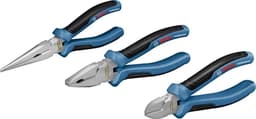
TPR, dual-component plastic and a soft red or yellow dip are there so the handle does not slip in a dry hand. They are not a tested insulation system. Treat insulated pliers as insulated only when they are certified for live work. A title that says electrical tasks, and SHALL, WORKPRO, Aoyfuwell, LuLuxinxin, OX and Ingco all lean that way, is a description of jobs people attempt. It is not a standard printed on the steel. The Bosch Professional 1600A016BG is the listing people most often want to excuse. In this comparison the specification line is CE, not a 1000 V mark. A review that once called the coating protective does not change the listing. If you need insulation, this Bosch set is the wrong product even though it is our top mixed three-piece for ordinary, dead work. Look at the tool, not the cardboard. Maun’s check is the double triangle and 1000 V on the tool itself. If those symbols are not moulded or printed on the handle, assume the grip is comfort only.

What BS EN IEC 60900 actually marks

BS EN IEC 60900:2018 is the British adoption of the insulated-hand-tool standard for work where the tool may touch live parts. The buyer-facing limit is up to 1000 V AC and 1500 V DC. The mark says the insulation, as designed and undamaged, is for that voltage range. It is not a reason to stay on a live circuit. The symbols belong on the tool: the double triangle, 1000 V, and a reference to IEC or EN 60900. VDE is a common certifier of that standard, not a UK statute. Check the marking, then the insulation: no cuts, no melted or peeled handle. A damaged sleeve is no longer the tool that was marked. Knipex sells an Electro set, 00 20 12, as a VDE three-piece. That kit is not in this comparison. Do not transfer its marking onto the Cobra tray 00 20 09 V02, which is also Knipex and also unmarked here. If you need a marked trio, you are shopping outside these twelve ASINs. A marked set still does not invite you to skip isolation.

Dead DIY versus live work in the UK

UK mains are 230 V. The safe default is to make the circuit dead before you cut or hold a conductor. Electrical Safety First tells DIYers to switch off at the fuseboard. For a socket, that means the breaker is off, you have confirmed the circuit is dead, and only then do you pick up pliers. The comfort-grip set in this comparison is, at best, a tool for that dead bench. The Electricity at Work Regulations 1989, regulation 14, allow live work only when it is unreasonable to make the equipment dead, reasonable to work live, and suitable precautions are taken. Rubber-looking handles are not those precautions. PUWER requires the tool to be suitable. An unmarked amazon.co.uk trio is the wrong tool for a live workplace task. You do not need a 60900 mark to hold a dead flex on the bench. You do need the mark if a conductor might still be live. If you cannot prove it is dead, stop. In England and Wales, Part P covers certain notifiable electrical work in dwellings. Scotland and Northern Ireland use their own building rules. Consumer-unit work, new circuits and anything you cannot isolate are electrician jobs.

What this comparison does not include

Every listing we scored has no live-work marking. That includes Bosch with its CE line, WORKPRO and OX, the Knipex Cobra tray, the Ingco seven-piece, and the budget kits whose titles lean on electrical language. A high star rating does not fill the gap. This comparison will not recommend any of the twelve for live conductors. Buy one of them for dead household jobs. If the work might meet a live part, buy a tool that shows the double triangle, 1000 V and BS EN IEC 60900 on the handle. Then still isolate. When the circuit is dead, go to how to use a pliers set. Handles sit fourth in the buying order, after the job and the steel.

Common questions

Are rubber handles on pliers insulated?
Not unless the tool is marked. Soft TPR and dual-material grips are for comfort and slip resistance. Insulation for electrical work is BS EN IEC 60900, identified on the tool by a double triangle and 1000 V. None of the twelve amazon.co.uk listings in this comparison print that mark. A title that says electrical does not add it.
What does VDE mean on pliers?
VDE is a third-party certification body, not a UK law. On pliers it usually means the tool has been certified to IEC/EN 60900. You still look for the double triangle and the 1000 V marking on the handle. A box that only says VDE, with bare handles in the photograph, is not enough. Other laboratories can certify to the same standard. The symbols on the tool are the check.
Can I use these sets on a socket?
Only after that circuit is dead, and not as insulated tools. Switch off at the consumer unit and confirm the circuit is dead before you cut or hold a conductor. Electrical Safety First advises householders not to DIY electrical installation work. These sets have comfort grips. If you are unsure the socket is dead, stop and use an electrician rather than relying on the rubber.
What is the double triangle on insulated tools?
It is the visible mark, with a 1000 V rating and a reference to IEC or EN 60900, that distinguishes a live-work tool from a comfort grip. Maun describes it as what you should see on the tool itself. It should survive after the packaging is gone. If the Bosch, WORKPRO or budget trio in this folder does not show it, the handle is not a 1000 V rating. Inspect any marked sleeve for cuts before use.
Do I need a 60900 set to change a plug?
You do not need a live-work mark to work on a BS 1363 plug that is off the wall and whose flex is dead. You need a mark only if the conductor might still be live. For an unplugged appliance, ordinary pliers used with care are a dead-work tool, and the sets in this comparison can sit in that category if the cutters are fit for copper. They are the wrong tools for a socket that is still energised.
Is the Bosch Professional set 1000 V?
No. In this comparison the Bosch 1600A016BG specification we record is CE, not BS EN IEC 60900. The price, the review count and the L-BOXX inlay do not add a voltage rating. Do not promote a customer review that liked the rubber into a certification. For dead DIY it remains a specified three-piece. For live parts it is the wrong tool.
When should I call an electrician?
Call an electrician for the fixed installation: consumer units, new circuits, and any conductor you cannot make dead and prove dead. In England and Wales some of that work is notifiable under Part P. Scotland and Northern Ireland have their own building rules. Regulation 14 of the Electricity at Work Regulations 1989 is aimed at workplaces and still sets the right caution at home. Unmarked pliers are not the precaution that regulation expects.

Related pages

Sources

Public UK sources from the research digest, last checked on 19 October 2026. Shelf prices and star lines are the amazon.co.uk figures in the display file.

  1. Toolstation: Pliers buying guide (retrieved 19 October 2026)
  2. BSI: BS EN IEC 60900:2018 live-working hand tools (retrieved 19 October 2026)
  3. BSI: BS 3087-1:1991 pliers and nippers (retrieved 19 October 2026)
  4. Maun Industries: VDE and IEC 60900 (retrieved 19 October 2026)
  5. legislation.gov.uk: Consumer Rights Act 2015, section 9 (retrieved 19 October 2026)
  6. GOV.UK: General Product Safety Regulations 2005 (retrieved 19 October 2026)
  7. legislation.gov.uk: PUWER 1998, regulation 4 (retrieved 19 October 2026)
  8. HSE: Reducing force on hand tools (retrieved 19 October 2026)