Independent comparisons. We may earn from shop links. More info

How to use a pliers set

Updated: 21 October 2026

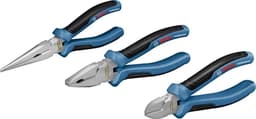
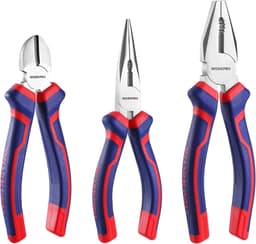
You have a combination pair, a long-nose pair and diagonal cutters on the bench, and the temptation is to grab whichever handle is nearest. That is how tips bend and edges chew. This page is how to use a pliers set as three different tools: which jaw, where the wire should sit when you cut, and when to stop. The listings are on the [pliers set comparison](/hub/pliers/pliers-set). Comfort grips on these kits are not a 1000 V rating.

You have a combination pair, a long-nose pair and diagonal cutters on the bench, and the temptation is to grab whichever handle is nearest. That is how tips bend and edges chew.

Our top picks

On this page

Match the jaw to the job

Combination pliers are the general pair. The inner faces are serrated for flats, there is a curved groove for a small pipe or a rounded fitting, and the cutter sits close to the joint. Use them when you need to hold a nut, a hose clip or a connector and then twist. They are the wrong pair when the work is 40 mm down a gap your fingers cannot enter, and they are the wrong pair when all you need is a flush snip on a cable tie. Long-nose pliers are the reach. The tips hold a clip, a split pin or a wire end that the combination jaws are too blunt to pick up. Maun distinguishes a precision grip, closer to a pen, from a power grip nearer the pivot when you do have to pull. The tips are for holding. They are not a crowbar. If you lever with the point, the nose bends, and a bent nose is a fault UK reviewers already report on cheap sets before anyone has worked them hard. Diagonal cutters, often called side cutters, are the cutting pair. The blades are bevelled. They suit cable ties, copper and small pins. They are not bolt cutters and they are not fence tools. If the set also includes a water-pump pair or locking pliers, those stay in the pouch until the job is a pipe nut or a clamp.

How to cut without chewing the edge

Open the diagonal cutters fully enough to see the blades, then put the wire next to the pivot, not at the tip. Wonkee Donkee’s method is the same idea: open, position the cut near the joint, close, and keep the squeeze on if you are twisting a conductor off. The joint is where the leverage is. Cutting on the tip leaves a fold instead of a snip. Wear eye protection. An offcut of copper or a cable-tie end leaves the jaws faster than you expect. If the blades need unusual effort on ordinary copper, stop. Do not move the same wire to the long-nose tips to finish it. If those pliers have a cutter, it is at the pivot. Do not cut hardened material because it is thinner than it looks. Fence wire, nails and spring steel are outside what a bevelled diagonal edge is for. If the listing does not state a diameter, assume copper, cable ties and small pins. Mains flex is a special case. You cut it only when it is dead. Electrical Safety First tells DIY readers to switch off at the fuseboard before work near electrics. The rubber on the handles in this comparison is not insulation. If a conductor might still be live, put the set down and read the VDE pliers set page.

Grip, twist and reach

For a hold-and-turn job, seat the work in the combination pliers rather than pinching it on the tip of the serrations. A nut that is barely caught will cam out and round. The pipe groove is for a rounded body, not for crushing a plastic waste pipe flat. Close the hand, then twist with the wrist and the length of the handle. If you are straining, use a longer pair or a water-pump plier, not a harder squeeze. Keep the squeeze on while you twist a wire you have nicked beside the joint. If you relax as you turn, the strands tear. On stranded flex, cut once, cleanly, beside the pivot. Do not saw. Long-nose work stays light. Grip the target with the tips, and if you must pull, slide your hand toward the pivot. A real example is a jubilee clip behind a dishwasher kickboard: hold the band with the long nose and turn the screw with a driver. Do not lever against the tip. When the nose has a cutter, use it only at the joint, on the same soft materials as the diagonal pair.

Aftercare and when to stop

Before you use them, look at the edges and the pivot. Maun’s guide is to inspect pliers before use, not to hammer with them, and to oil the joint if they have sat for a month. A dry pivot feels blunt because you are fighting the hinge. If the set arrived greased, wipe the excess and store it dry. Retire a pair when the blades no longer meet, a tip has snapped, or the edges pass each other. Grinding the bevel at home usually takes the hardness off. A sprung cutter is a return, which the pliers set buying guide covers, rather than a file. Stop and get an electrician when the work is the fixed installation or anything you cannot prove is dead at the fuseboard. If the pliers were the wrong type, no pump pair for traps, or no cutter in a Cobra-only tray, change the kit.

Common questions

Which pliers should I use for which job?
Use combination pliers to hold and twist, long-nose pliers to reach and hold a small part, and diagonal cutters to snip soft wire and cable ties. The cutter on combination pliers sits near the joint and suits a quick nick. It does not replace a proper diagonal pair for repeated cuts. Water-pump and locking pliers stay unused until the job is a fitting or a clamp.
Where should the wire sit when I cut?
Put the wire close to the pivot, not between the tips. That is where the leverage is, on both diagonal cutters and the cutter in combination pliers. Close fully and, if you are twisting the offcut away, keep the squeeze on so the strands do not tear. Cutting at the tip folds the edge and leaves a burr that the next cut will feel.
Can long-nose pliers cut fence wire?
No. Long-nose tips are for holding. If a cutter is fitted, it belongs at the pivot and it is still meant for soft wire, not fence wire, nails or spring steel. Fence wire will bend the nose or nick the bevel. Use a cutter made for that wire. A bent long-nose is already a common complaint on cheap sets in this comparison.
Do I need goggles to use pliers?
Yes when you cut. Offcuts of copper, cable-tie ends and pins leave the jaws at speed. Safety glasses are a small step and they match the eye-protection note in UK pliers buying guides. A quick cut on a bike cable is still a cut. Grip-only jobs are lower risk, and glasses still help if the part springs.
Why are the cutters blunt already?
Either the edge never met, which shows up in UK reviews of several cheap trios on arrival, or the edge has been used on material it cannot cut, such as fence wire or a nail. A dry, sticky pivot also feels like a blunt cutter because you are fighting the joint. Oil it, try a clean cut on copper beside the pivot, and return the set if the blades still pass or stand apart.
Can I use this set on a socket circuit?
Only on a circuit you have made dead, and not as if the handles were insulated. Switch off at the fuseboard, as Electrical Safety First advises for DIY near electrics, and confirm the circuit is dead before you cut or hold a conductor. None of the twelve sets in this comparison carry a BS EN IEC 60900 mark. Fixed wiring and a live socket are jobs for an electrician.
How do I stop pliers going rusty?
Wipe them after use, including any factory grease the listing tells you to remove, and store them dry. Oil the pivot if they have sat for about a month. A pouch keeps them together. It does not keep them dry if the pouch itself is left on a damp garage floor. Rust on the cutting edge is a reason to stop using that pair for flex.

Related pages

Sources

Public UK sources from the research digest, last checked on 19 October 2026. Shelf prices and star lines are the amazon.co.uk figures in the display file.

  1. Toolstation: Pliers buying guide (retrieved 19 October 2026)
  2. BSI: BS EN IEC 60900:2018 live-working hand tools (retrieved 19 October 2026)
  3. BSI: BS 3087-1:1991 pliers and nippers (retrieved 19 October 2026)
  4. Maun Industries: VDE and IEC 60900 (retrieved 19 October 2026)
  5. legislation.gov.uk: Consumer Rights Act 2015, section 9 (retrieved 19 October 2026)
  6. GOV.UK: General Product Safety Regulations 2005 (retrieved 19 October 2026)
  7. legislation.gov.uk: PUWER 1998, regulation 4 (retrieved 19 October 2026)
  8. HSE: Reducing force on hand tools (retrieved 19 October 2026)