Independent comparisons. We may earn from shop links. More info

How to use a hydraulic crimping tool

Updated: October 2026

The dies have closed, the handles feel solid, and the lug still turns on the strands. Learning how to use a hydraulic crimping tool on a 4–70 mm² kit means pumping until the relief valve operates, then judging the conductor, the hex and the die the lug maker specifies. The ten listings are on the [hydraulic crimping pliers comparison](/hub/pliers/hydraulic-crimping-pliers). Which family to buy, before you close the head, is the [hydraulic crimping tool buying guide](/hub/pliers/hydraulic-crimping-pliers/sub/hydraulic-crimping-pliers-buying-guide). Products Compared compared these amazon.co.uk listings on 16 October 2026, with no laboratory test. A purchase through our links can earn a commission at no extra cost to you.

The dies have closed, the handles feel solid, and the lug still turns on the strands.

Our top picks

On this page

Before the handles move

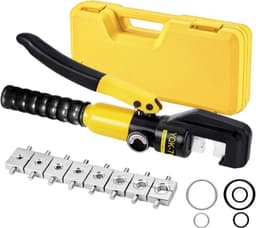
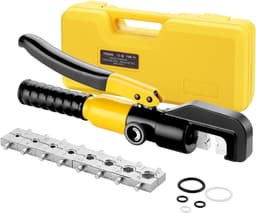
Seat both die halves so the engraved size faces you and the halves meet as a pair. Do not close the ram on a lug with the dies left out. A die that rocks in the nest will close off-centre, which is a complaint already attached to TEENO, Faankiton, Solsop and the Growlush YQK-70. Close the head once with no cable in it. If the halves do not meet evenly, stop. Isolate the conductor. These kits are for a cable you have already made dead, not for a live tail. Confirm you are holding a hex cable die. A U, TH or V jaw belongs on a pipe fitting, and that mix-up is the pipe press or cable crimper page. Power and Cables start from one brand of lug, die and tool. A no-name kit does not give you that match.

One crimp, in order

Strip so the bare conductor fills the barrel and the strands show at the inspection hole, if the lug has one. Push the conductor home until it stops. A half-full lug looks crimped and then pulls off. Place the barrel in the die the lug maker names. Pump until the relief valve operates. GTSE’s buyer guide makes that stop the end of the stroke, and then a tug. Release the ram and look before you pump again. Cembre charts often call for two hex crimps from 50 mm² on their own lugs. Follow the lug maker, and do not keep compressing a hex that has already flashed. The finished joint should show a regular hex, a conductor that reaches the inspection point, and no ears of metal standing off the flats. ETS, writing about BS 7609 practice, reads ears as over-crimp and voids as under-crimp.

Loose, flashed, or leaking

A lug that still rotates after the valve has operated is a failed joint. Reviews on these kits often drop a die size because the engraved number runs large. A MIG Welding Forum thread describes a 25 mm die that made no joint, and a smaller die that squashed the lug into ears. Do not adopt always go one size down. Use the lug maker’s die on a fresh lug, and retire the pair if it still will not hold. Flashing and ears mean the nest was too small or the die was cocked. Cut the lug off and start again. You cannot file an over-crimp back into a sound hex. Oil at the head is a stop-use fault. The Health and Safety Executive’s advice is not to feel for hydraulic leaks with your hand. Solsop includes two seal sets, Lsoar two pairs, and the Growlush YQK-70 one set. A leak under load, including the oil mist on the single FLASHEVER review, means the tool is out of service. A cracked body, reported on the AMZCNC, is the same decision. If the ram will not hold, return it.

What this kit must not terminate

A tug on the bench is a screen for a hobby lug, not a sign-off for a mains joint. Meter tails, consumer-unit conductors and gas pipe are outside this kit. So is copper above the 70 mm² these cases print, or aluminium above the 50 mm² several of them stop at. Return the tool when the dies will not seat, when the relief valve never operates, when oil appears under load, or when a correctly sized lug stays loose. A closed head and a firm handle are not, by themselves, a crimp.

Common questions

What are the steps for one cable lug?
Seat a matched die pair, close the empty head, and confirm the cable is dead. Strip so the barrel fills, insert the conductor fully, and pump until the relief valve operates. A second compression is only for a barrel whose maker asks for it, often from about 50 mm² on a Cembre chart.
How do I know the crimp is finished?
The relief valve has operated, and the lug shows a regular hex, the conductor home, no ears and no voids. Handle effort is not the signal. If the valve never clicks or blows back, the stroke is not finished.
The lug is loose. Do I use a smaller die?
Not as a standing policy. A smaller die can be the right nest if the lug maker names it, and it can also squash the barrel into ears, which ETS reads as over-crimp. One trial on a fresh lug is reasonable. Repeating one size down on every joint damages a barrel that needed a matched die.
What if oil appears at the head?
Stop. Do not hunt the leak with a finger. The Health and Safety Executive warns against feeling for hydraulic fluid by hand. A mist under load, as on the FLASHEVER review, means the tool is out of use even if a spare O-ring is in the box. Do not finish the cable run first.
Is a tug test enough for a mains joint?
No. A tug is a bench screen for a leisure or inverter lug you are allowed to remake. It does not replace the person who certifies a mains joint. Meter tails are outside this 4–70 mm² kit. If the cable is part of a fixed installation, use a calibrated tool in competent hands.

Related pages

Sources

Public UK sources checked for this comparison, plus the amazon.co.uk listing facts in the display file on 15 October 2026. Shelf prices and star lines are those UK figures. A later public snippet put the Solsop ASIN at £44.06, so the table price is the snapshot, not a promise.

  1. BSI, BS 7609:1992+A2:2009, code of practice for uninsulated connectors (retrieved 15 October 2026)
  2. IET Wiring Matters: will any old terminal block do? (retrieved 15 October 2026)
  3. ETS Cable Components: cable crimping and BS 7609 (retrieved 15 October 2026)
  4. E-Tech Components: crimping mistakes and good practice (retrieved 15 October 2026)
  5. HSE: fluid injection from hydraulic equipment (retrieved 15 October 2026)
  6. GOV.UK: General Product Safety Regulations 2005 (retrieved 15 October 2026)
  7. Z-Press: U, TH, V and M press-fit jaw profiles (retrieved 15 October 2026)