Hydraulic crimper for battery cable
You are in a camper van, a boat locker or a garage solar corner, holding a leisure battery and a length of thick red cable. A hydraulic crimper for battery cable is the hex tool that should close the lug on that DC run, if the die covers the conductor you will pull. The ten listings sit on the [hydraulic crimping pliers comparison](/hub/pliers/hydraulic-crimping-pliers). The buying order is the [hydraulic crimping tool buying guide](/hub/pliers/hydraulic-crimping-pliers/sub/hydraulic-crimping-pliers-buying-guide). Products Compared compared these amazon.co.uk listings on 16 October 2026, with no laboratory test. A purchase through our links can earn a commission at no extra cost to you.
You are in a camper van, a boat locker or a garage solar corner, holding a leisure battery and a length of thick red cable.
You are in a camper van, a boat locker or a garage solar corner, holding a leisure battery and a length of thick red cable. A hydraulic crimper for battery cable is the hex tool that should close the lug on that DC run, if the die covers the conductor you will pull. The ten listings sit on the hydraulic crimping pliers comparison. The buying order is the hydraulic crimping tool buying guide. Products Compared compared these amazon.co.uk listings on 16 October 2026, with no laboratory test. A purchase through our links can earn a commission at no extra cost to you.
Our top picks
| Badge | Product | Stated range | Metals | amazon.co.uk reviews | Note | Price | Offer |
|---|---|---|---|---|---|---|---|
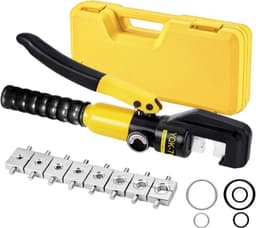
| Best overall |  AMZCNC AMZCNC YKQ-70 hand hydraulic cable-lug crimper | 12 AWG–2/0 | Cable lugs | 4.3 from 1,880 | 9.2 | about £39.78 | View offer |
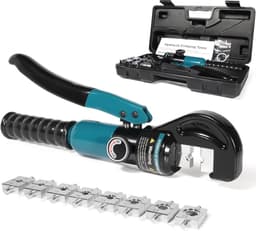
| Preis-Tipp |  Solsop Solsop hydraulic hex crimper 4–70 mm² | 4–70 mm² | Cu 6–70; Al 4–50 mm² | 4.2 from 1,672 | 8.8 | about £36.54 | View offer |
| Alternative |  Lsoar Lsoar hydraulic cable crimper 4–70 mm² | 4–70 mm² | Cable lugs | 4.0 from 31 | 7.6 | about £40.99 | View offer |

On this page
What battery cable this tool family is for
Crimp, do not solder, and do not trust throw-in lugs
Which listings were used on vans and batteries
When 70 mm² is the end of the kit
Common questions
What size of tool do I need for a leisure battery?
Should I crimp or solder a battery terminal?
Will a 4–70 mm² kit do 70 mm² inverter cable?
Are the lugs in the box good enough?
Can I use this on solar MC4 leads?
Related pages
Sources
Public UK sources checked for this comparison, plus the amazon.co.uk listing facts in the display file on 15 October 2026. Shelf prices and star lines are those UK figures. A later public snippet put the Solsop ASIN at £44.06, so the table price is the snapshot, not a promise.
- BSI, BS 7609:1992+A2:2009, code of practice for uninsulated connectors (retrieved 15 October 2026)
- IET Wiring Matters: will any old terminal block do? (retrieved 15 October 2026)
- ETS Cable Components: cable crimping and BS 7609 (retrieved 15 October 2026)
- E-Tech Components: crimping mistakes and good practice (retrieved 15 October 2026)
- HSE: fluid injection from hydraulic equipment (retrieved 15 October 2026)
- GOV.UK: General Product Safety Regulations 2005 (retrieved 15 October 2026)
- Z-Press: U, TH, V and M press-fit jaw profiles (retrieved 15 October 2026)