Hydraulic crimping tool buying guide
You are looking at a yellow case on amazon.co.uk whose title says hydraulic, 10 ton, and a cable size, while another listing is a U, TH or V jaw for pipe. This hydraulic crimping tool buying guide settles that split before any brand. Choose the joint, then the die family, then the force, and only then a row on the [hydraulic crimping pliers comparison](/hub/pliers/hydraulic-crimping-pliers). Products Compared compared these amazon.co.uk listings on 16 October 2026, with no laboratory test. A purchase through our links can earn a commission at no extra cost to you.
You are looking at a yellow case on amazon.co.uk whose title says hydraulic, 10 ton, and a cable size, while another listing is a U, TH or V jaw for pipe.
You are looking at a yellow case on amazon.co.uk whose title says hydraulic, 10 ton, and a cable size, while another listing is a U, TH or V jaw for pipe. This hydraulic crimping tool buying guide settles that split before any brand. Choose the joint, then the die family, then the force, and only then a row on the hydraulic crimping pliers comparison. Products Compared compared these amazon.co.uk listings on 16 October 2026, with no laboratory test. A purchase through our links can earn a commission at no extra cost to you.
Our top picks
| Badge | Product | Tool type | Stated range | Claimed force | Note | Price | Offer |
|---|---|---|---|---|---|---|---|
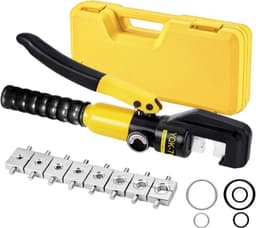
| Best overall |  AMZCNC AMZCNC YKQ-70 hand hydraulic cable-lug crimper | Cable hex crimper | 12 AWG–2/0 | Not stated | 9.2 | about £39.78 | View offer |
| Preis-Tipp |  Solsop Solsop hydraulic hex crimper 4–70 mm² | Cable hex crimper | 4–70 mm² | 80–100 kN | 8.8 | about £36.54 | View offer |
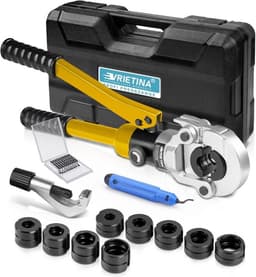
| Alternative |  Vrietina Vrietina V and TH hydraulic pipe press | V and TH pipe press | 12–32 mm | 100 kN | 7.8 | about £99.99 | View offer |

On this page
Cable lug, pipe press, or neither
Size, metal and how often you crimp
What the £32–£41 kits do not include
When the buy is a hire or a named system
Common questions
Do I need hydraulic pliers or a small ratchet?
Is 4–70 mm² enough for my cable?
What is the difference between 80 kN and 10 ton?
Should I buy a manual pump or a battery tool?
Will a cable kit press underfloor pipe?
Does a cheap kit replace a calibrated trade tool?
Related pages
Sources
Public UK sources checked for this comparison, plus the amazon.co.uk listing facts in the display file on 15 October 2026. Shelf prices and star lines are those UK figures. A later public snippet put the Solsop ASIN at £44.06, so the table price is the snapshot, not a promise.
- BSI, BS 7609:1992+A2:2009, code of practice for uninsulated connectors (retrieved 15 October 2026)
- IET Wiring Matters: will any old terminal block do? (retrieved 15 October 2026)
- ETS Cable Components: cable crimping and BS 7609 (retrieved 15 October 2026)
- E-Tech Components: crimping mistakes and good practice (retrieved 15 October 2026)
- HSE: fluid injection from hydraulic equipment (retrieved 15 October 2026)
- GOV.UK: General Product Safety Regulations 2005 (retrieved 15 October 2026)
- Z-Press: U, TH, V and M press-fit jaw profiles (retrieved 15 October 2026)