Independent comparisons. We may earn from shop links. More info

How to use water pump pliers

Updated: October 2026

You are on your back under a UK basin, the trap is off, and the waste nut will not start. This page is how to use water pump pliers in that cupboard: set the joint so both faces sit on the work, hold the body of the fitting with a second tool, turn the nut a measured amount, and stop before serrated teeth chew the chrome. There is no ranking here. The five listings and their scores stay on the [fitting pliers comparison](/hub/pliers/fitting-pliers).

You are on your back under a UK basin, the trap is off, and the waste nut will not start.

Our top picks

On this page

Set the joint so both faces sit on the work

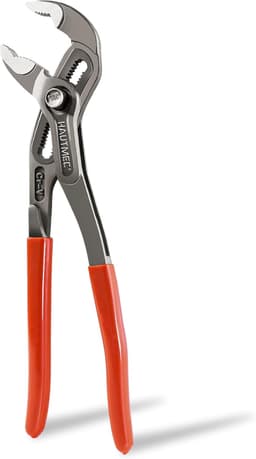
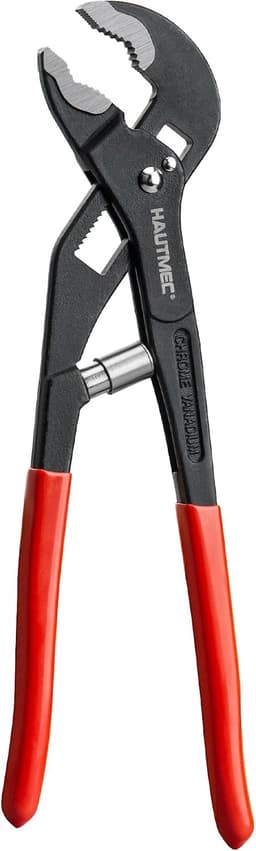
The first mistake is a tip bite. Engineer Fix’s UK how-to is the rule that still works: pick the tightest groove or button step that still lets both jaw faces land on the nut or the pipe, then pull so the jaws want to close, not open. If only the tips touch, the tool walks. On a box-joint pair such as Blue Spot, pull the halves apart and drop them onto a notch. UK notes say that joint can feel stiff the first few times; do not force a half-notch. On the HAUTMEC push-button pairs, press the button and check the claimed pinch guard before you squeeze. On the auto-adjust pair there is no button: you squeeze and the spring is supposed to take up. On GEINXURN, if the push-lock will not slide, stop rather than hammering it.

Hold the body, turn the nut

A compression joint needs two tools. Housewarm’s radiator-valve picture is the method: plumbers’ grips on the valve body or the fitting, a spanner or a second pair on the nut. If you turn only the nut, the pipe twists in the olive. How far past hand-tight is maker guidance, not a lab torque. Lawton’s current sheet is one full turn past hand-tight on 10–28 mm fittings and three-quarters of a turn on 35–54 mm. Start at hand-tight with the olive seated, mark the nut, then add the maker’s turn. Another full revolution is how olives get crushed. Plastic waste collars want even less. Seat the jaws on the flats or the rib, then a nip past finger-tight. If the collar ovalises, you have gone past useful.

Chrome, plastic, and pinch

Serrated teeth mark show chrome. That is the wrong face on a visible mixer or tap nut, not a mark you polish out later. A wet cloth slips, and neither a cloth nor a scrap of 2 mm MDF turns a serrated jaw into a pliers wrench. If the plating has to stay pretty, stop and use smooth jaws. That comparison is water pump pliers vs pliers wrench. Plastic is the opposite risk: the teeth hold, the collar yields. Keep the bite on a rib, not on a thin wall. ISO 5743 treats handle coats as comfort, not as a guard. Only the two HAUTMEC push-button listings claim an anti-pinch safety guard. Keep fingers out of the hinge on every pair. Soft-grip plastic is not BS EN IEC 60900.

If it slips, chips, or the handle comes off

If the jaws walk, you are probably on the tips or on a step that is too wide. Close one step, reseat both faces, and pull so the joint tightens. Inspect the tool before you blame the fitting. HAUTMEC’s shared parent notes include a handle covering that slid off. The auto pair’s UK sample includes jaws that do not meet, chipped teeth, and a spring that vanished on galvanised conduit. GEINXURN reviews mention a button that will not slide. Goods that fail on first jobs are a Consumer Rights Act 2015 conversation with the seller, not a reason to finish a radiator on a broken spring. If the joint is gas, buried, or larger than the printed opening, put the tool down. The plumbing page is the stop list.

Common questions

Which way do I pull so the jaws do not open?
Orient the pliers so the load tries to close the V, not open it. Engineer Fix’s short version is: tightest setting that still seats both faces, then pull. If the handles want to spread as you turn, you are on the wrong side of the nut or on the tips. Flip the tool or close a step before you add force.
Why do I need a second tool?
Because a compression olive grips the pipe. If you hold only the nut, the pipe and the fitting rotate together and the joint never seats. Housewarm’s method is grips on the body, spanner on the nut. One pair of water pump pliers can be the holding tool; it should not be the only tool on the joint.
How tight is a compression nut?
Hand-tight, then the maker’s extra turn. Lawton says one turn on 10–28 mm and three-quarters on 35–54 mm. That is guidance for those fittings, not a universal number. Stop when the olive has bit and the joint is dry. Another full turn past that is how you split an olive.
How do I stop marking chrome?
Do not put serrated teeth on show plating. Wrap the nut, use a cloth or MDF as a short-term shield, or switch to smooth jaws. A wet cloth slips. Grit in the jaw still scratches through a wrap. If the finish is the point of the tap, smooth jaws are the buying argument, not a thicker rag.
What do I do if the button will not slide or the spring is gone?
Stop using the tool as a wrench. A stuck GEINXURN button or a missing HT0088 spring is a defect, not a new technique. Reset once; if the mechanism is dead, return it. Do not finish a live heating joint on a pair that no longer locks.
When should I stop and call a plumber?
When the nut is larger than the printed opening, when the joint will be inaccessible after you close the wall, when the valve is seized, or when the pipe carries gas or enters a boiler case. None of these listings is marked for live electrics either. A plumber with a basin wrench, or a Gas Safe engineer, is cheaper than a chewed chrome mixer or a buried joint you cannot reach again.

Related pages

Sources

Public UK sources from the research digest, last checked on 19 October 2026. Shelf prices and star lines are the amazon.co.uk figures in the display file. The price bands are this set, not a market average.

  1. Screwfix: pliers buying guide (retrieved 19 October 2026)
  2. Housewarm: plumbers' grips (retrieved 19 October 2026)
  3. ISO 5743:2021, pliers and nippers, general technical requirements (retrieved 19 October 2026)
  4. ISO 8976:2021, pliers and nippers, multiple slip joint pliers (retrieved 19 October 2026)
  5. Gas Safe Register: home improvements (retrieved 19 October 2026)
  6. Water Supply (Water Fittings) Regulations 1999 (retrieved 19 October 2026)
  7. Consumer Rights Act 2015, goods remedies (retrieved 19 October 2026)
  8. DIY Doctor: chrome pipe (retrieved 19 October 2026)