Independent comparisons. We may earn from shop links. More info

Water pump pliers buying guide

Updated: October 2026

You are under a UK basin with a waste nut that will not turn by hand, and the search box is offering every length from 180 mm to a three-piece set. This water pump pliers buying guide is for that moment: you already know you need plumbers’ grips rather than mole grips or a pipe wrench, and you need the jaw and the opening to match the fitting before you care about the joint. Prices and the scored table stay on the [fitting pliers comparison](/hub/pliers/fitting-pliers).

You are under a UK basin with a waste nut that will not turn by hand, and the search box is offering every length from 180 mm to a three-piece set.

Our top picks

On this page

Start with the surface and the opening

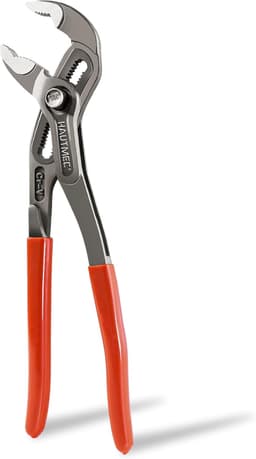
Buy the face that will sit on the metal, then the millimetres that will actually close around it. Four of the five amazon.co.uk listings here are serrated water pump pliers, or a box-joint pair that does not name a V-jaw. GEINXURN is a smooth-jaw pliers wrench aimed at plated fittings. If the nut is show chrome, that argument continues on water pump pliers vs pliers wrench. Opening is the figure most “250 mm” titles hide. Blue Spot and the HAUTMEC auto-adjust 250 mm pair both print 32 mm. The 180 mm push-button pair prints 42 mm, wider than both. The 300 mm HAUTMEC claims 75 mm. GEINXURN prints 38 / 50.8 / 63.5 mm.

180 mm, 250 mm, or 300 mm

Length is leverage and reach, not capacity. Housewarm’s rule of thumb for a UK first buy is 180 mm for a tight vanity, 250 mm as the pair you keep, and 300 mm for large plastic cistern nuts, cartridges and pumps. In this set those lengths do not line up with openings. The 180 mm HAUTMEC at £12.99 prints 42 mm, wider than both 250 mm pairs. The two 250 mm pairs share a 32 mm band. The 300 mm HAUTMEC claims 75 mm, and the same listing prints 10 g and 30 × 30 cm, which are not credible tool numbers. A three-piece title is not automatically the better buy. GEINXURN asks £25.99 for 180/250/300 mm, yet several UK reviews describe two 250 mm tools instead. Match the job on the plumbing page.

Grooves, button, or auto-spring

The joint is how you set the opening when one hand is already on the pipe. Blue Spot uses box-joint grooves: you pull the halves apart and drop them onto a notch. It is the cheapest mechanism in this set at £5.76, and UK notes say the joint can feel stiff the first few times. There is no push-button and no pinch-guard line. HAUTMEC’s 180 mm and 300 mm pairs claim a fast-adjust button and an anti-pinch guard. Those notes also report a handle covering that slid off and play between the halves. GEINXURN uses a push-lock. The HAUTMEC HT0088 is not a Cobra-style button. You squeeze and a spring takes up. UK reviews also report jaws that do not meet, teeth that chipped on first use, and a spring that vanished after about three days on galvanised conduit.

What the listing price does not include

The shelf price on amazon.co.uk is VAT-inclusive as shown. None of these five listings cites BS ISO 8976 or BS EN IEC 60900. ISO 5743 is the reminder that plastic coats are not insulation. Shared stars are the other hidden cost. The two push-button HAUTMEC lengths share 4.5 from 193. GEINXURN’s 4.4 from 21 is a small sample on top of the pack-count clash. The 300 mm listing’s 10 g line is a data error, not a featherweight tool. If you need a printed DIN ISO 8976 line, shop outside these five ASINs. If you stay, buy the printed opening and an honest piece count.

Common questions

What size should I buy first?
Housewarm’s UK advice is a 250 mm pair as the first plumbers’ grips, with 180 mm for tight vanities and 300 mm for large plastic nuts. In this set, check the opening before you follow that rule: both 250 mm listings print 32 mm, while the 180 mm HAUTMEC prints 42 mm. Buy the millimetres that fit the nut you can see, then the length that reaches it.
Is 32 mm enough for a basin waste?
It is enough for some household collars and not enough for a large plastic waste nut. Blue Spot and the HAUTMEC auto pair both stop at 32 mm on the listing. One Blue Spot reviewer mentioned a 52 mm basin back-nut; that is a reviewer’s job, not a measured 52 mm capacity, and this page does not promote it as a spec. If the collar looks wide, look at the 42 mm or 75 mm lines instead.
Push-button, grooves, or auto-spring?
Grooves are cheap and familiar; Blue Spot’s box joint can feel stiff at first. A push-button is faster in one hand if the button actually slides. HAUTMEC claims one, and the parent reviews also mention handle coverings that come off. Auto-spring on the HT0088 is squeeze-to-take-up, not a Cobra button, and the UK sample includes a lost spring. Choose the mechanism you will inspect on day one.
Do I need smooth jaws for chrome?
If the nut is show chrome on a mixer or a visible tap, serrated teeth are the wrong face. Wrap them or use a cloth as a workaround, or buy a smooth-jaw pliers wrench. GEINXURN is the smooth-jaw row in this set; the other four are serrated or unnamed. The versus page is the place for that trade-off.
Are red or blue handles safe on electrics?
No. None of these listings carries a BS EN IEC 60900 or VDE mark. Soft-grip plastic is comfort, not insulation, which is what ISO 5743 is there to stop you assuming. Isolate the circuit or leave live work to someone with marked tools.
Why do two HAUTMEC lengths share one star line?
The 180 mm and 300 mm push-button pairs both show 4.5 from 193 on amazon.co.uk. That is a parent variation, not two independent review piles. Handle-off and joint-play notes travel with both lengths. Count them as one conversation.

Related pages

Sources

Public UK sources from the research digest, last checked on 19 October 2026. Shelf prices and star lines are the amazon.co.uk figures in the display file. The price bands are this set, not a market average.

  1. Screwfix: pliers buying guide (retrieved 19 October 2026)
  2. Housewarm: plumbers' grips (retrieved 19 October 2026)
  3. ISO 5743:2021, pliers and nippers, general technical requirements (retrieved 19 October 2026)
  4. ISO 8976:2021, pliers and nippers, multiple slip joint pliers (retrieved 19 October 2026)
  5. Gas Safe Register: home improvements (retrieved 19 October 2026)
  6. Water Supply (Water Fittings) Regulations 1999 (retrieved 19 October 2026)
  7. Consumer Rights Act 2015, goods remedies (retrieved 19 October 2026)
  8. DIY Doctor: chrome pipe (retrieved 19 October 2026)