Independent comparisons. We may earn from shop links. More info

Plumbers grips for compression fittings

Updated: October 2026

A UK radiator valve or a basin waste is why most people buy plumbers’ grips, not a general pliers drawer. This page matches those jobs to a length and an opening, then stops you at the legal lines: a joint you must still reach, and gas work you must not touch. It is not a spec table. The turns on the nut are a separate job from choosing the length. Prices and the five listings sit on the [fitting pliers comparison](/hub/pliers/fitting-pliers).

A UK radiator valve or a basin waste is why most people buy plumbers’ grips, not a general pliers drawer.

Our top picks

On this page

Basin, waste, cistern, shower

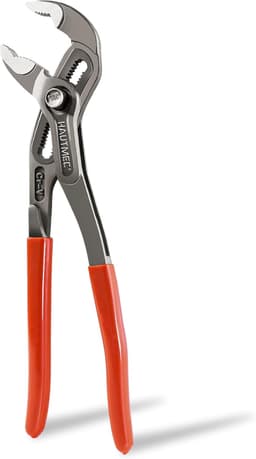
Start with the nut you can see. Blue Spot notes cover a toilet seat, a basin-waste back-nut, an outside-tap hose and a kitchen-tap attachment. The listing opening is still 32 mm. If the collar looks wide, look at the 42 mm or 75 mm lines. The 180 mm HAUTMEC is the compact push-button that parent notes use in tight spaces, and its jaw line is wider than both 250 mm tools here. The only 300 mm listing claims 75 mm and also prints 10 g, so weigh it. A basin tap back-nut up in the deck is often the wrong job for these jaws. A Monument-style basin wrench is the tool for that reach. Chrome versus serrated belongs on water pump pliers vs pliers wrench.

Radiator valves and heating pipe

Checkatrade and similar UK explainers treat a wet radiator valve as DIY if you can isolate the radiator, catch the water, and you are not opening a gas boiler. Housewarm’s picture is still the method: grips on the valve body so the pipe does not twist, a spanner on the nut. A 250 mm pair is the usual length under a radiator, where a 300 mm handle hits the floor and an 180 mm pair runs out of leverage on a painted tail. If the valve is seized, the pipe is corroded, or you cannot isolate it, that is a stop, not a bigger pair. HSE’s split is the one that matters next to a boiler: wet heating pipe can be other trades; the final connection on a gas boiler is Gas Safe. If the pump sits inside the case, put the grips down.

Joints you must still reach

The Water Supply (Water Fittings) Regulations 1999, Schedule 2 paragraph 7, is the access rule. A fitting must not be a concealed fitting. Water Regs UK’s pipework note says the same in buyer language: you have to reach the joint again, inspect it, and remake it without opening a finished wall. Grips that made an olive feel tight do not turn that joint into something you can hide behind plasterboard. An olive in a service void with a removable panel is one thing. An olive taped into a chase and tiled over is another. If you cannot get the jaws back on the nut next year, the joint is in the wrong place. The cheap pair will not be the expensive part of the invoice if a plumber has to chase it out.

When grips are the wrong tool

Grips are wrong when the opening is smaller than the nut, when the nut is a tap back-nut a basin wrench should take, when the face is show chrome and the jaws are serrated, and when the pipe carries gas or enters a combustion case. Gas Safe Register’s home-improvements pages are blunt: gas pipe and boiler connections are not DIY, even if you already own a 300 mm pair. Blue Spot and the HAUTMEC auto pair both print 32 mm. A large plastic cistern nut that looks wider wants the 42 mm or 75 mm lines, not more handle lean. A basin wrench or a named plumber is the step after those limits. The buying guide is where you pick the millimetres before you are already under the bath.

Common questions

Which pair for a basin waste?
Measure the collar. If it sits inside 32 mm, Blue Spot’s 250 mm pair is the household listing with the large unique sample. If it looks wider, the HAUTMEC 180 mm 42 mm bullet is the compact option in this set, or the 300 mm 75 mm claim if you can get that length into the cupboard. Do not take one reviewer’s 52 mm back-nut story as a Blue Spot spec.
Which pair for a toilet cistern nut?
Housewarm puts large plastic cistern nuts on a 300 mm pair. In this set that is the HAUTMEC 300 mm listing with a 75 mm bullet, inspected on arrival because of the 10 g weight line. A 250 mm 32 mm pair is the wrong assumption if the plastic collar is the wide one.
Can I change a radiator valve myself?
Often, if you can isolate the radiator, you are on the water side, and the valve is not seized. Use two tools: grips on the body, spanner on the nut. Seized valves, corroded pipe, and a boiler you then cannot repressurise cleanly are stop points. The final connection on a gas boiler is Gas Safe, not a longer pair of grips.
Can I bury a compression joint if the grips made it tight?
No. Schedule 2 paragraph 7 of the Water Fittings Regulations 1999 stops you treating a joint as a concealed fitting. Tightness is not access. A tight olive is not an accessible joint. Leave a panel or keep the joint in a void you can open.
When is a heating pump still not Gas Safe work?
When you are only on the water circuit and you are not opening a combustion case or a gas union. HSE and Gas Safe still own the boiler connection and anything that carries gas. If the pump is inside the case, treat it as appliance work.
Do I need a basin wrench instead?
Yes, when the nut is a tap back-nut up in the deck and grips only meet it on the tips. A Monument-style basin wrench is a different tool, not a product in this set. Using water pump pliers there is how chrome shrouds get marked.

Related pages

Sources

Public UK sources from the research digest, last checked on 19 October 2026. Shelf prices and star lines are the amazon.co.uk figures in the display file. The price bands are this set, not a market average.

  1. Screwfix: pliers buying guide (retrieved 19 October 2026)
  2. Housewarm: plumbers' grips (retrieved 19 October 2026)
  3. ISO 5743:2021, pliers and nippers, general technical requirements (retrieved 19 October 2026)
  4. ISO 8976:2021, pliers and nippers, multiple slip joint pliers (retrieved 19 October 2026)
  5. Gas Safe Register: home improvements (retrieved 19 October 2026)
  6. Water Supply (Water Fittings) Regulations 1999 (retrieved 19 October 2026)
  7. Consumer Rights Act 2015, goods remedies (retrieved 19 October 2026)
  8. DIY Doctor: chrome pipe (retrieved 19 October 2026)