Tying wire not structural: the drawing still decides

Tying wire holds bars while concrete is poured. It carries no design load. If the lap or coupler is missing from the drawing, more ties will not invent it.
On this page

The mesh is down and every crossing you can reach already has a twist of wire. It looks finished. The drawing says nothing about the overlap where two bars meet. Tying wire not structural is the line that matters before you pour. A tie holds a bar still while the concrete goes in. It does not pass load from one bar to the next, and more twisting will not invent a splice the sheet never specified.
This page is from the Products Compared editorial team. It follows the Concrete Society's public notes on fixing reinforcement, tying wire and couplers, Next Day Steel's installation guide, and BS 7973-2, the British Standard for tying reinforcement. We do not quote that standard, and we have not tested a slab. Prices and review counts are from amazon.co.uk listings, read on 16 October 2026. A qualifying purchase can earn us a commission at no extra cost to you.
In short
Tying wire, and the clips sold for the same job, keep reinforcement from moving during concreting. They carry no design load. Laps and couplers are how force transfers between bars, and both belong on the drawing. If the sheet is blank, ask the engineer. Extra ties, a mesh clip, or a tack weld will not supply the missing connection.
What a tie is for
You are fixing steel so it is still in the right place when the poker starts. The Concrete Society's note on fixing reinforcement describes ties as the means of stopping bars moving while concrete is placed. That duty ends once the concrete has hardened around the bar. The wire is not extra steel area, and a neat row of twists does not make the member stronger.
Next Day Steel says ties carry no design load. Bar diameter, spacing, and the way one bar hands force to another are design decisions. The nipper stops the cage walking when someone steps on it. Extra twists on crossings that were already stable still leave no splice where two lengths need to act as one.
BS 7973-2 is the British Standard for tying reinforcement. Public notes from that practice say the tie holds the bar during the pour and is not the design strength of the member, and that wire ends stay out of the cover. The Concrete Society's tying-wire note names 16 gauge, about 1.6 mm. Hard fence wire snaps in the jaws. Which coil matches a nipper is on the 16 gauge tying wire page.
Ends, the perimeter, and crossings you can leave
The Concrete Society says not every intersection has to be tied. Ends of bars should be tied, because a free end lifts when you walk the sheet. Public practice notes add the perimeter and, for bars up to 20 mm, alternate intersections in the body rather than every cross. That rule of thumb is not permission to skip a lap the drawing has drawn.
Laps and couplers belong to the drawing
A lap is the overlap where two bars lie together so the concrete can pass force from one bar into the next. A coupler joins two bar ends and transfers that force through the fitting. The Concrete Society treats the drawing as the control, and its coupler note presents couplers when bars are large and a long lap becomes awkward. That note is not a catalogue for steel that has arrived short.
Next Day Steel tells installers to follow the engineer for laps, and to ask when the drawing is silent. Cut every bar to the inside of the form and the ends sit butt to butt. You need longer bars, a specified coupler, or an instruction that this joint needs no splice. Twisting the ends together makes a knot, and the concrete still has no bond length.
Cover is specified on the same drawing. Public tying notes tell you to keep wire ends out of that zone. They do not give a cover depth for a footing, a retaining wall, or a garage slab, and this page will not invent one.
Why fifty diameters is not your wall
The Concrete Society illustrates a lap in the order of 50 bar diameters. That picture is long, many times the bar, not a hand's breadth where two ends touch. It is not a length to mark on your wall. Until a length is written down, leave the bars long enough that a proper lap can still be made, or stop.
A clip or a weld is not the splice
Clips in that tying-wire note are a faster way to hold a crossing. They remain ties. A spring clip or a packet labelled for mesh does not become a coupler because it grips. Couplers are made for a stated bar diameter and a stated system, and they go where the drawing names them. If the packet does not match that system, you are holding a position fixer.
The usual miss is a short overlap and a box of mesh clips. The bars look joined, they are too short to act as a lap, and the clip was never asked to transfer load. The pour hides it.
Tack welding usually appears after the wire has snapped. The Concrete Society notes that tack welding can affect the steel locally. This article will not describe a weld. If the coil is the wrong temper, go back to annealed 16 gauge and leave the bar unwelded. A rebound hook or a nylon cable tie can hold a bar for a moment, and neither is the splice. Which tool actually cuts is on concreters' nippers versus a wire twister.
Signs you should stop
Stop when the drawing does not show the lap, the coupler, or the cover. Ask before you cut the last bar to length. A steel fixer or the engineer can mark the overlap, specify a coupler, or confirm that the joint is not required. Stop when the cage is a beam or a column. Links, laps, and starter bars have to land where the drawing puts them. Ties that make the cage feel stiff do not check those positions.
Stop when the concrete has to hold water, or when a face you will see has no wire named. A retaining wall, a basement, or a tank is intolerant of bars that have drifted into the cover, and an exposed soffit can show rust from ordinary black tying wire. Stop when the bars move underfoot in the splice. Tie the ends, the perimeter, and any lap the drawing shows. If a link slides, concrete will lock the steel where the pour pushed it.
What the nipper still has to do well
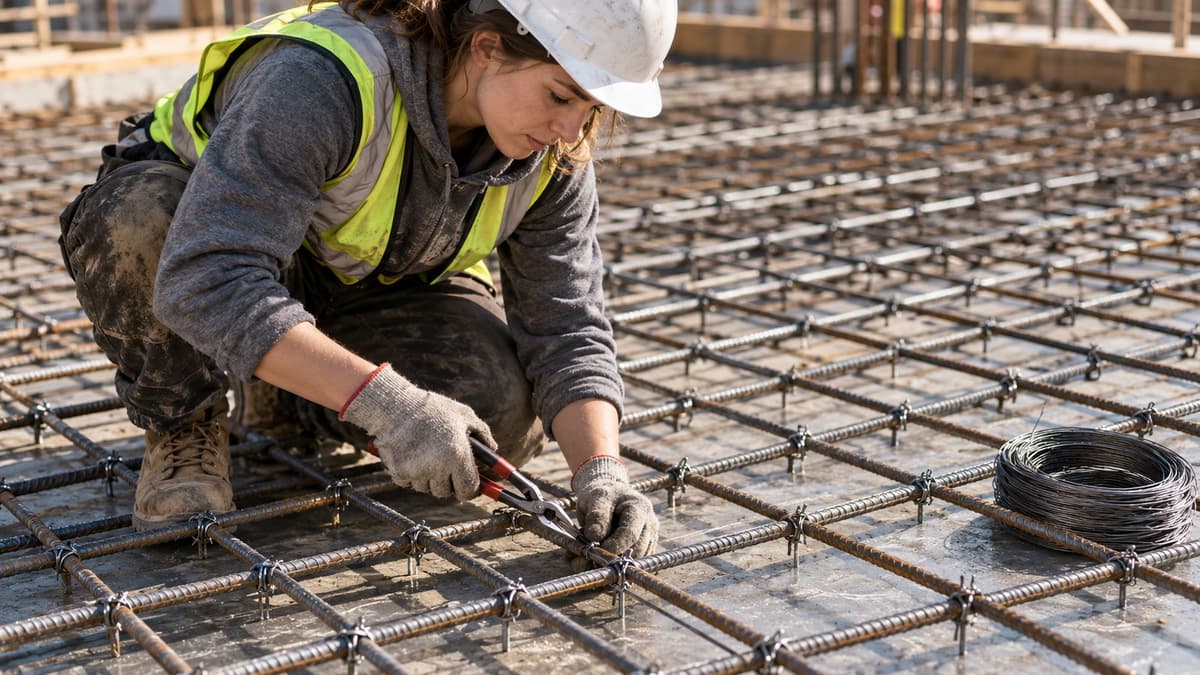
A loose wrap still lets the bar migrate during the pour. With a cutting nipper the usual method is a slash tie: the wire goes around the crossing, the jaws spin it tight, and the same edges cut the tail. The sequence is on how to tie rebar with nippers. A long tail in the cover undoes the note about wire ends.
In the binding pliers comparison the listing that states this job is the KNIPEX 99 11 300, ASIN B00202HMWU, at £26.99. The amazon.co.uk bullets say the wire is twisted and cut in one pass: 300 mm, 537 g, a 25 mm cutting width, and DIN ISO 9242 named on the listing rather than a certificate we inspected. Knipex puts medium-hard wire at 3.8 mm for this pattern, so 1.4 mm and 1.6 mm annealed tying wire sits inside that line. The star line is 4.5 from 1,073 reviews, and written UK comments include snaps and edges that do not meet.
Length is the limit. Trade notes put about 250 mm at the centre of a day's leverage and about 200 mm inside tight formwork. A 300 mm nipper suits an open mesh sheet and is the wrong reach in a narrow trench. Knipex states about 25 percent less effort than its own conventional nipper of the same length. That shortens the squeeze, not the handles. The concreters' nippers buying guide covers length. It does not make the tool a substitute for a lap.
The Pissente end-cutter, at £10.46, claims a cutter, but the size lines disagree and the file is three ratings. The Zeromall hook, at £7.99, does not say it cuts. None of the three adds capacity to the steel. The plastic handles are not described as insulated. Wear eye protection when a tail lets go, and retire a pair whose edges no longer meet. Tie the laps the drawing specifies, then stop. Where a connection is required, it is a lap or a coupler with a length written down.
Common questions
Do ties make the steel stronger?
What is a lap?
When is a coupler used?
Can I invent a lap if the drawing is blank?
Are mesh clips the same as couplers?
What if bars move when I walk on them?
Who signs off a beam cage?
Is tack welding a DIY option?

Products Compared publishes British-English buying guides based on amazon.co.uk listings and public UK sources. We do not run a lab and we do not invent test scores.
Related articles
How many rebar intersections to tie
Perimeter and laps are tied. Alternate crossings in a slab body follow a different rule, and the drawing still sets the splice.

Turn tying-wire tails inward
A tail left in the cover stains the face and steals the concrete the bar needs. The twist belongs against the steel.

Why cheap rebar twisters fail
A rebound hook that will not hold the wire, and does not cut it, is a different tool from a concreters' nipper.