How many rebar ties: perimeter, laps, then the body
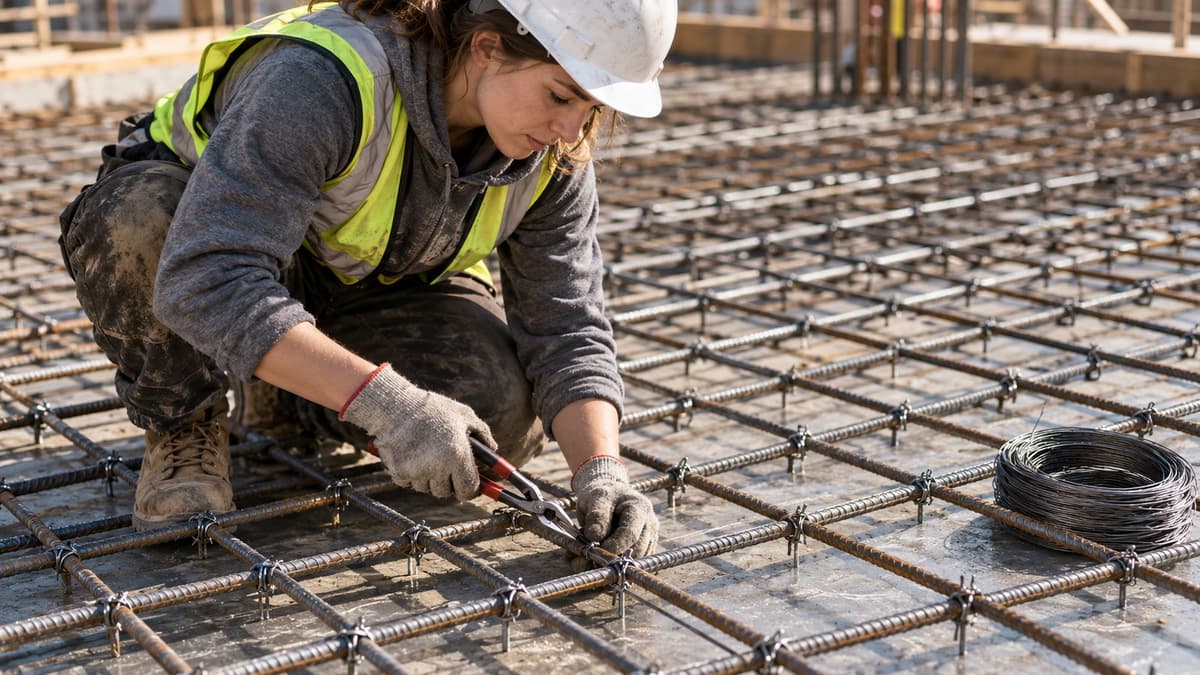
Tie every crossing on the perimeter and at laps, then alternate crossings in the body of mesh. Columns and a stricter drawing can still demand more ties.
On this page

The mesh is down, the coil is lighter than you expected, and you are still only halfway across the sheet. That is the moment how many rebar ties stops being a vague site habit and becomes a pattern you can walk. Tie every intersection on the perimeter and along every lap. In the body of the sheet, for bars up to and including 20 mm, tie alternate intersections. Columns, links, and any drawing that asks for more sit outside that split.
This page is from the Products Compared editorial team. It follows public UK notes on BS 7973-2:2001, the Next Day Steel installation guide, the Concrete Society's notes on fixing reinforcement, and a commentary such as Structville that summarises tying practice. We read the amazon.co.uk listings in our binding pliers comparison on 16 October 2026. We have not laboratory-tested a cage, and we do not quote the paid text of the British Standard. If you buy through our links, a qualifying purchase can earn us a commission at no extra cost to you.
In short
Tie the edge of each sheet and every lap at every crossing, then tie alternate intersections in the body where the bars are 20 mm or smaller. Column links and a stricter drawing ask for more. No published summary we used gives a tie count for a whole sheet, so this page will not invent one.
How many rebar ties on a slab or wall
On fabric in a slab or a wall, how many rebar ties you make is a pattern with two densities. Next Day Steel tells fixers to tie alternate intersections in the body of the mesh, and every intersection on the perimeter and at laps. Commentaries that cite BS 7973-2:2001 put the same split in bar sizes: every intersection on the perimeter, and alternate intersections for bars up to and including 20 mm. Mesh wires on a domestic slab sit inside that 20 mm line, so the body of the sheet is every other crossing once the edge is finished.
Alternate means a tie, a gap, a tie, in both directions, so the sheet is held on a grid. A handful of twists where you are standing leaves long runs free to creep when a barrow crosses the steel. BuildWiz keeps the perimeter and lap rule and is looser in the body, talking of every second or third intersection. Where that disagrees with the published summary of the standard, use alternate intersections.
The Concrete Society describes fixing as holding the steel still while the concrete is placed. A twist does not set the lap length or the cover. Those stay on the drawing.
A garden shed base is still a slab. Tie the four edges of each sheet and every crossing on the lap, then alternate intersections through the middle. The summaries we used give neither a tie total nor a percentage of ties per sheet, including on a sheet around 4.8 m.
Perimeter bars tied, and every lap
Start at the perimeter, because that is the line people skip to save wire. Every intersection on the edge gets a tie, including the corners. A band of ties in the centre, with the outside wires resting only on the chairs, lets the sheet creep when the barrow crosses it and when the poker goes in.
A lap is the other full line. Where two sheets overlap, or two bars overlap, tie every intersection along that overlap. Next Day Steel groups laps with the perimeter. This page will not give you the lap length in millimetres. If the drawing shows the overlap, tie every crossing in that zone. If nothing marks the lap, ask before you treat a short overlap as enough.
Keep the cut tails out of the cover. Next Day Steel tells fixers to turn tails inward. The Concrete Society treats wire left in the form as a stain, cosmetic rather than a structural failure on its own, and it still shows on a power-floated slab. The hand sequence is on how to tie rebar with nippers. The coil is on 16 gauge tying wire. Finish the untied edge crossings before you open another coil for the middle.
Beams and columns are tighter
A cage is not a sheet laid flat. Next Day Steel says links are normally tied at every junction with the main bars. Commentaries citing BS 7973-2 say column verticals are tied at every link. Alternate intersections, the slab rule for bars up to 20 mm, is the wrong density on that cage. A link tied on one face and left open on the other can rotate when you lift the cage or when the concrete rises.
On a beam, the crossings you can reach from the top are the ones that get tied, and the bottom bars stay loose. If the drawing shows the links and says nothing about which junctions to tie, ask. A beam, a column, or concrete that has to hold water goes to a steel fixer when you do not already have the fixing note. A shed base with a merchant detail is a different job from a transfer beam.
The tie holds position. Load travels through the bar, the lap, or the coupler the drawing names. Twists do not turn tying wire into a splice. If you cannot tell a lap from two bars that merely touch, read the schedule before you spend another coil there.
Larger bars and a stricter drawing
Bar diameter changes the body spacing only past a line the commentaries state. Up to and including 20 mm, alternate intersections remain the body rule once the perimeter is tied. From 25 mm upwards, those commentaries allow wider centres, not exceeding 50 times the smallest bar. On a 25 mm bar that ceiling is 1,250 mm. That is a commentary reading, not the paid text of BS 7973-2:2001, and the drawing can be tighter.
The wider spacing does not cancel the perimeter, and it does not apply to 10 mm, 12 mm, 16 mm or 20 mm bars. Tying a 25 mm bar more often than every 1,250 mm is still inside the commentary. Tying it only at the ends, with a longer clear run, is outside it. If a bar on the schedule matches neither rule, ask and leave it untied.
A stricter specification outranks the default. Next Day Steel says the specification can ask for more ties than the ordinary pattern. A note that says all intersections, or a water-retaining detail, includes the body of a sheet where alternate ties would otherwise have been enough.
What a sheet will not tell you
Sheet size does not convert into a tie total. The summaries we used never turn length, width and pitch into a number of ties, and doing that sum yourself still misses the laps. Walk the perimeter, walk the laps, then walk alternate crossings in the body. A merchant sheet around 4.8 m has no published tie total to copy.
The nipper does not set the pattern. The binding pliers comparison asks which listing twists annealed tying wire and which one cuts it. The top pick is the KNIPEX 99 11 300, listed at £26.99, with 4.5 from 1,073 amazon.co.uk reviews. The bullets say the wire is twisted and cut in one pass, and the page names DIN ISO 9242. Written comments also include snaps. It does not decide which crossings to tie.
The Zeromall hook in that comparison, at £7.99, does not say it cuts. You can spin a loop that is already a tie, and you still need a cutter or pre-cut ties. That split is on concreters' nippers versus a wire twister. Wear eye protection when you cut. The Health and Safety Executive treats the eyes as a projectile risk, and a tying-wire tail is a piece of steel leaving the jaws.
The Concrete Society names 16 gauge annealed wire for a handmade tie, about 1.6 mm on the UK pages we used. Hard fence wire fights the twist. If the drawing is silent on a beam, a column, or any loaded member, ask a steel fixer before the pour.
Common questions
Must every crossing on the mesh be tied?
What about the edge of the sheet?
What about a lap?
Are columns different from mesh?
Can I tie less often if the bars are large?
How many ties does a shed base need?
What if the specification is stricter?
Does a missed tie fail the slab?

Products Compared publishes British-English buying guides based on amazon.co.uk listings and public UK sources. We do not run a lab and we do not invent test scores.
Related articles

Turn tying-wire tails inward
A tail left on the shutter can stain the face and sit inside the cover. Bend the cut ends back into the cage.

When a wire tie is not the connection
A tie holds the bars while you pour. The lap or the coupler on the drawing is what transfers the load.

Black, galvanised, or stainless tying wire
Black annealed wire is the ordinary coil inside a pour. An exposed face can need a wire the drawing names.