Tying wire tails rust: fold the ends into the cage

Tying wire tails rust if they face the form. Turn the ends into the cage so the face stays cleaner and the cover on the drawing is not taken by a stub.
On this page

The mesh is tied, the shutter is up, and the pour is booked for the morning. Along the edge of the sheet, tying wire tails rust if you leave them pointing at the plywood. They look small beside a bar. They are the part of the tie the concrete will either bury inside the cage or press into the cover the drawing set aside for the steel.
Turn those ends inward, into the cage, as you finish each tie. Next Day Steel's installation guide tells fixers to make that bend. A tail left on the form can mark the face, and it can sit in the cover the bar was meant to keep.
This page is from the Products Compared editorial team. It follows that Next Day Steel note, the Concrete Society's fingertip on local surface rust staining, and commentaries on BS 7973-2 about projecting ends and water-retaining work. Prices are from amazon.co.uk listings saved on 16 October 2026. A qualifying purchase can earn a commission at no extra cost to you.
In short
Turn tying-wire tails into the cage, away from the shutter and away from any face that will be seen. Tying wire tails rust when they are left in the form. The Concrete Society treats that mark as cosmetic. A tail in the cover is a separate problem, and on water-retaining work it is treated as a leak risk. The drawing sets the cover.
Where the tail sits after the cut
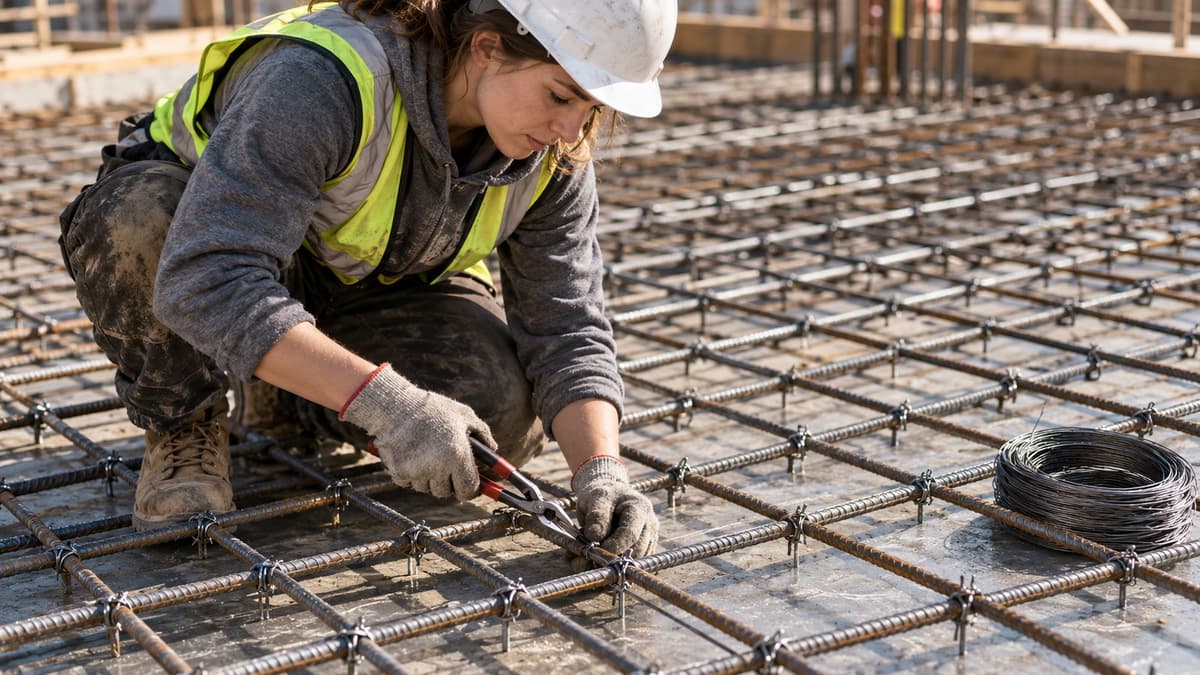
A slash tie and a figure-of-eight finish in the same place. You twist until the crossing holds, then you cut. What remains is a short pair of ends, and their direction is the last decision of that tie. Point them at the shutter and they occupy the concrete between the bar and the face. Point them back into the mat and the pour buries them with the steel. Next Day Steel tells you to turn the tails inward with the nipper, or a gloved finger, before you move on. Saving those bends for a walk around the sheet is how the edge ties stay proud. Once the shutter is tight against them, folding a tail means easing the form.
The usual miss is a proud end left so you can see which crossings are tied. After the pour it is a brown line, or a glint of wire in the arris. Cut close to the twist, then fold what remains into the cage. A tail you can still hook with a fingertip, once the shutter is offered up, is still in the cover zone. The twist itself is on how to tie rebar with nippers.
Why tying wire tails rust on the form
A tail that faces the form can cause two different problems. The first is the mark. The Concrete Society's note on local surface rust staining says tying wire left in the formwork stains the concrete, and the Society calls that staining cosmetic. On its own, it is not a loss of long-term structural performance.
The second problem is cover. Commentaries on BS 7973-2 say projecting ends must not enter the cover, the concrete between the bar and the outside of the element. A wire across that zone puts steel closer to the weather than the drawing allowed, and the same stub can hold the shutter off a spacer so the bar sits shallow. This page states no cover in millimetres. On water-retaining work, a tail in the cover is a leak risk: a basement wall, a tank, or a slab specified to stay dry. A wire breaking the surface belongs with the person who specified the cover, before anyone grinds the face.
Black wire on a face you will see
Black annealed tying wire is the ordinary coil for steel that will sit inside the concrete. UK merchants sell it around 1.6 mm and around 1.4 mm. The dark finish is not a coating you should trust once a tail touches the shutter. Next Day Steel points to galvanised wire near an exposed face. Galvanising changes how readily the tail marks the paste, and it leaves the geometry alone, so turn a galvanised end inward as well.
Stainless tying wire is a specification, often a thinner wire on exposed work, not an upgrade for a buried footing. Changing the coil because the face might show, without that note, can give you the wrong diameter. If the face will be seen and the wire is unnamed, ask before you tie. The merchant split is on 16 gauge tying wire. Black wire inside a buried cage remains the usual coil when the drawing is silent.
When the drawing overrules the habit
The habit is short: cut, fold inward, keep the ends off the shutter. Cover, laps, and the tying wire belong to the designer. Shed bases do not set the cover for a beam. If the drawing is missing, get one, or hand the cage to a steel fixer, before the concrete is ordered. This article states no millimetre of its own.
On fair-faced concrete, and on a power-floated floor you will leave bare, a cosmetic stain is still a mark you walk past. Galvanised wire near the exposed ties, with the tails turned into the cage, matches the Next Day Steel note. Follow the specification when it names stainless. A spacer holds the bar, and a tail propping the shutter off it has undone that spacer. Where the concrete has to hold water, check every edge tie after the shutter is up and before the pour. Public notes on BS 7973-2 tie the perimeter and, for bars up to 20 mm, alternate intersections in the body. Your drawing can require more.
Cut close, then fold, and know when to stop
Cut the tails close to the twist, then bend the stubs inward. If the twist unwinds, the crossing is loose and you tie it again. Flush means no projection toward the form. Taking the twist off the bar leaves a loose piece of wire, and the bars can creep while you pour.
A disc on a proud tail, after the concrete has hardened, cuts the cover you were trying to keep, and the rust may already be in the paste. Where a tail has broken structural concrete, or anything specified to hold water, tell the person who owns the drawing before you cut the face. A faint streak on a shed slab is the case where cosmetic is the Society's own word.
Put eye protection on for the cut. The Health and Safety Executive treats the eyes as needing protection from flying particles, and a tying-wire offcut is that kind of piece. Stand so the end flies away from your face. Hand the cage on when you have no drawing for cover, when the element is a beam or a column, when the concrete has to hold water, or when a visible face has no wire specified. The listing that claims the close cut is the KNIPEX 99 11 300, at £26.99 on amazon.co.uk: 300 mm, twisting and cutting binding wire in one pass, 4.5 from 1,073 reviews. Trade notes still centre about 200 mm in tight formwork, and the long handle does not fold the tail. Length against a shutter is on the concreters nippers buying guide, and the row sits in the binding pliers comparison.
How we prepared this guide
The Products Compared editorial team used Next Day Steel's installation guide for the inward bend and for galvanised wire near an exposed face, and the Concrete Society fingertip on local surface rust staining for the cosmetic judgement. Commentaries on BS 7973-2 supplied the cover point and the leak risk on water-retaining work. The standard text is not reproduced. The KNIPEX price, length, and review count are from the amazon.co.uk listing saved on 16 October 2026. There was no laboratory test and no site pour.
Common questions
Which way should tying-wire ends point?
Will a rust stain mean the slab has failed?
Should I cut tying-wire tails off flush?
Is black wire the problem, or the direction of the tail?
What about a basement wall?
Can I grind proud tails after the pour?
Who decides the concrete cover?
Does stainless wire change which way the tails point?

Products Compared publishes British-English buying guides based on amazon.co.uk listings and public UK sources. We do not run a lab and we do not invent test scores.
Related articles

Black, galvanised, or stainless tying wire
Black annealed wire suits steel buried in the pour. Near a face you will see, the drawing decides galvanised or stainless.

When a wire tie is not the connection
A tie holds the bar where the drawing put it. It does not take the place of a lap or a coupler when the steel has to carry load.
How many rebar intersections to tie
Perimeter crossings and the body of the mat are different jobs. The drawing, and the usual alternate-tie habit, decide how many you tie.