PUWER hand tools: what the site box still requires

Hand tools kept in a site box count as PUWER hand tools at work. What HSE expects on suitability, maintenance and eyes, and where a shed base differs.
On this page

You open the site box and the concreters' nippers are there, next to the tying wire, because they always are. PUWER hand tools are easy to file as only a pair of pliers until a jaw has sprung or a wire end flicks off the cut. If those nippers are provided for work, the Health and Safety Executive treats them as work equipment: suitable, safe, maintained, and used by people who have been instructed. A householder tying one shed base is not that reader.
Products Compared checked HSE's public PUWER and PPE pages, the L22 note on toolbox tools, and the amazon.co.uk listings in our binding pliers comparison. There was no laboratory test. A qualifying purchase can earn a commission at no extra cost to you.
In short
Hand tools used at work sit inside PUWER, and HSE's L22 guidance counts toolbox tools as work equipment. Formal inspection is often unnecessary for a simple pair of nippers when maintenance keeps them safe, which is not a reason to keep a sprung jaw or edges that no longer meet. Plastic handles are not electrical insulation, eyes need protection that matches a flying wire end, and this page is not legal advice.
Why site-box pliers are work equipment
The Provision and Use of Work Equipment Regulations 1998, which HSE shortens to PUWER, cover equipment people use at work. Equipment provided for use at work has to be suitable for the job, safe for use, maintained in a safe condition, and used only by people who have had adequate information, instruction and training. Nothing in that list waits for a motor, a guard or a plug.
HSE's Approved Code of Practice L22 settles the toolbox question. Tools kept in a box and issued for work are work equipment. Concreters' nippers, an end cutter, or a spare pair in the bag are in scope if the crew uses them on the job you are paying them to do. Calling them personal kit does not move them outside that sentence. Someone still has to say they suit annealed tying wire, they still cut, and the user knows the limits. Presence in the box is not that decision.
Who the duty sits with
PUWER binds employers who provide equipment for work, and self-employed people who are in scope. You do not settle that from a business card. A sole trader fixing steel on a client's job, with other trades around the pour, should read HSE's pages on who the regulations cover before treating the nippers as a private matter. This article will not classify your contract from one sentence.
If you employ a fixer, even for a short run of mesh, the nippers you put in their hand are your work-equipment problem. Experience is not a substitute for a pair that still cuts, or for telling a new starter that these handles are not for live cable. A friend you pay for the day is not outside the duty because you used the word friend.
This guide covers the United Kingdom, including Northern Ireland, and not the Republic of Ireland. If people use the pliers because you engaged them to do the work, start from the workplace duty. Do not borrow the shed-base distinction as a way to duck a crew.
Suitable for tying wire, not live cable
Suitable, in HSE's wording, means suitable for the intended use. You catch annealed tying wire around a crossing, twist until the bars stop sliding, and cut the tail. A concreter's nipper does that. It does not cut the rebar, and it is not an insulated electrician's plier. Plastic coating is for grip. These nippers are not EN 60900 tools. Do not take them to a live conductor.
A rebar twister that does not cut leaves the tails long. Our page on nippers or a rebar twister sets out that split. A tool that cannot finish the tie is the wrong tool, however cheap it was.
On the amazon.co.uk listing, the KNIPEX 99 11 300 was £26.99, with 4.5 stars from 1,073 reviews: a 300 mm high-leverage nipper with plastic-coated handles that twists and cuts the wire in one pass. DIN ISO 9242 on that page is a construction-pincers line, not a certificate we inspected and not an electrical rating. Review texts also report snaps and edges that do not meet. At 300 mm it is a long reach on an open cage and awkward in tight formwork. The concreters' nippers buying guide matches length to the job.
Maintenance instead of a ritual inspection
Formal inspection is frequently unnecessary for simple hand tools, provided maintenance keeps them safe. That is not a reason to leave a tired pair in the box. The jaw should open and close without grit. The cutting edges should meet. A scrap of that day's tying wire should part in one squeeze. Soft annealed wire is the test, not a nail and not the bar. Harder stock is the wrong job, which the tying-wire diameter page covers.
Wipe slurry out of the joint before it sets, then oil the pivot lightly. Oil on top of cement paste does not free a seized pin. Retire the pair when the jaw has sprung, the edges have chipped, or the cut folds the wire. The HSE material used here states no weekly interval. The check takes about a minute when the pliers come out of a wet box. Maintenance is the control. An empty sheet is not.
Eyes when a wire end flies
Cutting tying wire throws short ends. Choose spectacles or goggles that match the impact, not glasses that merely look like site kit. Safety spectacles with a stated impact rating suit flying ends on a dry cage. Goggles earn their place when slurry or grinding leaves a gap. Sunglasses from the van are not that control. At work, provide the protection, including a pair that fits over prescription glasses.
HSE's PPE pages support protection against projectiles at work. They do not prove a penalty for a householder who cuts one tie without glasses. If the site assessment says eyes are exposed, spectacles or goggles matched to impact are the control.
A shed base is a different reader
A householder tying mesh for one shed base, with no employees and not working for a client, is not the contractor this article instructs. Copying workplace duties onto a private Saturday and announcing an offence goes further than these sources will go. The wire can still hit an eye, so impact glasses and a pair that cuts remain sensible. On the material gathered here, they are not proof of the same legal breach.
The boundary moves as soon as the activity is work. A paid shed base, a labourer, or self-employed work in scope with other people at risk is not answered by calling it a garden. Where you are unsure, read HSE's current pages. Nothing here advises a site in the Republic of Ireland.
A stiff new pair and a new fixer
A nipper that arrives stiff is not ready for a cage. Wipe the pivot, put a drop of light oil on it, and work the handles, then cut a scrap of the tying wire specified for the job. If the action stays notchy or the edges miss, do not issue it. A stiff pair is a suitability problem on day one. The listing can be right and the individual pair still wrong.
A new fixer needs to see the wire caught, twisted and cut, and where the tail goes so it does not steal cover. The hand sequence is on how to tie rebar with nippers. That page is a method, not a certificate. These handles are not insulated, the nippers do not cut rebar, and a pair that folds the wire comes out of the box. Five minutes beside an experienced fixer starts a simple tie. It is not competence for a beam.
Common questions
Do pliers count as work equipment under PUWER?
Must I inspect nippers formally?
What maintenance is enough for nippers at work?
Do I have to provide eye protection for cutting wire?
Are plastic handles on nippers electrically rated?
Does PUWER apply if I tie a shed base in my own garden?
Who trains a new fixer to use the nippers?

Products Compared publishes British-English buying guides based on amazon.co.uk listings and public UK sources. We do not run a lab and we do not invent test scores.
Related articles
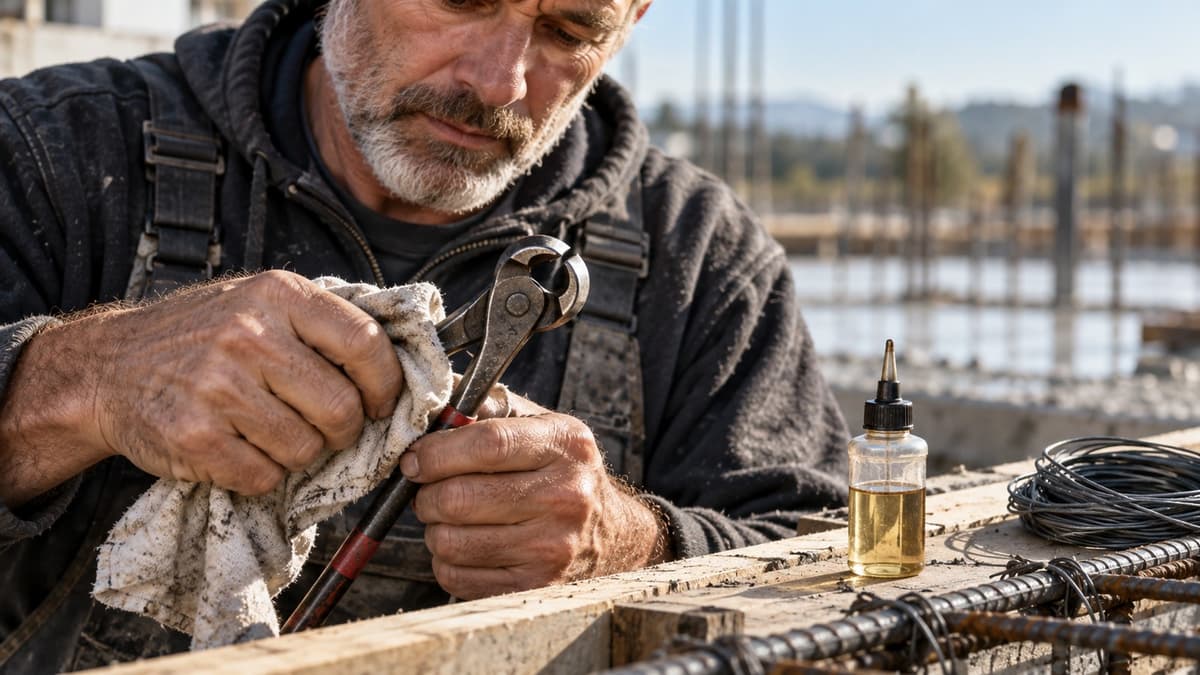
Oil, wipe, and retire a pair of nippers
What to do when slurry seizes the joint, and when edges that no longer meet mean the nippers leave the box.

High-leverage nippers and ordinary end cutters
Why a high-leverage joint changes the squeeze, and why length still decides the pair in tight formwork.

What concreters' nippers cost in the UK
How amazon.co.uk shelf prices for concreters' nippers sit against trade-counter prices in the UK.