Concreters nippers maintenance: wipe, oil, then retire
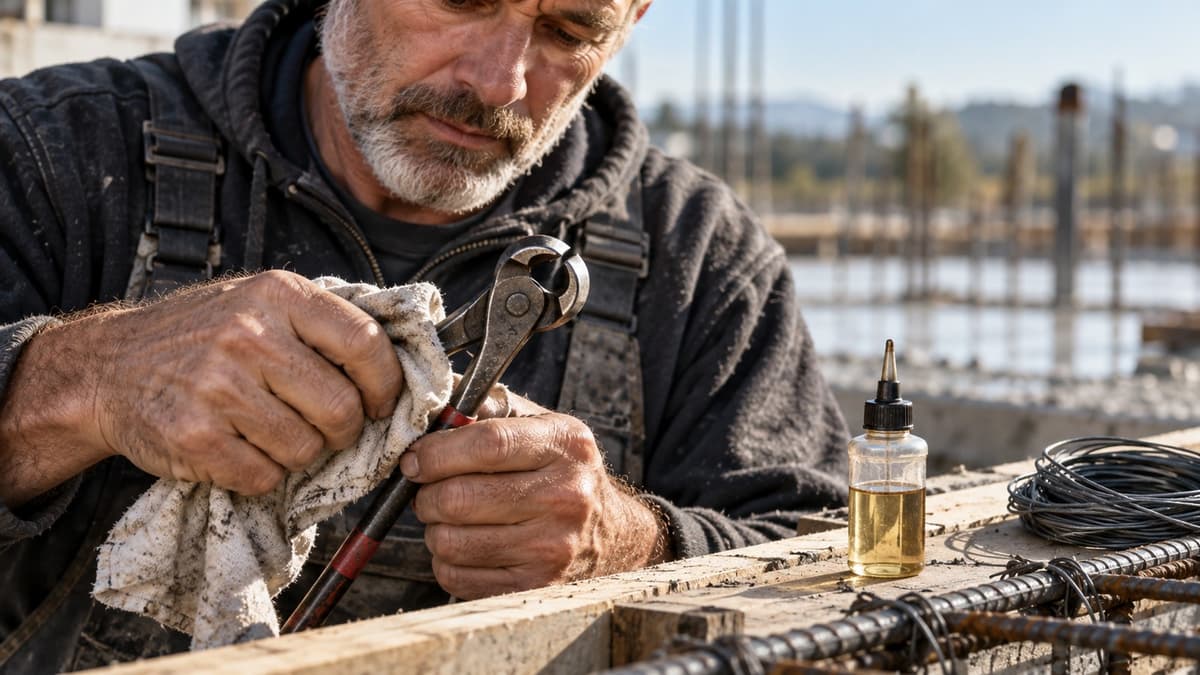
Wipe concrete slurry off concreters' nippers, oil the joint with light machine oil, and retire a pair whose edges no longer meet before the next pour.
On this page

The nippers worked on Friday. On Monday the joint is gritty, the handles will not close, and the tying wire folds instead of parting. Concreters nippers maintenance is a wipe and a drop of oil, done before the slurry sets in the pivot. It will not bring back edges that no longer meet.
This page is from the Products Compared editorial team. We used amazon.co.uk listings, including the KNIPEX 99 11 300 at £26.99 with 4.5 stars from 1,073 reviews, plus public care notes from Tooled-Up, Wonkee Donkee, and the Knipex family page. We did not run a lab test, and we did not invent an oil grade beyond the light machine oil those notes name. A qualifying purchase through a link can earn us a commission at no extra cost to you.
In short
Wipe concrete off the cutting edges before you oil anything. Put one drop of light machine oil on the joint, then store the nippers dry. Retire a pair whose edges no longer meet, whose head has opened, or whose joint stays stiff after a proper clean. A file is not a promise that a hardened edge will cut again.
Wipe the slurry off before you oil
Cement paste is what locks a concreters' nipper. It sits in the pivot, dries overnight, and turns a free joint into something you have to lean on. Tooled-Up's care note starts with the edges: wipe the concrete off before you think about oil. Oil on wet slurry makes a grinding paste, and you feel that as stiffness the next time you twist a tie.
Do the wipe while the paste is still soft, at the end of the day or mid-afternoon on a long mesh pour. Open the jaws and wipe the cutting edges, the flats behind them, and the gap around the rivet. A dry rag is enough if you catch it early. A stiff brush helps where grit has packed in. If you rinse, shake the water out and dry the metal before any oil goes on.
Stop if the joint is already set solid. Forcing the handles to crack dried slurry can spring the head, and that pair is then finished as a maintenance job. A jaw carrying slurry and then oil prints both onto the shutter, so the only thing you add is a small drop at the pivot. Length and the cut are set out in the binding pliers comparison.
What the finish is asking for
Wonkee Donkee's coating note says black phosphate is porous and needs oil if it is to resist rust. A dry phosphate surface after a wet day will freckle even when the edges still look sharp. Knipex describes atramentised bodies as part of the rust protection on this family, with hardened cutting edges. That dark coat is not a paint you wire-wheel off. The family page we used does not give a home sharpening method, and it does not name an oil viscosity.
Polished jaws need more care, not less, because there is no porous coat holding a film. Chrome can chip, and a chip rusts at the edge of the plate. If the nose is bright and the legs are dark, oil both.
The KNIPEX 99 11 300 in our comparison is the 300 mm high-leverage pattern at £26.99, 537 g, with a 25 mm cutting width and plastic-coated handles. The listing names DIN ISO 9242. That is a claim on the amazon.co.uk page, not a certificate we checked. The handles are a grip, not insulation for live work. Written comments include stiffness, edges that do not meet, and snaps. A dripping tool runs oil onto gloves and tying wire.
A drop on the joint, then dry storage
Light machine oil is the phrase the trade notes use. Tooled-Up's note is a drop on the joint, then dry storage, and MyToolShed sits in the same place. Put the drop on after the wipe, with the jaws slightly open. Work the handles a dozen times and wipe what squeezes onto the cutting edges. The oil comes second, after the grit is gone.
There is no published hour count. Wipe after a day in slurry, and add oil when the joint looks dry or has been rained on. Keep the pair in a pouch or the site box, not on the shutter. Rain strips the film off phosphate and lets paste set in the rivet. Stiffness within a few days is a theme in written UK comments. It is not proof that every nipper fails on day three.
A water-displacing spray can free a seized pivot and then evaporates. Follow it with light machine oil. Do not soak the tool and cut beside a form, or the jaws will smear oil onto the shutter. If the nippers are used at work, hand tools are work equipment under PUWER and have to stay in efficient working order. This page is not legal advice. A pair that will not close comes out of service before the next pour.
Edges that no longer meet
Oil fixes friction. It does not close a gap. Hold the nippers up to the light. If the cutting edges miss, tying wire crushes and a tail stays attached. More oil changes nothing.
Written comments on the amazon.co.uk listing for the 300 mm Knipex report blades that do not meet, alongside stiffness and snaps. The star line is 4.5 from 1,073 reviews, and it is not a record that every pair stays true. A gap can come from a sprung head, a loose rivet, or a file that has already been here. Annealed tying wire at about 1.4 mm or 1.6 mm sits inside the 3.8 mm medium-hard line Knipex publishes for this pattern. If that wire will not part, suspect the tool.
Merchant pages mention a fine file or a professional sharpen. Treat that as their guidance, not a method we measured. Knipex does not publish a home procedure on the page we used, and the edges are described as hardened. Filing until the jaws no longer meet leaves you with levers. Stop if the edges miss, if the head has opened, if the rivet rocks, or if there is a crack. Trade notes centre about 250 mm for everyday leverage and about 200 mm in tight formwork. The buying guide sets that choice out.
A twister is not maintained like a nipper
A rebar twister is a hook on a shaft. You catch the wire and spin it. It has no cutting edge and no pivot that shears the tail. It fails when the hook comes off, bends open, or will not hold the wire. Oil on the shaft will not put a hook back. A detached hook is a replacement. If the hook is still on and only dirty, a wipe is enough. There is no hardened jaw to ruin with a file.
You cannot shear a tie with a hook, so the tail stays long and can steal cover. That is a tying problem, set out in how to tie rebar, not a joint you oil. The choice of tool is in nippers or a rebar twister. Use the nipper when you need the twist and the cut in one squeeze. Dry a hook that has been in slurry, because the bend rusts and snaps.
When you retire the pair
Keep the nippers while three things are true. The edges meet along the cut. The joint closes with one hand after a wipe and a drop of oil. The head is closed, with no crack and no sideways rock at the rivet. Retire them when any one of those fails. Edges that miss will fold 1.6 mm tying wire all afternoon, and forcing a stiff joint is how handles snap.
A quiet star line is not evidence on a short listing. The Pissente end cutter at £10.46 has three amazon.co.uk reviews, so a pair that arrives with jaws that miss is a return, not a sharpen. Take the dead pair out of the box so nobody uses it for the easy ties.
Match the replacement to the job in the wire diameter guide. A 300 mm high-leverage nipper suits open mesh and is the wrong length in tight formwork, where about 200 mm is the usual note. Check the edges when the parcel arrives, before the pair sees slurry.
Common questions
How often should I oil concreters' nippers?
Can I sharpen concreters' nippers myself?
What if the nippers are stiff after a few days?
Does a phosphate finish need oil?
When should I throw concreters' nippers away?
Will oil fix a twister hook that fell off?
Should I leave concreters' nippers in the rain?
Is WD-40 the same as light machine oil?

Products Compared publishes British-English buying guides based on amazon.co.uk listings and public UK sources. We do not run a lab and we do not invent test scores.
Related articles

Why cheap rebar twisters fail
A hook that comes off is a replacement, not a joint you can oil back into shape.

PUWER and the pliers in a site box
Hand tools used at work are work equipment, so a stiff pair is a maintenance item.

High-leverage nippers and ordinary end cutters
The extra pivot helps on tying wire. It does not repair edges that no longer meet.