Independent comparisons. We may earn from shop links. More info

How to repot a moth orchid

Updated: October 2026

Bark that used to crumble between your fingers now feels like a wet sponge, or roots are climbing the rim and the plant wobbles. That is the usual moment to repot a moth orchid in a UK home: the medium has broken down, or the root ball has outgrown the container. How to repot a moth orchid is a refresh of air around the roots and a chance to cut dead tissue. It does not cure crown rot on its own. Pot listings, if you need a new container, are in our [orchid pot comparison](/hub/plant-accessories/orchid-pot).

Bark that used to crumble between your fingers now feels like a wet sponge, or roots are climbing the rim and the plant wobbles.

Our top picks

On this page

When to repot

Plan on roughly every two years for a healthy moth orchid in bark, or sooner if the mix collapses and holds water like peat. Firm green or silver-tipped roots mean the plant can cope with disturbance. Mush at the crown, a foul smell, or leaves yellowing from the base need more than a larger pot. Spring is forgiving in many UK homes, but a late repot is still better than anaerobic bark. Do not use a sealed decorative cachepot as the only container. Keep a slotted grow pot inside an outer shell. That split is on clear plastic vs ceramic orchid pots.

Step by step

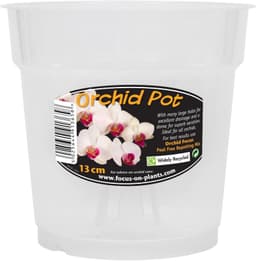
Set aside fifteen to twenty minutes. You need a clear pot sized to the trimmed root ball, not the leaf span, plus fresh orchid bark, clean secateurs and tepid water. If the photos do not show base holes, do not assume they will appear later.

Lift the plant and clear old bark

Water lightly a day ahead if the bark is bone dry and clings. Slide the plant out and rinse old compost away under lukewarm water, keeping live roots attached. Work over the sink. Slightly moist mix comes apart more easily than dust-dry chips.

Set the base and fill

Hold the plant so the stem junction sits at the same depth as before, above the bark surface. Fill around the roots with fresh bark and tap the pot to settle the mix. Do not pack it like houseplant soil. If the plant leans, reuse the old stake until new roots grip.

Soak, drain, then the saucer

Water with tepid water until it runs from the base, then wait until dripping stops before the pot goes on a saucer. Empty that saucer within a few hours. Leaving a puddle undoes the point of fresh bark. A wick reservoir is a different regime from this soak, so do not drop a newly potted plant straight onto a standing reservoir.
T4U T4U 11 cm clear pots, 6 pack

Testsieger

T4U T4U 11 cm clear pots, 6 pack
8.3/10about £9.99

Choosing the pot size

UK guidance does not agree on one step. Kew favours the smallest pot that holds the roots, often the same pot after a bark change if trimmed roots still fit. Gardeners' World illustrates moving one size up in a clear pot. Measure the root ball after trimming, then choose a pot only slightly wider. If roots were sparse, reuse that diameter with fresh mix rather than jumping two sizes because the leaves look large. Titles exaggerate: a headline may say 15 cm while a dimension row shows 10 cm. Trust the tape. A ring of spare wet bark is a common mistake in a heated flat. An 11 cm slotted pack matches many supermarket pots. A stated 14 cm pack is a step up only when the ball needs it, and one bullet on that listing still says 11 cm.

Aftercare and watering

For the first weeks, keep the plant in bright indirect light, out of midday sun on a south-facing sill. Water when bark near the top feels dry and roots look silvery-white, the Orchid Society of Great Britain cue, not a fixed weekday. Hold a heavy feed until you see new root tips. If leaves wrinkle while the bark stays wet, the pot may still be too large or a hole may be blocked. Wick pots are a different habit, set out on self-watering orchid pots.

What to do with the old pot

If trimmed roots still sit comfortably in the old clear pot, wash it and refill it with fresh bark. If they circle with no gap, move one measured size up, not to the largest pot in a mixed box. If the only container you like has no drainage, use it as an outer shell and keep the grow pot slotted.

Common questions

Can I repot a moth orchid while it is flowering?
Yes if the medium is failing and staying wet, but buds may drop because the plant redirects energy. If the bark still drains and the roots are firm, waiting until the flowers finish is gentler. A tired nursery pot is not, by itself, a reason to strip a spike that is still opening cleanly.
What compost should I use?
Use an orchid bark mix labelled for epiphytes, not multipurpose peat. A chunk size around 4–8 mm suits many Phalaenopsis plants in a UK living room. Fine dust holds water the way peat does. If the bag is labelled for both terrestrial and epiphytic orchids, pick the coarser grade for a moth orchid.
How do I trim dead roots?
Cut back to firm live tissue with clean secateurs. Healthy moth orchid roots are firm and white or green inside. Dead tissue is brown, hollow or mushy, and that part should come away entirely. Leave firm white or green roots intact, including pieces that look untidy but still feel solid.
Do aerial roots go inside the new pot?
Only if they fall in naturally without forcing. RHS guidance is not to bury healthy aerial roots just to tidy the silhouette. Trim a long aerial root only when it snags furniture. Snapping roots to fit a smaller pot wastes the part of the plant that was already taking up moisture from the air.
Should I water with ice cubes after repotting?
No. Ice cubes chill roots and do not wet a bark core evenly. Use tepid water, soak until it runs from the base, drain, and empty the saucer. Repeat when the new bark dries and roots turn silvery, not because a cube has melted on the surface.
What if the crown turns black and soft?
A black, soft crown is more than a pot-size problem. A fresh container and new bark will not reverse rot that has already reached the stem junction. Ask a specialist nursery or a local orchid society rather than buying a larger pot and watering again on the same schedule.

Related pages

Sources

Public UK sources used for this comparison. Shelf prices, stars and review counts are the amazon.co.uk figures captured for these twelve listings. Last checked 19 October 2026.

  1. RHS Phalaenopsis growing guide (retrieved 19 October 2026)
  2. Orchid Society of Great Britain, Phalaenopsis care (retrieved 19 October 2026)
  3. Kew, caring for your orchids (retrieved 19 October 2026)
  4. orchid.org.uk, repotting (retrieved 19 October 2026)
  5. Gardeners' World, how to repot a moth orchid (retrieved 19 October 2026)
  6. GOV.UK, General Product Safety Regulations 2005 (retrieved 19 October 2026)
  7. GroWell, clear orchid pot (retrieved 19 October 2026)
  8. GOV.UK product marking by sector (retrieved 19 October 2026)