Independent comparisons. We may earn from shop links. More info

Orchid pot buying guide

Updated: October 2026

You have brought a moth orchid home, or been given one, and the nursery sleeve already looks tired. Before you order from amazon.co.uk, it helps to know what a Phalaenopsis pot is supposed to do in bark. A useful orchid pot is a draining shell that lets you see when the mix has dried and when water has left the saucer. It is not a shield against rot. This orchid pot buying guide covers holes, clear walls, diameter and pack size so you can match the plant without paying for features you will not use. Specific listings are ranked in our [orchid pot comparison](/hub/plant-accessories/orchid-pot).

You have brought a moth orchid home, or been given one, and the nursery sleeve already looks tired. Before you order from amazon.co.uk, it helps to know what a Phalaenopsis pot is supposed to do in bark.

Our top picks

On this page

Drainage holes, side slots and air cones

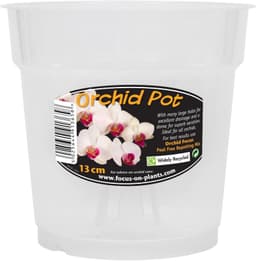
Base drainage holes are non-negotiable for bark. Without them, water pools at the bottom even when the top looks dry. Side slots speed drying in a warm room, but fine bark spills through wide openings and roots can snag in the slots at the next repot. Air cones, raised centres that lift the root mass, are not guaranteed on every amazon.co.uk listing. The Growth Technology 13 cm pot names numerous drainage holes, yet side slots are not clearly confirmed on this exact listing. At least one UK review describes drilling side holes. Slotted multipacks usually show vents in the photos. Title and bullet lines sometimes disagree inside the same T4U family, so read the diameter row.

Clear walls: what they show you

Clear polypropylene lets you see green root tips and spot brown, mushy tissue early. The Royal Horticultural Society recommends a transparent container so you can judge moisture and root colour, and Orchid Society of Great Britain growers water when the bark feels dry and the roots look silvery-white. Treat clarity as that check. It does not prove that roots photosynthesise usefully through the wall, and it does not replace bark or watering at the compost surface. Opaque ceramic can hold a moth orchid only when there are real holes, and root colour stays hidden unless you lift the plant. For a hallway shelf, many UK growers keep a clear pot inside a heavier outer shell. Materials and cachepots are set out on clear plastic vs ceramic orchid pots.

Size, packs and how to measure

Pot size splits reputable UK advice. Kew favours the smallest pot that holds the root ball, often the same pot if trimmed roots still fit. Gardeners' World typically shows moving one size up in a clear pot. Measure after you shake off old bark. The new pot should leave only a modest gap for fresh compost, not a wide ring that stays wet for weeks. Listings often disagree with themselves. A 13 cm title can sit beside a 5 litre row, or a ceramic title can disagree with the dimension fields. Treat the size row and buyer photos as primary. A six-pack near £9.99 suits several moth orchids with matching saucers. A single near £5.70 suits one gift plant.

What to do with the saucer

A drip saucer protects the windowsill. It is not a water store. After you soak bark in the sink, let the pot drain until water stops running, stand it in the saucer, and empty anything collected within a few hours. That habit matches RHS guidance not to leave plants sitting in water. A full tray re-wets the bark from below even when the pot itself has plenty of holes. Wick reservoirs are a different product class, and they change the dry-down you use for silver roots. Read self-watering orchid pots before you treat a wick pair as the low-effort default. None of the review lines on a listing replace the first watering you do at home.

Which check decides the order

If you have one gift plant, a single clear pot near the measured root ball is enough, and a tray you already own will do. If you are refreshing several Phalaenopsis plants this spring, a slotted pack with saucers is the more practical buy, provided the spare pots will actually be used. If a listing blurs a drip tray and a wick chamber, settle that before you pay. The table shows three listings that illustrate those jobs, not every pot in the wider set.

Common questions

Do moth orchids need a clear pot?
They do not strictly require plastic, but a clear slotted pot makes RHS and Orchid Society of Great Britain moisture cues easier to follow. If you grow in holed ceramic, lift the plant or use weight and a skewer instead of root colour. A decorative outer with no holes should not be the only container.
Is a six-pack better value if I only have one plant?
Only if you will use the spare pots within a year or pass them on. Otherwise a single specialist pot near £5.70 avoids clutter. Multipacks make sense when you keep several moth orchids and want matched saucers. Spare pots are useful insurance when they leave the cupboard, and dead storage when they do not.
How do I spot unreliable review counts on amazon listings?
Duplicate review blocks across pack variants, identical star averages, and the same pasted text on three ASINs are red flags. In this scrape, three T4U listings share one 4.6-from-1,131 block, so that figure is one pool. Read reviews on the exact ASIN you plan to buy, and do not multiply the count by three.
Can I use multipurpose compost in an orchid pot?
No. These pots are meant for a coarse bark mix. Multipurpose compost stays wet too long and raises rot risk no matter how many holes you can see. Buy compost labelled for epiphytes, and keep the stem junction above the bark surface when you fill the pot. Ice cubes are not a substitute for that mix.
How many drainage holes and side slots are enough?
Several open base holes are essential. Side slots help in a warm, dry room and increase bark spill onto the sill. A listing without side slots can still work if a short soak drains the mix. Confirm the holes in photos of the variant you click, not the wider brand range.
What is the difference between a drip saucer and a wick reservoir?
A saucer catches drips for a short time, and you empty it. A wick reservoir feeds moisture upward over days and changes how dry the bark feels at the base. They solve different problems. A feature row that says self-watering does not, by itself, mean a cotton wick is in the box.

Related pages

Sources

Public UK sources used for this comparison. Shelf prices, stars and review counts are the amazon.co.uk figures captured for these twelve listings. Last checked 19 October 2026.

  1. RHS Phalaenopsis growing guide (retrieved 19 October 2026)
  2. Orchid Society of Great Britain, Phalaenopsis care (retrieved 19 October 2026)
  3. Kew, caring for your orchids (retrieved 19 October 2026)
  4. orchid.org.uk, repotting (retrieved 19 October 2026)
  5. Gardeners' World, how to repot a moth orchid (retrieved 19 October 2026)
  6. GOV.UK, General Product Safety Regulations 2005 (retrieved 19 October 2026)
  7. GroWell, clear orchid pot (retrieved 19 October 2026)
  8. GOV.UK product marking by sector (retrieved 19 October 2026)