Independent comparisons. We may earn from shop links. More info

Ultrasonic pest repeller for mice

Updated: October 2026

You can hear scratching in the ceiling, or you have found droppings by the kickboard, and a plug looks simpler than finding the hole. An ultrasonic pest repeller for mice does not close that hole, and UK sources say the effect does not last once food and shelter stay. This page stays with rodents. Insects and the dog-and-cat detail live elsewhere. The catalogue is the [ultrasonic pest repeller comparison](/hub/pest-control/ultrasonic-pest-repeller). Peter F. read the listings and UK pest sources on 16 October 2026. We did not run a field trial. A qualifying purchase can earn us a commission at no extra cost to you.

You can hear scratching in the ceiling, or you have found droppings by the kickboard, and a plug looks simpler than finding the hole.

Our top picks

On this page

What the UK sources say about mice

Rentokil says ultrasonic devices are inconsistent, that mice get used to them if food and shelter remain, and that the sound does not travel through walls or furniture, leaving quiet dead zones. The same company’s chemical-free page publishes hearing ranges: rats about 200–76,000 Hz, and mice about 1,000–91,000 Hz, at Rentokil’s chemical-free rodent page. Any effect is limited to a few days if the rodents are new, and an established infestation is unlikely to shift. A GOV.UK poultry code says practical results have generally been disappointing and that verifiable trials are lacking.

Why the cavity stays quiet on the device and loud for the mouse

The noise at night is often inside a wall, a ceiling void, or the space under a bath. The plug is in the room. Ultrasound does not enter those cavities in a useful way. Rentokil’s dead zones are the same idea: solid material leaves a patch the mouse can still use. If you use a unit at all, put it in the room you can see, on an open socket, not in the void. Heights that only some listings print are on the how to use page.
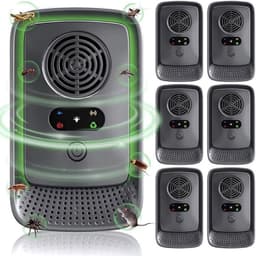
Siyuio Siyuio 6-pack, 4 modes

Testsieger

Siyuio Siyuio 6-pack, 4 modes
7.9/10about £23.74

What reviews in this set show

The reviews do not line up, so they cannot crown a winner. On Pestbye, among 50 written reviews, some people report quiet after weeks and some say the unit did nothing. One says mice returned after about a year while it still made a noise. Pestbye is the rodent-aimed listing, at £30.18, on 3.8 from 429 ratings, with a loft bullet and a warning for hamsters, gerbils, or chinchillas. That file is not a success rate. TruSky, at £29.99 and 2.8 from 14 reviews, has one note that mice were still coming after two months. FunBean’s red mode is specified at 10–15 kHz for mice and rats, and the seller says not to use it while people or pets are indoors. Dog-and-cat limits are on the pets page.

If the loft might be bats

Stop before any plug goes into a roof that might hold bats. The Bat Conservation Trust says these devices are largely untested against rats and mice, that the effect on bats is unknown, and that use may break the law if bats are disturbed. The helpline is 0345 1300 228. GOV.UK makes intentional or reckless disturbance of a roost an offence. Pestbye says a loft is a place you can plug in, and it never mentions bats. That sentence is not a survey of your roof. If the space is a roost, the product choice on this page does not apply.

What to do instead of waiting on the plug

Close the gaps the animals use: holes around pipes, gaps under doors, and the places food is left out. The British Pest Control Association puts that ahead of gadgets. A plug does not replace it. If droppings continue, if you cannot tell bats from rodents, if the building handles food, or if the problem is spreading, call a pest controller. If you still want a unit after the holes are closed and the loft is settled, FunBean’s mouse mode is the audible one, and Pestbye is the single unit with hundreds of ratings and a whole-house claim you should not trust. The buying guide is the checklist for that extra.

Common questions

Will a plug get mice out of the wall cavity?
No. The sound does not travel usefully through walls or into the voids where mice often run. Rentokil calls those spots dead zones. A socket in the room you can see does not reach the inside of the stud wall. Closing the hole they use to enter that void matters more than the setting on the plug.
How long should you wait before deciding it has not worked?
Use the seller’s window only as a timetable they printed. FunBean says one to two weeks, then three to four. T-MENG says about three or four weeks. Rentokil’s limit for a new arrival is a few days, and an established infestation is a different case. If droppings continue after that seller window, stop waiting on the plug.
What if the noise is in the loft?
Treat it as a stop. The loft may hold bats. The Bat Conservation Trust helpline is 0345 1300 228, and disturbance of a roost can be an offence. Two TruSky attic reviews report less noise, and another says mice were still coming after two months. Neither is a reason to plug in before you know what is up there.
Should you still proof the holes?
Yes. A plug does not close a gap under a door or around a pipe. The British Pest Control Association puts proofing at the front of mouse control. A quiet fortnight in a review does not remove that step. Food left out is the same job, which is why Rentokil’s about 3 g a day line is about access, not a diet.
When do you call a pest controller?
Call when scratching and droppings continue, when you cannot tell bat droppings from rodent droppings, when the building handles food, or when the problem is spreading. A 3.8-star plug at £30.18 is not the person who proofs a terrace. If you are unsure about a roost, use the helpline before you buy another unit.

Related pages

Sources

Public UK sources and the amazon.co.uk listings in this set, last checked on 16 October 2026.

  1. ASA, pest repellents (retrieved 16 October 2026)
  2. GOV.UK, code of practice on rodent infestations on poultry farms (retrieved 16 October 2026)
  3. BPCA, pest control while protecting bats (retrieved 16 October 2026)
  4. BPCA, mouse control (retrieved 16 October 2026)
  5. BPCA, the hearing of rats (retrieved 16 October 2026)
  6. Bat Conservation Trust, bats in a property (retrieved 16 October 2026)
  7. Electrical Equipment (Safety) Regulations 2016, regulation 35 (retrieved 16 October 2026)
  8. GOV.UK, bats: protection and licences (retrieved 16 October 2026)