Flea spray safe for cats
Flea spray safe for cats, in this set, means a household aerosol used on the room with the cat out of it. It does not mean pointing that can at the coat. If a household spray or a dog flea product goes on the cat, PDSA says contact a vet immediately. Products Compared did not treat an animal. The notes follow PDSA, Blue Cross, the VMD permethrin leaflet and the listings in the [flea spray comparison](/hub/pest-control/flea-spray). Prices are GBP from amazon.co.uk. A qualifying purchase can earn a commission at no extra cost to you.
Flea spray safe for cats, in this set, means a household aerosol used on the room with the cat out of it. It does not mean pointing that can at the coat.
Flea spray safe for cats, in this set, means a household aerosol used on the room with the cat out of it. It does not mean pointing that can at the coat. If a household spray or a dog flea product goes on the cat, PDSA says contact a vet immediately. Products Compared did not treat an animal. The notes follow PDSA, Blue Cross, the VMD permethrin leaflet and the listings in the flea spray comparison. Prices are GBP from amazon.co.uk. A qualifying purchase can earn a commission at no extra cost to you.
Our top picks
| Badge | Product | Use on animals | Re-entry | Named actives | Note | Price | Offer |
|---|---|---|---|---|---|---|---|
| Best overall |  Virbac Virbac Indorex Defence, 500 ml | Not for direct use on animals | 30 minutes closed, then air for 1 hour | Permethrin and pyriproxyfen in the bullets | 9.2 | about £13.63 | View offer |
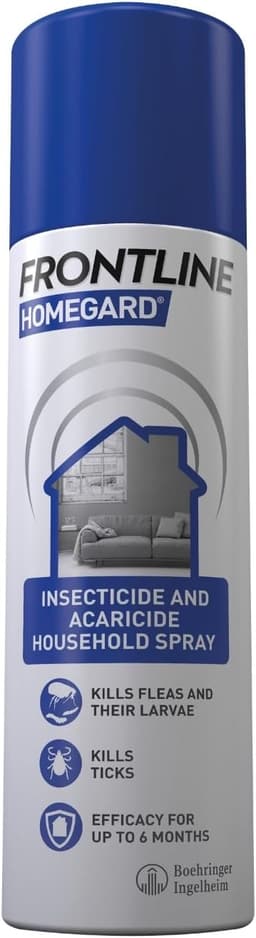
| Best value |  FRONTLINE FRONTLINE HomeGard, 500 ml | Never spray on animals | Until dry, about 1 hour, then air | Permethrin and (S)-methoprene in the bullets | 8.4 | about £11.24 | View offer |
| Alternative |  Isabella's Clearly Isabella's Clearly CATS, 60 ml | Topical spray for cats. Age field says Adult | Listing claim: up to 8 hours on the coat | Lavender and rosemary hydrosol | 7.6 | about £19.99 | View offer |


On this page
What must not touch the cat
What PDSA and Blue Cross each say
Re-entry, fish, and this set
The cat still needs its own product
Common questions
Can I spray the household can on my cat?
Is a permethrin room spray the same hazard as a dog spot-on on a cat?
How long do I keep the cat out?
What if the cat walks back in while it is wet?
What signs mean a vet now?
Does a lavender spray avoid this problem?
Related pages
Sources
Public UK sources used for this comparison. Shelf prices, stars and review counts are the amazon.co.uk figures captured for these seven listings. Last checked 22 October 2026.
- PDSA, fleas on cats (retrieved 22 October 2026)
- PDSA, permethrin toxicity in cats (retrieved 22 October 2026)
- GOV.UK, veterinary medicines on the market (retrieved 22 October 2026)
- HSE, regulated biocides (retrieved 22 October 2026)
- Blue Cross, dog flea advice (retrieved 22 October 2026)
- Blue Cross, cat and kitten flea treatment (retrieved 22 October 2026)
- Indorex Defence 500 ml label (retrieved 22 October 2026)
- FRONTLINE HomeGard (retrieved 22 October 2026)