Independent comparisons. We may earn from shop links. More info

Clothes moth trap vs spray

Updated: 23 October 2026

You are standing in the airing cupboard with a hole in a wool sleeve and two kinds of product in the basket: a sticky pheromone card, and a spray, a cedar ball or a lavender bag. A clothes moth trap vs spray choice is three columns. A monitor shows male clothes moths. A contact treatment only works where it touches the larva. Cedar, lavender and old mothballs do neither job properly. This page does not rank sprays. The eleven cards are on the [clothes moth trap comparison](/hub/pest-control/clothes-moth-trap). Listings were saved on 21 October 2026. A qualifying purchase can earn a commission at no extra cost to you.

You are standing in the airing cupboard with a hole in a wool sleeve and two kinds of product in the basket: a sticky pheromone card, and a spray, a cedar ball or a lavender bag.

Our top picks

On this page

A monitor when you need to see males

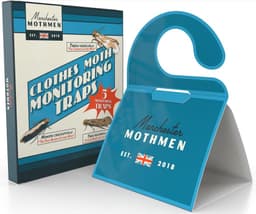
Start with a monitor when you need to know whether male clothes moths are in that room. Adults do not feed on the textile. Larvae do. A male sex pheromone does not call females or the grubs in the cuff. HSE says a trap clearly labelled, sold and used only to monitor can sit outside the biocidal products rules. Kills, controls, protects clothes, prevents damage and repels are not acceptable on that kind of product. Great Britain uses GB BPR. Northern Ireland uses EU BPR. Insectix, Entopest and Manchester Mothmen stay closest to monitor wording. London Moth, MothOut’s 10-pack title, Super Ninja, Nozerix, Acana, Erigathe and Lumora also use protect, control, kill or prevention language. Glue can still catch a male either way. A full card is a count, not a clearance. One MothOut review found cards catching moths while the clothes were still eaten. Who each pack is for is on best clothes moth traps.

A spray only where it touches the larva

An aerosol aimed at adults on the wing misses larvae in folds, under furniture and in the underlay. A residual insecticide such as permethrin, used on carpet edges, can affect larvae if it contacts them, and it may need repeating. That is a contact rule, not a brand recommendation. This page does not name a spray to buy. Fogging so the mist never reaches the gripper rods is the step to avoid. Call someone before you fog, and before you use mothballs. A spray does not prove which moth you have. If the insect is a brown house moth or a pantry moth, a clothes-moth card was already the wrong tool. Vacuum the edge, bag the damaged wool, and use a monitor to see whether males return. Non-toxic on a listing is a seller phrase, not an HSE approval. Floor holes are on carpet moth traps.

Cedar, lavender and mothballs are not the lure

English Heritage says lavender and cedar can repel adult moths for about three months and do not affect larvae. A Manchester Mothmen reviewer reported moths on the glue where cedar blocks and lavender sachets had already failed. That is one household, not a trial. A lavender pouch in a MothOut kit is a freshener, not the pheromone. Parking it in the same plume can get in the way of the lure. Commission Implementing Decision (EU) 2016/678, which HSE lists for Great Britain, says a pad of dried lavender blossoms sold to repel moths is neither a biocidal product nor a treated article. That is legal status, not proof that larvae stop eating. Naphthalene has been prohibited in pesticides since 2008, which is the line in Southwark Trading Standards and in Which?. Do not buy mothballs, and do not use old stock. Paradichlorobenzene balls are the ones Heritage does not recommend. Transfluthrin sachets are still a biocide, aimed at adults in a closed space.

Freeze or heat the textile, then decide on help

The wool and a rug you can lift still need their own treatment. The Museum cites −20°C for a week, or 49°C for more than 30 minutes. English Heritage cites −18°C for two weeks. Do not average them into a night in the freezer. A fitted carpet is not a jumper you can bag. The Museum line is that dry-cleaning destroys these pests. Which? says not to rely on dry-cleaning as an insecticide. Ask the cleaner what process you are buying. Call a professional if carpet, underlay or loft insulation is still eaten after a clean and fresh traps, or before foggers and mothballs. How to peel and place a card is on how to use clothes moth traps.

Common questions

Do cedar and lavender kill larvae?
No. English Heritage says they may repel adults for about three months and do not affect larvae. Decision (EU) 2016/678 says a dried-lavender pad sold to repel moths is not a biocidal product. That is legal status, not a clearance. Keep the pouch off the card.
Can I still buy naphthalene mothballs?
You should not. Naphthalene has been prohibited in pesticides since 2008. Old tins are not a legal fallback. Paradichlorobenzene products are the ones Heritage does not recommend. None of them replaces a clean.
What should I do with the wool itself?
Wash what can be washed, and use a freeze or a heat treatment you can name. The Museum cites −20°C for a week or 49°C for more than 30 minutes. Heritage cites −18°C for two weeks. Keep those figures apart. A card does not treat a sleeve that is already holed.
Why do freeze times differ?
Two UK sources publish two protocols. The Museum states −20°C for a week. English Heritage states −18°C for two weeks. They are not the same instruction. Use one source for the whole item. A fitted carpet will not fit either method.
When should a professional take over?
When carpet, underlay or loft insulation is still eaten after a clean and fresh traps, when you cannot identify the moth, or before foggers or mothballs. A chimney or loft nest is a building fault. Another cedar ball will not empty it.

Related pages

Sources

Public UK sources used for species, lure limits, and monitor wording. Shelf prices, stars and review counts are the amazon.co.uk figures captured for these 11 listings. Last checked 21 October 2026.

  1. Natural History Museum clothes moth guide (retrieved 21 October 2026)
  2. English Heritage clothes moth prevention (retrieved 21 October 2026)
  3. English Heritage insect pest management (retrieved 21 October 2026)
  4. HSE monitoring traps (retrieved 21 October 2026)
  5. HSE regulated biocidal products (retrieved 21 October 2026)
  6. HSE decisions on scope (retrieved 21 October 2026)
  7. UKMoths brown house moth (retrieved 21 October 2026)
  8. Fort Products safety data sheet (retrieved 21 October 2026)