Independent comparisons. We may earn from shop links. More info

Clothes moth trap buying guide

Updated: 23 October 2026

You have found holes in a wool jumper, or a bald patch where the sofa meets the skirting, and amazon.co.uk is offering sticky cards that all sound like a cure. A clothes moth trap is a glue card or pad with a pheromone for male clothes moths. It is not a spray, and it is not a pantry-moth trap. Larvae do the damage. Adults do not eat fabric. The lure attracts only males and will not control an infestation. Pounds and stars sit on the [clothes moth trap comparison](/hub/pest-control/clothes-moth-trap), from listings saved on 21 October 2026. There is no lab test. A qualifying purchase can earn a commission at no extra cost to you.

You have found holes in a wool jumper, or a bald patch where the sofa meets the skirting, and amazon.co.uk is offering sticky cards that all sound like a cure.

Our top picks

On this page

Name the moth before the pack

The two species the Museum treats as the usual textile pests are the common clothes moth, Tineola bisselliella, and the case-bearing clothes moth, Tinea pellionella. A listing that prints both names tells you more than one that only says clothes moths. Acana prints both, and also says the boards attract and kill. Insectix, Entopest and Super Ninja name male Tineola and stop there. London Moth, MothOut and Manchester Mothmen use common names that include case-making or case-bearing moths, and they also name the pale-backed clothes moth. That third name is a seller claim. London Moth and MothOut exclude the brown house moth, the white-shouldered house moth and the Indian meal moth. UKMoths puts the brown house moth at about 15–26 mm. Pantry moths need a food-moth lure. Females ignore a male lure, and larvae never fly to the glue, so a blank card is not an all-clear. A short list with a condition is on best clothes moth traps.

Monitor wording, not a kill claim

HSE guidance says a trap that is clearly labelled, sold and used only to monitor sits outside the biocidal products rules. Great Britain uses GB BPR. Northern Ireland uses EU BPR. Examples that are not acceptable on a monitor include kills, controls, protects clothes, prevents damage, and repels. Non-toxic on a bullet is a seller phrase, not an HSE approval, and the glue still sticks. Insectix, Entopest and Manchester Mothmen stay closest to monitor wording. London Moth also says protect. MothOut’s 10-pack title talks about prevention and protection, while the bullets say locate, measure and monitor. Super Ninja says control and monitor. Nozerix says protect clothes and break the breeding cycle. Acana says attracts and kills. Erigathe and Lumora mix monitor and protection. A 4.5 does not turn a kill claim into a monitor.

Life, form and price per trap

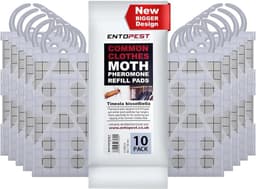
Stated lives run from about 8 to 12 weeks on Erigathe and up to 12 weeks on Entopest, through 90 days on Insectix and 3 months on Nozerix, MothOut, Super Ninja and Lumora, to 4 months once opened on London Moth. Acana and Manchester Mothmen do not state a life. Entopest’s data sheet says avoid storage above 30°C. Most packs are folded glue cards. Manchester’s is three-sided for a carpet. Entopest is pads plus hangers, and the title says 10 hangers while a bullet says 5. A MothOut lavender pouch is a freshener, not the lure. Do not divide Lumora’s £15.99: the title says 10 and the unit count says 6. Peel and placement are on how to use clothes moth traps.

Pack counts that do not agree

Entopest’s title says 10 refill pads and 10 reusable hangers. A bullet says 10 pads and 5 clear hangers. The model field says Fruit Traps. Insectix’s title and unit count say 6, and the pieces field says 1. Lumora’s 10-versus-6 split is why there is no price per trap. If the box does not match the title, that is a description problem. MothOut’s 10-pack and 5-pack both show 4.5 from 1,769, and the saved review text matches, so it is one sample. Erigathe is 5.0 from 4 reviews. Lumora has no Customer Reviews line. Acana’s saved line is £14.84 and 4.0 from 116, and UK texts include moths that ignored the cards. Holes in the pile are a different check, on carpet moth traps.

Common questions

What should I check on a clothes moth trap before I buy?
Check the species name, whether the title is a monitor or a kill claim, the stated lure life, the form, and the price per trap. Prefer Tineola bisselliella and, for carpet holes, Tinea pellionella. Skip a price per trap when the pack count disagrees with itself, as on Lumora.
Will a clothes moth trap catch pantry moths or brown house moths?
Not on purpose. London Moth and MothOut exclude the brown house moth, the white-shouldered house moth and the Indian meal moth. A pantry infestation needs a food-moth lure. The brown house moth is about 15–26 mm on UKMoths. An empty clothes-moth card does not prove the wool is clear.
What is the difference between a monitor and a trap that says it kills?
A monitor is sold to show whether male moths are present. HSE says that use can sit outside the biocidal rules when the label stays honest. Kills, controls, protects clothes or prevents damage are a different product. Acana says attracts and kills. Glue can still catch a male. It does not take larvae out of a jumper.
How long should the listing say the lure lasts?
Anything from about 8 weeks to 4 months appears here, and two packs say nothing. London Moth says 4 months once opened. Entopest says up to 12 weeks. Insectix says up to 90 days. Acana and Manchester Mothmen leave the life blank. Heritage practice is a quarterly change unless the pack prints its own figure.
Why do two MothOut packs show the same review count?
The 10-pack and the 5-pack both show 4.5 from 1,769, and the saved review titles match. It is one sample on two listings, not 3,538 opinions. Do not add the two counts together.

Related pages

Sources

Public UK sources used for species, lure limits, and monitor wording. Shelf prices, stars and review counts are the amazon.co.uk figures captured for these 11 listings. Last checked 21 October 2026.

  1. Natural History Museum clothes moth guide (retrieved 21 October 2026)
  2. English Heritage clothes moth prevention (retrieved 21 October 2026)
  3. English Heritage insect pest management (retrieved 21 October 2026)
  4. HSE monitoring traps (retrieved 21 October 2026)
  5. HSE regulated biocidal products (retrieved 21 October 2026)
  6. HSE decisions on scope (retrieved 21 October 2026)
  7. UKMoths brown house moth (retrieved 21 October 2026)
  8. Fort Products safety data sheet (retrieved 21 October 2026)