How to use cat repellent spray
You have sprayed the sofa arm once, or the edge of the lawn once, and by the next morning the cat is back. That is the usual way these bottles get judged, and it is the wrong clock. How to use cat repellent spray, on the listings in this set, means spraying the place on that bottle's own schedule, after you have removed the mess, and stopping when the pattern looks like illness rather than habit. The Products Compared editorial team read the saved amazon.co.uk extracts behind the [cat repellent spray comparison](/hub/pest-control/cat-repellent-spray), plus the Royal Horticultural Society and the RSPCA. None of those extracts give a square-metre rate. Prices and schedules below were saved before 21 October 2026.
You have sprayed the sofa arm once, or the edge of the lawn once, and by the next morning the cat is back. That is the usual way these bottles get judged, and it is the wrong clock.
You have sprayed the sofa arm once, or the edge of the lawn once, and by the next morning the cat is back. That is the usual way these bottles get judged, and it is the wrong clock. How to use cat repellent spray, on the listings in this set, means spraying the place on that bottle's own schedule, after you have removed the mess, and stopping when the pattern looks like illness rather than habit. The Products Compared editorial team read the saved amazon.co.uk extracts behind the cat repellent spray comparison, plus the Royal Horticultural Society and the RSPCA. None of those extracts give a square-metre rate. Prices and schedules below were saved before 21 October 2026.
Our top picks
| Badge | Product | Reapply line | Stated place | Safety line | Note | Price | Offer |
|---|---|---|---|---|---|---|---|
| Best overall |  n/a Anti-scratch cat spray, 150 ml | 2–3 times daily | Indoor furniture and garden | Not on a kitten's head; away from flames | 6.2 | about £14.99 | View offer |
 Cooper and Gracie Cooper and Gracie Urine Stop, 250 ml | Every 2–3 days, then weekly | Indoors on carpets and sofas; patios and fences | Vet if marking is sudden or worse | 8.4 | about £9.99 | View offer | |
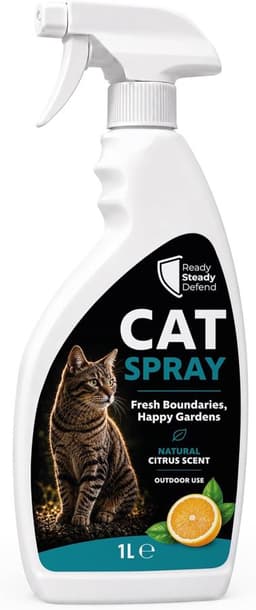
| Best value |  n/a Outdoor citrus cat spray, 1 litre | After heavy rain or cleaning | Outdoor gardens, lawns, beds and patios | Edible-plant question unanswered | 5.9 | about £12.99 | View offer |


On this page
Spray the spot, not the cat
Clean the spot, then spray
Repeat on the line printed for your bottle
When to stop
Common questions
Do I spray the cat or the place?
How often do these bottles say to repeat?
What do I do after rain?
Should I remove the mess first?
When do I stop and call a vet?
Related pages
Sources
Public UK sources used for this comparison. Shelf prices, stars and review counts are the amazon.co.uk figures on extracts saved before 21 October 2026. Last checked 20 October 2026.
- RSPCA: cats in gardens (retrieved 20 October 2026)
- RSPCA advice on deterring cats (retrieved 20 October 2026)
- RHS: cats in the garden (retrieved 20 October 2026)
- HSE: regulated biocides (retrieved 20 October 2026)
- HSE: using biocides (retrieved 20 October 2026)
- HSE: UK authorised biocidal products (retrieved 20 October 2026)
- Animal Welfare Act 2006, section 4 (retrieved 20 October 2026)
- Cats Protection: scratching (retrieved 20 October 2026)