Independent comparisons. We may earn from shop links. More info

Cat repellent spray buying guide

Updated: 23 October 2026

You are looking at a row of citrus bottles on amazon.co.uk, and they are not the same job. One is a 150 ml mist for a sofa arm. One is a litre for a lawn edge. A cat repellent spray buying guide only helps if it tells you which checks to run before you pay, and which claims to leave alone. The Products Compared editorial team read the seven saved listings in the [cat repellent spray comparison](/hub/pest-control/cat-repellent-spray). Shelf prices come from those extracts, saved before 21 October 2026. This page does not pick a winner. The shortlist sits on the [best cat repellent spray](/hub/pest-control/cat-repellent-spray/sub/cat-repellent-spray-best) page.

You are looking at a row of citrus bottles on amazon.co.uk, and they are not the same job. One is a 150 ml mist for a sofa arm. One is a litre for a lawn edge.

Our top picks

On this page

Match the bottle to the place

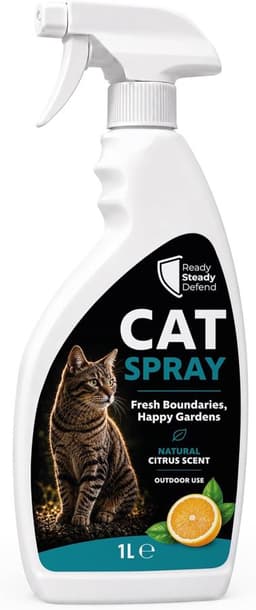
Start with the places the listing names in its own bullets. Cooper and Gracie Urine Stop is the only brand name in this set. At £9.99 for 250 ml it lists dogs and cats, and it names carpets, sofas, beds, doorways, patios and fences. That is not a statement that 250 ml will treat a whole garden. The outdoor citrus cat spray is £12.99 for 1 litre, ready to use with no mixing, and it names gardens, lawns, beds, patios, paths and hard surfaces. That is the row written as a garden bottle. The anti-scratch cat spray is £14.99 for 150 ml. Its bullets lead with sofas, carpets and wires, then add gardens. If the label cannot separate a sofa from a flower bed, do not separate them for it. Indoor scratching belongs on the furniture page. Neighbour fouling belongs on the garden page.

Read the fill and the reapplication line

A shelf price without millilitres is not a comparison. Three listings here leave the fill blank: the £7.59 cat and kitten deterrent (the pack weighs 130 g), the £5.99 plant-based deterrent, and the natural deterrent at £15.63 (the item weighs 240 g). The stated volumes are 250 ml for Cooper and Gracie, 150 ml for the anti-scratch mist and for the £7.99 cat repellent spray, and 1 litre for the outdoor citrus bottle. The outdoor bottle is £12.99 a litre. Cooper and Gracie is about £40 a litre. The £14.99 bottle of 150 ml is about £100 a litre. Cooper and Gracie says every two to three days, then once a week. The £14.99 mist says two to three times a day. The litre says reapply after heavy rain, cleaning, or long exposure.

Named extracts are not an authorisation

Where a product needs authorisation for the general public, the label carries a number: UK, GB or NI, a year, and a code, or an older HSE number. None of the seven extracts in this set print an authorisation number. We did not row-match them to the HSE authorised-products list. This page therefore does not call them approved, and it does not call them illegal. HSE's COPR pages describe vertebrate repellents, including cat and dog fouling products, as a type that needs approval until a BPR decision. That is not a verdict on these bottles. The £7.99 listing says "catnip spray", but the formula bullet names deionised water, citrus essential oil, citronella and lemon oil, not catnip.

How to read a small star line

The score on the main table is a listing method, not a laboratory ranking. Ultrasonic stakes are a different product. The natural deterrent at £15.63 is 1.0 from three texts that all say it failed. A perfect average on a dozen new reviews should not lift a bottle above a printed place and a stated fill.

Common questions

How do I tell a furniture mist from a garden bottle?
Read the places in the bullets before the scent. A furniture mist names sofas, carpets, curtains or wires, and it is often 150 ml. The garden bottle here is the outdoor citrus spray at £12.99 for 1 litre, with a line to reapply after heavy rain. If indoor and outdoor both appear, as on the £7.59 listing, treat that as an unclear label. A 150 ml mist will not hold a lawn on two or three sprays a day.
Why does a 5.0 from 12 not outrank 3.6 from 6,555?
Twelve five-star texts can be real and still be a small, new sample. The £14.99 mist was first listed on 31 August 2026. Cooper and Gracie's 3.6 is drawn from 6,555 ratings, so the misses are visible: no change, dogs still peeing, a weak sprayer, and a dispute about the enzyme claim. A perfect line on twelve reviews cannot show those limits.
Does natural mean it is not a biocide?
No. Natural, plant-based, and a list of citrus oils are seller wording. They are not an HSE authorisation, and they do not prove the bottle sits outside biocide rules. HSE describes vertebrate repellents for garden fouling as a type that needs approval until a biocidal products decision. None of these seven extracts print an authorisation number, and this page did not match them to the HSE list. The word natural does not close that check.
Should I buy the cheapest bottle if the fill is missing?
The lowest shelf price in the set is £5.99, and the specification table does not state millilitres. A review that says 150 ml is not the listing specification, so you cannot price it per litre from the extract. The file has 2.9 from six ratings, including a recliner scratched in under a minute. The £7.59 bottle has the same hole: no stated fill, and 2.2 from 10.
What must I not assume about food crops or kittens?
The 1 litre outdoor listing prints a question about edible plants and does not answer it. This page does not clear that spray for vegetable beds or herbs. The £14.99 mist says not to spray a kitten's head and to keep the bottle away from flames. Other listings print kitten, fabric or stain questions and leave them blank. If indoor marking is sudden, new or getting worse, Cooper and Gracie's own line is to see a vet.

Related pages

Sources

Public UK sources used for this comparison. Shelf prices, stars and review counts are the amazon.co.uk figures on extracts saved before 21 October 2026. Last checked 20 October 2026.

  1. RSPCA: cats in gardens (retrieved 20 October 2026)
  2. RSPCA advice on deterring cats (retrieved 20 October 2026)
  3. RHS: cats in the garden (retrieved 20 October 2026)
  4. HSE: regulated biocides (retrieved 20 October 2026)
  5. HSE: using biocides (retrieved 20 October 2026)
  6. HSE: UK authorised biocidal products (retrieved 20 October 2026)
  7. Animal Welfare Act 2006, section 4 (retrieved 20 October 2026)
  8. Cats Protection: scratching (retrieved 20 October 2026)