Bird spikes or a scarer
You have two amazon.co.uk tabs open, a packet of plastic spikes and a hawk kite, and you want one of them to be the answer. Bird spikes or a scarer is the wrong question until you say where the bird is. A spike strip denies the surface you cover. A scarer buys time on open ground while the bird still treats it as new. Peter F., editor for DIY & tools at productscompared.co.uk, is comparing those two jobs on the household products in the [bird deterrent comparison](/hub/pest-control/bird-deterrent), priced on amazon.co.uk on 20 October 2026. It is not a lab test, and a star rating cannot pick between them. A qualifying purchase can earn a commission at no extra cost to you. GOV.UK lists both as non-lethal methods and does not crown a winner.
You have two amazon.co.uk tabs open, a packet of plastic spikes and a hawk kite, and you want one of them to be the answer. Bird spikes or a scarer is the wrong question until you say where the bird is.
You have two amazon.co.uk tabs open, a packet of plastic spikes and a hawk kite, and you want one of them to be the answer. Bird spikes or a scarer is the wrong question until you say where the bird is. A spike strip denies the surface you cover. A scarer buys time on open ground while the bird still treats it as new. Peter F., editor for DIY & tools at productscompared.co.uk, is comparing those two jobs on the household products in the bird deterrent comparison, priced on amazon.co.uk on 20 October 2026. It is not a lab test, and a star rating cannot pick between them. A qualifying purchase can earn a commission at no extra cost to you. GOV.UK lists both as non-lethal methods and does not crown a winner.
Our top picks
| Badge | Product | Job | Mechanism | What it misses | Note | Price | Offer |
|---|---|---|---|---|---|---|---|
| Best overall |  EarlyGrow EarlyGrow fence spikes, 10-pack | The rail you can cover | Perch denial | Bare return and the lawn | 8.3 | about £6.95 | View offer |
| Best value |  KOKMEYA KOKMEYA bird scare rods, 6-pack | A flash, not a cover | Moving visual | The fence cap itself | 6.1 | about £6.29 | View offer |
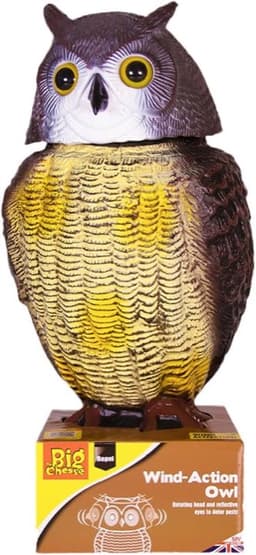
| Alternative |  The Big Cheese The Big Cheese wind-action owl | Open ground you can change | Moving visual | A still head becomes a perch | 6.5 | about £12.99 | View offer |


On this page
Two different jobs
What a spike strip covers, and what it does not
What a scarer can do until the birds learn it
Which to buy, and when to use both
Common questions
Should I buy bird spikes or a bird scarer?
Do pigeons get used to spikes the way they get used to a plastic owl?
Will reflective rods keep birds off a fence cap?
Are plastic anti-climb spikes the same product as stainless ledge spikes?
Is a hawk kite a substitute for spikes on a balcony?
Can I use both, or do I have to pick one?
What fails if I only cover the long rail and not the return?
Related pages
Sources
Public UK sources used for this comparison. Shelf prices, stars and review counts are the amazon.co.uk figures captured for these 11 listings. Last checked 20 October 2026.
- Wildlife and Countryside Act 1981, protection of birds (retrieved 20 October 2026)
- GOV.UK, prevent wild birds damaging land (retrieved 20 October 2026)
- Natural England GL41 (2026) (retrieved 20 October 2026)
- Natural England GL42 (2026) (retrieved 20 October 2026)
- WML-GU01, legal methods (retrieved 20 October 2026)
- Defra annex on non-lethal alternatives (retrieved 20 October 2026)
- Natural Resources Wales, deterring birds (retrieved 20 October 2026)
- RSPCA, pigeons in the garden (retrieved 20 October 2026)