Independent comparisons. We may earn from shop links. More info

Bed bug killer for mattress

Updated: October 2026

You have lifted the sheet and the specks, or the bites, sit along the piping rather than in the hallway. A bed bug killer for mattress is a treatment of that piece of furniture: the mattress surface the label allows, the frame, and the headboard. It is not a soak for the duvet, and it is not a whole-flat programme. Sheets are laundry. An encasement, if you use one, is a physical cover you buy separately. It is not one of the cans in our [bed bug killer comparison](/hub/pest-control/bed-bug-killer).

You have lifted the sheet and the specks, or the bites, sit along the piping rather than in the hallway.

Our top picks

On this page

Mattress, frame and bedding are different jobs

Bed bugs on a bed hide in tight fabric and wood, not in a neat patch in the middle of the sleeping surface. On a typical UK divan that means the piping, the frame joints, the headboard brackets, and the gap where the base meets the skirting. Bedding is the other job. NHS says wash sheets, pillowcases and covers at 60°C and tumble dry on hot for at least 30 minutes. Spraying the duvet in place leaves insecticide where you sleep.

What the amazon listings say

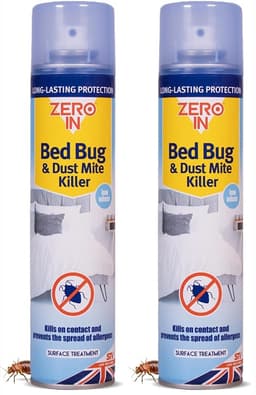
NOPE! is the clearest mattress line in this set. The 500 ml water-based spray is £13.99, 4.1 from 1,208 reviews, names cypermethrin, and lists bed frames and mattresses, with a residual claim of up to three months. The Zero In two-pack at £11.00, 4.2 from 8,217 reviews, names mattresses and tells you to test a small area first so the spray will not stain. Pestshield's title mentions mattress, while the mattress question is unanswered. Do not promote that can onto the fabric from the product name alone.

Drying and sleeping in the bed

Spot-test a hidden patch before you treat the piping. If that patch marks, stop. Stay out until the spray is dry. Medway says at least two hours before you go back in. Your label wins if it is longer. Do not remake the bed with the unwashed sheets. The no-vacuum window is on the how to use bed bug spray page. An encasement is a separate zip cover. Fit one only after the spray is dry.

When the mattress is the wrong focus

Treat the bed first when the signs are on that furniture: spotting on the piping, insects in the frame, or a second-hand mattress you have just brought in. Stop concentrating on one mattress when insects show up in a second room or in a neighbour's flat. A can does not cross a party wall. NHS says DIY is unlikely to clear an infestation alone. Replacing the mattress is a poor first move if the frame and the next room stay untreated.

Common questions

Do I spray the sheet or the mattress fabric?
Spray the mattress only where the label names it, usually seams and the surface after a spot-test, and wash the sheet. Sheets, pillowcases and duvet covers go through a 60°C wash and a hot tumble dry of at least 30 minutes. Leaving them on and spraying through them treats the wrong layer and puts insecticide against your skin. Bag the laundry before you start on the piping.
Which listings name mattresses in the bullets?
NOPE! names mattresses, bed frames, carpets and soft furnishings. The Zero In bed-bug aerosols name mattresses, frames and skirting, and they add a spot-test. Pestshield's bullets name bed heads, carpets and skirting, while the mattress question is unanswered despite the title. Rentokil's captured fields do not name a surface. If your ASIN is one of the blanks, read the tin before it touches fabric.
Do I need an encasement as well?
It is an optional physical barrier, not a spray and not a product in this table. A zip cover can trap insects inside a mattress you are not throwing away, after the spray has dried. It does not treat the frame, the headboard or the bedding, and you should not assume you can spray the cover itself. Buy it as a separate step if the mattress is staying.
Can I sleep on the mattress the same night?
Only after the spray is dry and the re-entry time on your label has passed. Medway's sheet says at least two hours out of the room. After that, sleeping in the bed is often what councils want, so insects cross the treated seams. If the spot-test is still wet, or the smell is too strong, wait. Do not put unwashed sheets back on to make it feel finished.
What about the divan base and headboard?
Treat them if the label allows furniture and wood, not only the soft top. Bugs use frame joints, headboard brackets and the gap against the skirting. Brighton and Hove's notes include the headboard with the mattress seams. Pull the bed out so you can reach the wall side. A spray that only wets the centre of the sleeping surface misses those harbourages.
Will aerosol stain the fabric?
It can. Zero In tells you to test a hidden patch so the spray will not stain mattresses or carpets. Ultra Power says it may slightly stain white items, and reviews mention yellow marks. NOPE! says non-staining when used as directed, which is not a licence to soak a seam. If the test patch marks, stop. Dark bases are a smaller gamble than a pale mattress top, and neither is guaranteed.
When is replacing the mattress the better move?
When the cover is split, you cannot spot-test or dry it, or a professional tells you the mattress is not worth treating in place. Replacing it on day one, while the frame and the next room stay untreated, often moves the problem onto the new bed. Wash the bedding, treat the frame the label allows, and ask the council or a pest controller before you pay for a new mattress as the only step.

Related pages

Sources

Public UK sources used for this comparison. Shelf prices, stars and review counts are the amazon.co.uk figures captured for these nine listings. Last checked 20 October 2026.

  1. NHS, Bedbugs (retrieved 20 October 2026)
  2. HSE, Using biocides (retrieved 20 October 2026)
  3. HSE, UK authorised biocidal products (retrieved 20 October 2026)
  4. HSE, COPR (retrieved 20 October 2026)
  5. BPCA, controlling bed bugs (retrieved 20 October 2026)
  6. BPCA, Bed bugs in 2024 (retrieved 20 October 2026)
  7. Medway Council, before and after bedbug treatment (retrieved 20 October 2026)