Independent comparisons. We may earn from shop links. More info

Bed bug killer buying guide

Updated: October 2026

You are comparing bed bug cans on amazon.co.uk and several of them sit between 4.0 and 4.2 stars. That cluster does not tell you whether you are buying a directed aerosol, a water-based spray or a one-shot fog, or whether the active ingredient is even printed. This bed bug killer buying guide is the label order: who may use the product, what is in it, where it may go, how long any residual claim lasts, and whether the pack size on the title matches the other fields. Prices below are the captured amazon.co.uk shelf prices in GBP. The full table is on our [bed bug killer comparison](/hub/pest-control/bed-bug-killer).

You are comparing bed bug cans on amazon.co.uk and several of them sit between 4.0 and 4.2 stars.

Our top picks

On this page

What counts as a bed bug killer here

In this comparison a bed bug killer is a household spray, aerosol or one-shot bomb sold to kill bed bugs, often with dust mites on the same label. The Health and Safety Executive expects you to buy a general-public biocide and follow that label. A professional-only product is out of scope for a home treatment. A surface spray reaches seams, frames and skirting if you aim it. A bomb fills a closed room and then you leave. Neither format replaces a 60°C wash of sheets and pillowcases.

Checks before you buy

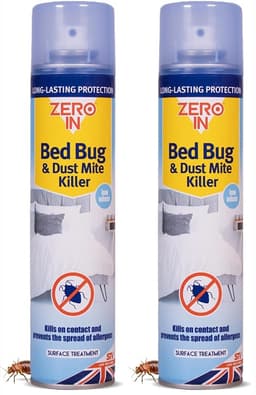
Start with the active. Cypermethrin, cyphenothrin, prallethrin or pyrethrins should be printed if you are choosing from the listings that name one. NOPE! prints cypermethrin. The Zero In aerosols print cyphenothrin and prallethrin. The bomb prints pyrethrins from chrysanthemum. Pestshield and Rentokil leave the ingredient field blank in this capture. The British Pest Control Association describes pyrethroid resistance as widespread, so a named pyrethroid is a label fact, not a guarantee. "HSE registered" on NOPE! appears without a number. This page does not fill in a number the listing omitted. Zero In aerosols say over two weeks. NOPE! says up to three months. Those are claims on the shop page, not a test run for this guide.

Pack sizes that disagree on the page

Pestshield states six cans of 200 ml, 1,200 ml in total, at £11.99. That is the clearest volume-per-pound figure among the kept listings, which is why it carries the best-value mark on the main table, even with no active printed. The £6.99 Zero In row is the one to slow down on. The title says two 300 ml cans. The liquid-volume field says 300 ml, the unit count says 1, and the weight says 150 g. That listing stays out of any value ranking until the basket matches the title. The best bed bug spray page then applies those checks to a conditional pick.

What the listings will not answer

Pets, babies and fish are not cleared by any bullet in this set. "Natural" on the bomb's pyrethrin line is a source description, not a low-hazard pass: you still leave the room. A can also cannot treat the flat upstairs. Partial treatment can push insects into the next room, which is the warning BPCA gives about amateur sprays. Cypermethrin listings in this set carry a very-toxic-to-aquatic-life warning. Do not tip leftovers down a drain.

Common questions

Can I use a professional-strength product at home?
Only if the label is for the general public and you follow it. The Health and Safety Executive draws a line between amateur products and professional-only biocides. Strength wording on a title does not move a product across that line. If the can is marked for professional use, it is the wrong purchase for a bedroom, and this comparison does not include those packs.
What should be printed for the active ingredient?
Look for cypermethrin, cyphenothrin, prallethrin or pyrethrins, then the surfaces and any residual claim. NOPE! and the Zero In aerosols and bomb print an active in this capture. Pestshield and Rentokil do not. A blank ingredient field means you are buying on brand, pack size and stars until you can read the tin.
Does HSE registered on the page mean it is verified?
No. NOPE! says HSE registered and Ultra Power says HSE approved, and neither saved listing prints an approval number. Treat that as a prompt to read the bottle and, if a number is there, to check it against the HSE's GB or Northern Ireland lists. This guide does not invent the missing code.
Why do two Zero In two-packs show different prices and review counts?
The £11.00 listing, with 4.2 from 8,217 reviews, is the pack of two 300 ml aerosols with a 600 ml volume field. The £6.99 listing also says two cans in the title, but other fields say one 300 ml can and 150 g. They are different ASINs. Use the £11.00 row when you want the long review trail, and do not treat £6.99 as the same product on offer.
Do I spray bedding or wash it?
Wash sheets, pillowcases and duvet covers at 60°C, and tumble dry on hot for at least 30 minutes, which is the NHS line. Sprays in this set name mattresses, frames, carpets or skirting, not a soaked duvet as a substitute for the machine. Unwashable items can be bagged and frozen. NHS says two to three weeks. BPCA says at least three days. Those intervals are different, so follow the one you were given rather than averaging them.
What does up to three months residual mean in practice?
It is NOPE!'s claim for the film left after application, not a measured result from this page. Reviews say vacuuming soon afterwards lifts that film, and some buyers still saw insects after several bottles. Zero In's comparable line is over two weeks. Either claim fails if you wipe or vacuum the surface the same day, and neither claim treats a whole block of flats.
Is a dust-mite claim the same as bed bugs?
No. Several cans are labelled for both, and reviews mix fleas, mites and bed bugs on the same star line. A result against dust mites, or a suitcase sprayed after a trip, is not proof the bed bugs have gone. Read the pest named in the sentence you are relying on, then look again a week later, because eggs can hatch after the first pass.

Related pages

Sources

Public UK sources used for this comparison. Shelf prices, stars and review counts are the amazon.co.uk figures captured for these nine listings. Last checked 20 October 2026.

  1. NHS, Bedbugs (retrieved 20 October 2026)
  2. HSE, Using biocides (retrieved 20 October 2026)
  3. HSE, UK authorised biocidal products (retrieved 20 October 2026)
  4. HSE, COPR (retrieved 20 October 2026)
  5. BPCA, controlling bed bugs (retrieved 20 October 2026)
  6. BPCA, Bed bugs in 2024 (retrieved 20 October 2026)
  7. Medway Council, before and after bedbug treatment (retrieved 20 October 2026)