Independent comparisons. We may earn from shop links. More info

How to use bed bug spray

Updated: October 2026

You have a can, bites or specks along the mattress piping, and a bedroom you still need to sleep in tonight. How to use bed bug spray is the order that keeps the residue where the insects walk: wash and bag the laundry first, vacuum before you spray, treat the surfaces the label names, leave until it is dry, then do not vacuum that film off for the interval you were given. Councils do not agree on one number of days, so this page will not invent a UK law. Prices and product names below are from the amazon.co.uk listings in our [bed bug killer comparison](/hub/pest-control/bed-bug-killer).

You have a can, bites or specks along the mattress piping, and a bedroom you still need to sleep in tonight.

Our top picks

On this page

Before you open the can

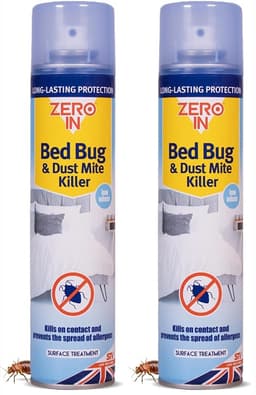
NHS guidance is blunt: contact the council or a pest controller, because DIY treatment is unlikely to clear an infestation on its own. A spray still has a place when the problem looks limited to one room and everyone, including pets, can leave until the surface is dry. Read the label on the can you bought, not a generic script. The Zero In bomb is a different method: press, leave immediately, wait two hours, ventilate. If your product is the bomb, do not follow the stand-and-spray steps below as if they were the same job.

Prep and laundry

Strip the bed. Sheets, pillowcases and duvet covers go in the wash at 60°C, then a hot tumble dry for at least 30 minutes. That is the NHS line. Vacuum before you spray, not after. The mistake that shows up in NOPE! reviews is hoovering the same day and lifting the residual film. Councils print different gaps, from about a week to four weeks, so the label you were given leads.

Where to spray

Spray the places bed bugs harbour, not a light mist across the centre of the mattress and nothing else. On a typical UK divan that means the piping and seams, the headboard, the bed frame joints, and the skirting where the bed meets the wall. The Zero In aerosols tell you to spot-test a hidden patch because the fragrance can stain. Do not spray the sheets you just decided to wash. The bed itself is on bed bug killer for mattress.

After treatment

Stay out until the spray is dry and the time on your label has passed. Then ventilate. Sleeping in the bed after that safe point is often what council sheets want, including Stroud, because bed bugs come out to feed and then cross the treated surface. Do not vacuum the treated film during the no-vacuum window. Eggs can hatch in about a week, so look again then. If bites continue after that second look, stop adding cans and contact the council or a pest controller.

Common questions

Do I vacuum before or after spraying?
Vacuum before you spray, so the surface is clear, then keep the vacuum off the treated areas. Medway says at least 15 days, BPCA at least two weeks, Bedford three weeks, and other councils print different gaps, including up to four weeks. NOPE! reviews say an early vacuum strips the residue. Follow the label you were given when it names an interval. Do not pick the shortest council figure because it is more convenient.
How long must I stay out of the room?
Until the spray is dry, and for at least the time on your label. Medway's bed-bug sheet says do not enter for at least two hours. Another council has said up to about four hours. The Zero In bomb's listing says leave immediately and wait two hours before you ventilate, which is a fogger rule, not a licence to stay and spray. Pets leave as well. These listings do not answer a pet-safety question in the bullets.
Can I sleep in the bed the same night?
Only after the re-entry time on the label has passed and the surface is dry. Council sheets often want you to keep sleeping in the bed after that, so insects cross the treated piping on the way to feed. If the smell is still strong, or someone in the household cannot tolerate it, wait. Rentokil and Zero In reviews both describe harsh fumes. A same-night return is not a prize for finishing the can quickly.
Do I spray the duvet?
No. Wash bedding at 60°C and tumble dry hot for at least 30 minutes. NOPE! reviews in this set treat bedding as out of scope and describe spraying frames and furnishings instead. Sheets left on the bed and sprayed in place keep insects in the fabric and put insecticide where your face will be. Bag the laundry on the way to the machine.
What temperature wash for bedding?
60°C, then a hot tumble dryer for at least 30 minutes, which is the NHS instruction for bed-bug laundry. A cool eco wash is the wrong programme for this job. Items that cannot be washed can be sealed and frozen, for two to three weeks on the NHS page or at least three days on the BPCA page. Use one of those sources, not a blend.
When do I need a second treatment?
Look again about a week later, because eggs can hatch on that sort of timetable. A second spray is worth considering if you still see insects or new marks and the label allows a repeat. It is not a daily routine. If the problem has spread to another room, or bites continue after that second look, contact the council or a pest controller rather than buying a third brand of the same pyrethroid.
Can I use a bomb and a spray the same day?
You can, but they are not two ways of doing one step. Wash the bedding first either way. Use the directed spray on seams, frames and skirting you can reach. Use the Zero In bomb only if the room is within 40 cubic metres, you can leave immediately, and the latch actually locks. A bomb does not put residue into a deep seam the fog never touches. Read both labels before you combine them, and do not stay in the room to help the fogger.

Related pages

Sources

Public UK sources used for this comparison. Shelf prices, stars and review counts are the amazon.co.uk figures captured for these nine listings. Last checked 20 October 2026.

  1. NHS, Bedbugs (retrieved 20 October 2026)
  2. HSE, Using biocides (retrieved 20 October 2026)
  3. HSE, UK authorised biocidal products (retrieved 20 October 2026)
  4. HSE, COPR (retrieved 20 October 2026)
  5. BPCA, controlling bed bugs (retrieved 20 October 2026)
  6. BPCA, Bed bugs in 2024 (retrieved 20 October 2026)
  7. Medway Council, before and after bedbug treatment (retrieved 20 October 2026)