Best ant spray
A best ant spray, here, is the ready-to-use listing that names the insecticide and prints a nest-transfer claim, at a low price per litre in this set. That conditional top pick is Deadfast Ant Killer Plus, 750 ml, at £6.00. It is the wrong bottle if you need a dried lacquer, or an indoor aerosol you already trust. The [Ant spray](/hub/pest-control/ant-spray) comparison holds the table. The [ant killer spray buying guide](/hub/pest-control/ant-spray/sub/ant-spray-buying-guide) refuses a single winner. Peter F., editor for DIY & tools at productscompared.co.uk, did not run a laboratory test. Prices are the saved amazon.co.uk listings. A purchase through our links can earn a commission at no extra cost to you.
A best ant spray, here, is the ready-to-use listing that names the insecticide and prints a nest-transfer claim, at a low price per litre in this set.
A best ant spray, here, is the ready-to-use listing that names the insecticide and prints a nest-transfer claim, at a low price per litre in this set. That conditional top pick is Deadfast Ant Killer Plus, 750 ml, at £6.00. It is the wrong bottle if you need a dried lacquer, or an indoor aerosol you already trust. The Ant spray comparison holds the table. The ant killer spray buying guide refuses a single winner. Peter F., editor for DIY & tools at productscompared.co.uk, did not run a laboratory test. Prices are the saved amazon.co.uk listings. A purchase through our links can earn a commission at no extra cost to you.
Our top picks
| Badge | Product | Who it is for | Active on the listing | amazon.co.uk line | Note | Price | Offer |
|---|---|---|---|---|---|---|---|
| Best overall |  Deadfast Deadfast Ant Killer Plus Spray 750 ml | Named active and a nest line | Lambda-cyhalothrin | 4.5 from 741 | 8.4 | about £6.00 | View offer |
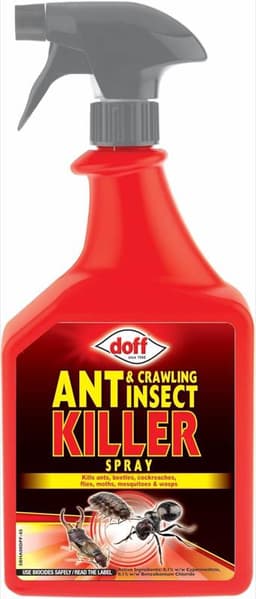
| Best value |  Doff Doff Ant & Crawling Insect Killer Spray 1 litre | Most millilitres per pound | Not stated | 4.4 from 734 | 6.4 | about £6.00 | View offer |
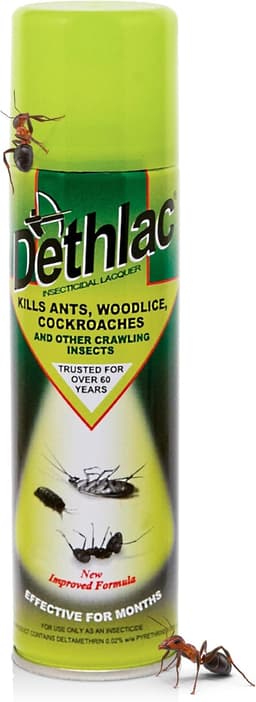
| Alternative |  Dethlac Dethlac Insecticidal Lacquer 250 ml | Dried film on hard surfaces | Pyrethrins, deltamethrin | 4.2 from 5,593 | 7.2 | about £7.90 | View offer |

On this page
The criterion, not the stars
Who should buy the litre or the indoor can
Who should buy the lacquer instead
What best does not mean
Common questions
Which of these five is the top pick, and for what job?
Why not the Raid pack with more stars?
Why not Dethlac, which has thousands of reviews?
Is Doff the better buy because the bottle is a full litre?
What if I only spray indoors and already use red Raid?
Does best mean it kills the queen today?
Related pages
Sources
Public UK sources used for this comparison. Shelf prices, stars and review counts are the amazon.co.uk figures captured for these five listings. Last checked 19 October 2026.
- HSE biocidal labelling (retrieved 19 October 2026)
- HSE home and garden pesticides (retrieved 19 October 2026)
- BPCA ant identification (retrieved 19 October 2026)
- BPCA ant control advice (retrieved 19 October 2026)
- Deadfast Ant Killer Plus Spray (retrieved 19 October 2026)
- Dethlac aerosol (retrieved 19 October 2026)
- Tesco Raid Ant and Cockroach Killer 300 ml (retrieved 19 October 2026)
- Waltham Forest garden ant fact sheet (retrieved 19 October 2026)