Independent comparisons. We may earn from shop links. More info

Ant bait stations vs ant spray: choose one job

Updated: October 2026

You sprayed the visible ants yesterday, but a new line is crossing the same threshold today. The choice between ant bait stations vs ant spray is not simply slow versus fast: bait depends on workers carrying food away, while a spray or powder acts on ants and surfaces you can reach. Using both on one route can undermine the bait. Our [ant poison comparison](/hub/pest-control/ant-poison) covers enclosed stations sold on amazon.co.uk; this guide explains when a station, contact product or lawn treatment fits the problem instead.

You sprayed the visible ants yesterday, but a new line is crossing the same threshold today.

Our top picks

On this page

What a bait station is doing

An enclosed station gives foraging workers access to bait inside a plastic case. The colony effect depends on workers feeding and carrying that bait back, rather than dying beside the station. Visible ants may stay active for days, and a busy station on the first day can be a useful sign. Stations suit a stable trail when you cannot reach the nest. A black garden ant route along a skirting board is the usual example. Place an activated station on or beside that path and remove competing sugary food. Our how-to guide for ant bait stations covers lugs, click seals and adhesive-backed cases. They are a poor fit when ants must not be allowed to feed, or when tiny pale pharaoh ants in a heated block need professional identification first.

Spray and powder work on contact areas

A trigger spray is meant to kill exposed ants or leave a residual treatment on a permitted surface. That can give quicker knockdown than bait, but killing the workers in front of you does not prove the inaccessible colony is gone. Powder can suit a reachable nest entrance or dry void when the product is expressly labelled for that use. It is not a layer to scatter around a kitchen. Rochdale Council and Waltham Forest say not to use gel bait with residual spray or powder on the same route. The Ferris four-pack listing says the same about ant sprays. If you sprayed first, do not place bait on that surface for extra protection. Moving the station a few centimetres does not necessarily avoid a treated surface.
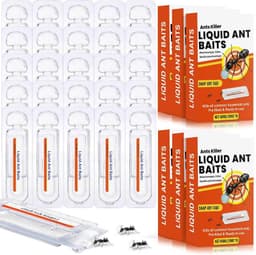
Jawell Jawell 24 x 10 ml stations

Testsieger

Jawell Jawell 24 x 10 ml stations
10.0/10about £9.99

Lawn heaps need a different decision

Ants in a lawn are not automatically a reason to use poison. The Royal Horticultural Society advises tolerating garden ants where possible and brushing away soil heaps when they interfere with mowing. For troublesome nests in lawns and flower beds, the RHS lists the nematode Steinernema feltiae as a biological control used in summer. It is watered into the soil rather than placed in a station. Do not describe it as a guaranteed colony killer, and biological controls may affect non-target insects. A nematode is not a solution for ants crossing a kitchen worktop. An outdoor station may still fit a sheltered route if its label permits that placement. Rain, direct sun or loose soil can move a lightweight case. Our ant bait station buying guide explains how to read outdoor wording without assuming weather resistance.

Flying ants and professional gels

Flying-ant activity is usually a short reproductive event, not a new species arriving. Bait feeding can pause while queens emerge. Removing fliers with a labelled contact method does not mean a station and a spray should then overlap on the workers' trail. Wait until the swarm passes and reassess the ordinary route. A gel syringe can resemble the liquid inside a station, but user category and exposure differ. Some gels are professional-only. Members of the public must use only general-public products, even if a professional pack appears online. Do not decant station bait into a syringe unless the label instructs that use. Dispose of residues according to the label. Do not wash bait, powder or spray into drains, ponds or surface water. The named Nippon safety data sheet carries an aquatic-hazard statement.

Common questions

Should I use ant spray and a bait station together?
Not on the same trail. Council guidance says residual spray or powder can kill or repel workers before they carry bait back. Pick the method that fits the current job, follow its label and ask the manufacturer or a professional if you need to change strategies after a recent treatment.
When is ant powder the better tool?
Powder may suit a reachable nest entrance or dry void when its label specifically permits that location. It is not a useful companion to bait on the workers' route, and it should not be scattered around food areas. A hidden or shared-building nest may need professional control instead.
Will ant spray kill the nest?
A spray can kill exposed ants and may leave a residual deposit, but that does not prove it reaches an inaccessible queen and colony. Read the product's authorised claims rather than assuming visible knockdown equals nest removal. Repeated trails after spraying suggest the source remains or the route has shifted.
What should I use for ants in the lawn?
First consider tolerating them or brushing away disruptive soil heaps, as the RHS suggests. For a troublesome lawn nest, an authorised Steinernema feltiae product is one option during suitable summer conditions. Follow its living-product instructions and account for possible effects on other insects.
Is a gel syringe the same as a bait station?
Both may use attractive bait, but exposure, placement and user category differ. An enclosed station restricts access through its case. Some syringes are professional-only and must not be used by householders. Check the exact authorisation and never decant one format into another.
What should I do with flying ants?
Treat the brief swarm and the underlying worker trail as separate situations. Feeding may pause while queens emerge, so a quiet bait is not necessarily broken. Once the event passes, reassess the route and use one label-approved strategy. Seek identification if the insects do not match ordinary black garden ants.
Can leftover bait go down the sink?
No. Keep insecticide out of drains, ponds and surface water and use the disposal directions on the physical label. If a station leaks, isolate the area from people and animals and follow the product's spill instructions rather than washing the liquid away.

Related pages

Sources

Public UK sources on biocides, ants and bait use. Shelf prices, stars and review counts are the amazon.co.uk lines in these twelve listings. Prices move.

  1. HSE, using biocides (retrieved 17 October 2026)
  2. HSE, biocide advertising (retrieved 17 October 2026)
  3. legislation.gov.uk, Article 72, biocidal products (retrieved 17 October 2026)
  4. HSE, Control of Pesticides Regulations (retrieved 17 October 2026)
  5. RHS, ants in the garden (retrieved 17 October 2026)
  6. Buglife, black ant (retrieved 17 October 2026)
  7. BPCA, pharaoh ants (retrieved 17 October 2026)
  8. Rochdale Borough Council, ants (retrieved 17 October 2026)
  9. BWARS, Lasius niger (retrieved 17 October 2026)
  10. Vitax SDS, Nippon Ant Bait Station (retrieved 17 October 2026)