Independent comparisons. We may earn from shop links. More info

Wood filler or wood putty: which type should you buy?

Updated: October 2026

A nail hole in bare skirting, a chip in finished laminate and a stripped hinge screw may all produce an amazon.co.uk result headed wood putty, yet they need different materials. The useful question is not simply wood filler or wood putty, but whether the repair must be sanded, stained, walked on or drilled. This guide sorts those jobs before you spend money; our [wood putty comparison](/hub/paints-and-varnishes/wood-putty) then shows the relevant listings, prices and rating evidence. For application steps, see [how to use wood filler](/hub/paints-and-varnishes/wood-putty/sub/wood-putty-how-to-use). The central rule is simple: buy for the depth and the next finish, not for the loosest word in the product title.

A nail hole in bare skirting, a chip in finished laminate and a stripped hinge screw may all produce an amazon.co.uk result headed wood putty, yet they need different materials.

Our top picks

On this page

What the two names usually mean

In UK decorating language, wood filler usually means a product applied before the final finish. It dries hard enough to sand, so it suits nail holes, cracks and shallow losses in bare or stripped timber. Wood putty traditionally means a more flexible material used after finishing to disguise tiny holes. Paste, wax and kneadable epoxy can all appear under either name. A ready-mixed paste in a tub is normally intended to dry and be sanded. A wax stick is pressed or melted into an existing finished surface and scraped flush rather than sanded. An epoxy stick has two components that must be mixed and cures to a hard repair. The wax sticks comparison covers that first distinction in more detail.

Paste, wax, epoxy or a two-part tub

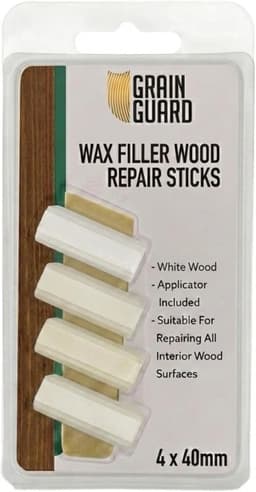
Ready-mixed filler is the convenient starting point for small, shallow work. Everbuild's light stainable 250 ml paste is an example from this comparison. Its technical sheet limits one coat to 5 mm, so a 12 mm-deep hole is not a reason to apply one thick lump; use successive layers or choose a product designed for depth. Wax is for concealment in an existing film. It does not create a sandable base and should not be expected to hold a screw. Grain Guard's four-stick white-wood pack is pressed in, scraped level and buffed. Kneadable epoxy fills a different gap. J-B Weld KwikWood is aimed at repairs including screw holes and lists a 15–25-minute set with a one-hour full cure. Milliput Standard is also an epoxy that bonds wood, yet its amazon.co.uk listing is ranked in Sealers. It is a general repair putty, not a dedicated colour-matching wood filler.

Stain, paint or an existing finish

Stain is much less forgiving because filler and timber absorb colour differently. Stainable means that stain can be applied; it does not promise that dried filler will reproduce the surrounding grain. Everbuild's guidance says to match the filler to the wood rather than the stain and warns that the paste may dry darker. An existing factory finish changes the decision again. Sanding a laminate board can permanently dull or cut through its printed wear layer, so paste is usually the wrong way to hide a superficial chip. A coloured wax repair avoids broad sanding, though it remains a cosmetic insert.

What this comparison's prices are for

The prices here are amazon.co.uk shelf prices for this set, not a claim about the whole UK market. At the entry level, roughly £4–£6, the set includes KwikWood at £4.03, Everbuild 250 ml at £4.69, Milliput at £5.24 and a four-colour Cncedi touch-up set at £5.69. Review counts also need a job label. Everbuild's 4.5 from 9,188 ratings is strong evidence for a widely bought small tub, but it does not prove suitability for laminate or a stripped screw. For a job-by-job shortlist, read which wood filler fits which job. If the timber is outdoors or feels soft, switch to the exterior wood filler guide before ordering.

Common questions

Is wood putty the same as wood filler?
Not reliably. UK trade guidance often uses filler for a hard, sandable repair before finishing and putty for small work after finishing. Retail titles may use both names for paste, wax or epoxy, so check the product form, layer depth, finishing instructions and intended surface rather than relying on the title.
Do I need ready-mixed or two-part filler for a nail hole?
A shallow nail hole in sound, dry timber normally suits ready-mixed filler, particularly if you will paint it. Everbuild limits its multi-purpose paste to 5 mm per coat. A much deeper loss, damaged edge or impact-prone repair may justify a two-part filler, provided you can mix it accurately and work within its setting time.
When is an epoxy stick the right buy?
Use epoxy when a small repair needs to cure into a hard, shaped plug, such as a stripped screw hole or broken furniture edge. Mix both components until the colour is uniform and respect the stated cure. It is less suitable when your main aim is an unobtrusive stain match across visible natural wood.
Will stainable filler match oak?
Not necessarily. Filler has no natural grain and may absorb stain differently from oak. Stainable only means it accepts a coating. Match the dried filler colour to the timber as closely as possible, then test the intended stain on a cured sample before filling a conspicuous area.
What should I budget?
In this comparison, basic paste, epoxy and small colour products cost about £4–£6; simple wax and paste kits sit around £7–£10; broader colour or heated kits cost about £17–£23. These are amazon.co.uk listing prices and can change. Compare the chemistry and usable quantity before comparing price alone.
When should I stop treating this as a filler job?
Stop if exterior timber is soft across a wide area, a structural section has been lost, or a floor board is swollen or breaking down. Correct the moisture source first and ask a joiner about replacement or a splice where needed. Filler can restore a local surface; it cannot cure continuing decay.

Related pages

Sources

Public UK sources and maker sheets used for the limits on this page. Prices, stars and review counts are the amazon.co.uk listing figures for the ten products compared here.

  1. Leyland SDM — wood fillers guide (retrieved 17 October 2026)
  2. Ronseal Multi Purpose Wood Filler (retrieved 17 October 2026)
  3. Ronseal High Performance Wood Filler (retrieved 17 October 2026)
  4. Everbuild multi-purpose wood filler technical data sheet (retrieved 17 October 2026)
  5. Milliput — how to use (retrieved 17 October 2026)
  6. HSE — wood dust (retrieved 17 October 2026)
  7. VOC in Paints, Varnishes and Vehicle Refinishing Products Regulations 2012 (retrieved 17 October 2026)
  8. Consumer Rights Act 2015, section 9 (retrieved 17 October 2026)