Independent comparisons. We may earn from shop links. More info

Use Class 4 fence posts: what the label must say

Updated: October 2026

Use Class 4 fence posts are timber products treated for contact with the ground or fresh water. That is a specific end-use classification, not another way of saying green, pressure treated, tanalised or C24. None of the eight amazon.co.uk extracts in our [wood post comparison](/hub/paints-and-varnishes/wood-post) prints Use Class 4, even though several mention preservatives or treatment. If you are buying a post to bury, ask the seller to confirm UC4 and the intended service-life specification in writing before installation. A colour, brand name or review cannot supply the missing declaration.

Use Class 4 fence posts are timber products treated for contact with the ground or fresh water. That is a specific end-use classification, not another way of saying green, pressure treated, tanalised or C24.

Our top picks

On this page

What Use Class 4 means

BS EN 335 groups timber uses by their exposure to moisture and biological attack. In buyer-facing terms, UC4 covers timber in direct ground or fresh-water contact, including a buried wooden fence post. The Wood Protection Association’s “Make sure it’s 4” campaign warns that UC3, intended for exterior timber above ground, is not the appropriate class for a post placed in soil. Use Class describes the intended exposure; it does not promise that every piece lasts for a fixed number of years. The WPA discusses desired service-life specifications such as 15 and 30 years. Ask a merchant or seller for three connected facts: the timber is treated to UC4, the desired service-life specification, and the evidence supplied with the product or order. For dimensions as well as treatment, consult our wood post buying guide. UC4 treatment cannot make a 300 mm peg long enough for a fence panel.

What the listings actually claim

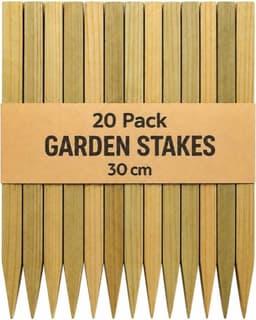
The two Gro Garden listings name Wolmanit CX and describe high-vacuum pressure treatment. Their bullets say this can extend life by up to 15 years, but neither extract prints UC4. P Dot Wolf calls its 2 ft × 45 mm stakes tanalised and pressure treated. “Tanalised” indicates treatment using a preservative system associated with the Tanalith brand, but the word alone does not tell you the achieved Use Class. The two Konrado-Garden listings say pressure treated in their bullets. UK reviewers of the 300 mm pack report no green appearance or preservative smell. TG Supplies separately claims C24, kiln drying and pressure treatment. Austin Commerce claims a water-based preservative. Yardwe states no treatment. None of these phrases states UC4.

Colour, tanalised timber and C24

Fresh treated softwood is often greenish because of the preservative formulation or a colour marker, but colour is not the Use Class. The same caution applies to “tanalised” and “pressure treated”. Pressure is a treatment process; the achieved result depends on the timber, preservative and process specification. Ask whether the finished product is UC4 for ground contact rather than trying to infer it from the process word. C24 belongs to a different conversation. It is a strength grade, with the “24” referring to a characteristic bending-strength value of 24 N/mm², not a preservative dose or expected life. PEFC and kiln drying are also separate from decay resistance in soil.

CCA, creosote and treated-timber waste

Do not try to reproduce industrial UC4 treatment by brushing a general fence stain onto a post. An approved end-grain preservative is useful after an unavoidable cut, yet the cut end should not become the buried foot of the post. Copper chrome arsenic, usually called CCA, has been off sale for general use in the UK since 1 September 2006, according to NetRegs guidance. Creosote is also not a general DIY tin for garden fencing. HSE has announced a further Great Britain market change from 1 April 2027. From that date, new creosote-treated tree stakes and non-safety-critical fencing may no longer be placed on the GB market. Never burn treated offcuts in a garden fire, fireplace or domestic stove. Northern Ireland can follow a different route from Great Britain, so check local guidance there.

Common questions

What is Use Class 4 in one sentence?
Use Class 4 is the timber end-use class for direct contact with the ground or fresh water, which is why a buried wooden fence post should be specified as UC4. It describes exposure and treatment requirements; it is not itself a guarantee that every post will last a fixed number of years.
Does green timber mean it is UC4?
No. Green colour may come from a preservative formulation or marker, and it can fade without meaning that the treatment has vanished. Appearance cannot establish preservative penetration, retention or quality control. Ask for UC4 and the desired service-life specification in the seller’s paperwork.
Is tanalised timber automatically Use Class 4?
No. “Tanalised” identifies treatment associated with a preservative brand and process, but it does not by itself state the achieved Use Class. Ask whether the finished product is specifically treated to UC4 for ground contact and request written evidence for the order you are buying.
Is C24 a preservative treatment?
No. C24 is a structural strength grade, not a durability class. A C24 post may also be pressure treated, but those are separate claims and the listing should state both where both apply. Burial still calls for a UC4 specification regardless of the strength grade.
Can I buy CCA timber for a new garden post?
CCA-treated timber has been off sale for general UK use since 1 September 2006. Do not seek old stock or reuse unidentified treated timber for a new domestic post without competent advice. Modern UC4 timber uses approved preservative systems and should arrive with a clear specification.
Can I apply creosote to a new fence post myself?
Creosote is restricted to professional and industrial uses rather than general DIY application. HSE has also announced that from 1 April 2027, new creosote-treated tree stakes and non-safety-critical fencing cannot be placed on the Great Britain market. Use an authorised product for the stated application and follow its label.
What should I ask the seller to confirm?
Ask for “Use Class 4 for ground contact”, the desired service-life specification, the timber dimensions and any warranty conditions in writing. If the reply only repeats “treated”, “green” or “outdoor use”, it has not answered the ground-contact question. Keep the invoice and product documentation after installation.

Related pages

Sources

Public UK sources used for the use-class, planting and planning points on this page. Prices, stars and review counts are from the amazon.co.uk listings on 16 October 2026.

  1. Wood Protection Association — Understanding Use Class 4 (retrieved 16 October 2026)
  2. Wood Protection Association — Make sure it’s 4 (retrieved 16 October 2026)
  3. Timber Decking and Cladding Association — timber preservation (retrieved 16 October 2026)
  4. Wood Protection Association — installing treated fence posts (retrieved 16 October 2026)
  5. RHS — How to stake a tree (retrieved 16 October 2026)
  6. Planning Portal — fences, gates and garden walls (retrieved 16 October 2026)
  7. NetRegs — wood preservatives (retrieved 16 October 2026)
  8. HSE — creosote renewal bulletin (retrieved 16 October 2026)