Independent comparisons. We may earn from shop links. More info

How to stake a tree without restricting growth

Updated: October 2026

Learning how to stake a tree starts with one distinction: the stake is temporary support, not a miniature fence post. It should hold the root ball steady while allowing the stem to flex, and it should normally come out after the tree has established. The Royal Horticultural Society advises an angled stake driven at least 400 mm into the soil, with a flexible tie and spacer about one-third of the way up the stem. Several products in our [wood post comparison](/hub/paints-and-varnishes/wood-post) are too short for that method, even if their titles call them garden stakes.

Learning how to stake a tree starts with one distinction: the stake is temporary support, not a miniature fence post.

Our top picks

On this page

A tree stake is not a fence post

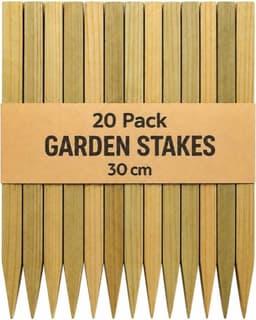
Do not concrete a tree stake into a boot beside the root ball. The aim is temporary anchorage with minimal disturbance, not a permanent rigid column. If you are actually building a boundary, use the separate fence-post installation guide. A 300 mm site peg is also not a tree stake. The RHS method asks for at least 400 mm of stake in the soil, so the entire Konrado 300 mm peg would still fall short before any useful length remained for a tie. The stated 400 mm Konrado pack would have no above-ground height if buried to that minimum. Staking is not automatic for every new tree. Use a stake where wind movement would rock the roots or the tree cannot stand securely after planting.

Set the angle, depth and tie

Plant the tree correctly before adding the support, keeping the root flare at the proper level rather than burying the stem. If the root ball can be lifted enough to avoid damage, the RHS method uses one stake placed at roughly 45 degrees to the trunk and driven outside the main root mass. Angle it so the top meets the trunk on the side facing the prevailing wind. Drive at least 400 mm into undisturbed soil. If the ground is hard or stony, make a pilot hole or use suitable equipment rather than battering a thin square until it splits. Fit a purpose-made flexible tree tie about one-third of the way up the trunk, not near the crown. Use a spacer or a figure-eight arrangement that keeps the stake from rubbing the bark. Wire or cord directly against bark can cut in as the trunk expands and should not be used as a substitute.

Which lengths in this comparison work?

The 1.2 m × 32 mm Gro Garden stake has the most workable proportions in this set. With 400 mm in the soil, about 800 mm remains above ground for positioning a low tie. The listing names Wolmanit CX pressure treatment but does not state a Use Class. Our wood post buying guide covers the wider size distinctions. The Gro Garden stake titled at 900 mm × 25 mm would leave about 500 mm above ground after the same burial. That may suit a small sapling with a low tie, but the listing conflicts: another dimension line says 120 cm, and the piece-count field disagrees with the ten-pack title. P Dot Wolf’s 2 ft stake is approximately 610 mm long. Subtract 400 mm of burial and only about 210 mm remains above ground. The 300 mm and 400 mm pegs cannot provide the RHS burial depth plus an above-ground tie point.

Check, loosen and remove the support

Inspect the tie through the growing season and after strong winds. Loosen or reposition it before it presses into expanding bark. RHS planting guidance says stakes are generally kept for two or three years, but establishment rather than the calendar is the deciding test. Remove the tie temporarily and move the stem gently. If the root ball remains firm and the tree stands without excessive movement, take out the tie and stake rather than leaving them as permanent fixtures. Pull or dig the stake out with as little root disturbance as possible. Do not burn treated offcuts. HSE has announced that from 1 April 2027, new placing on the Great Britain market of creosote-treated tree stakes will no longer be permitted. That does not make every alternative stake suitable; ask what treatment was used.

Common questions

How deep should a tree stake go?
The RHS advises driving an angled stake at least 400 mm into the soil. That depth must be added to the height needed for the tie, so a 300 mm or 400 mm peg cannot perform the whole job. Hard, exposed ground may require a different support method rather than heavier hammering.
Should I use one stake or two?
One angled stake is a common RHS method when the tree and root ball allow it. Larger root-balled trees or particular sites may need two stakes or another designed system. Do not add supports merely to make the trunk rigid; the root ball should be stable while the stem retains some movement.
How high should the tree tie be?
Place the tie roughly one-third of the way up the stem, using a spacer to stop stake and bark rubbing together. A low tie controls root-ball movement while allowing the upper stem to flex. Check it regularly and loosen it before growth causes constriction.
Can I use a 2 ft stake?
Two feet is approximately 610 mm. After the recommended minimum 400 mm burial, only about 210 mm remains above ground, which is too low for many saplings. It can work only where the tree’s required tie point is genuinely that low and the product is suitable for the soil exposure.
Should I concrete a tree stake?
No. A tree stake is intended as removable, temporary support and is normally driven into soil outside the main root mass. Concrete occupies rooting space, complicates removal and turns a flexible planting aid into a permanent obstruction. Fence-post practice does not belong beside a young tree.
When should I remove the stake?
RHS guidance commonly allows two or three years, but remove it once the tree is securely rooted and can stand without the root ball rocking. Test it during an inspection rather than waiting blindly for an anniversary. Keeping a tight tie too long can rub or constrict the trunk.

Related pages

Sources

Public UK sources used for the use-class, planting and planning points on this page. Prices, stars and review counts are from the amazon.co.uk listings on 16 October 2026.

  1. Wood Protection Association — Understanding Use Class 4 (retrieved 16 October 2026)
  2. Wood Protection Association — Make sure it’s 4 (retrieved 16 October 2026)
  3. Timber Decking and Cladding Association — timber preservation (retrieved 16 October 2026)
  4. Wood Protection Association — installing treated fence posts (retrieved 16 October 2026)
  5. RHS — How to stake a tree (retrieved 16 October 2026)
  6. Planning Portal — fences, gates and garden walls (retrieved 16 October 2026)
  7. NetRegs — wood preservatives (retrieved 16 October 2026)
  8. HSE — creosote renewal bulletin (retrieved 16 October 2026)