Independent comparisons. We may earn from shop links. More info

Wax sticks vs wood filler for laminate

Updated: October 2026

An amazon.co.uk title may call the same small tube wax, putty, paste and filler, but those materials do not behave alike on a finished floor. In the choice between wax sticks vs wood filler for laminate, depth and wear matter more than the label: soft wax disguises a shallow mark, hard wax or a laminate-suitable paste fills a chip, and ordinary sandable timber filler belongs on bare wood that will be coated. Our [wood floor repair kit comparison](/hub/paints-and-varnishes/wood-floor-repair-kit) identifies the kit type for twelve listings; here is how to choose the material. We did not run a laboratory test, and a qualifying purchase can earn a commission at no extra cost to you.

An amazon.co.uk title may call the same small tube wax, putty, paste and filler, but those materials do not behave alike on a finished floor.

Our top picks

On this page

Four materials, not one product

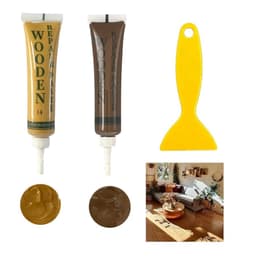
Soft wax is the crayon-like option. You rub or press it into a scratch, let it settle and buff away excess. The rysons five-stick pack is this type, with black, white and three brown shades. Soft wax is inexpensive and easy to correct, but it can lift from a deep hollow or a busy walkway. Hard wax is designed to be melted, placed into a chip and levelled after cooling. The two SZ-KARIDGE sets combine eleven blocks with a heating tool and eight markers. The wood-tone listing gives a maximum tool temperature of 450°C, so the method brings a genuine burn risk. Paste or tube filler is applied with a small scraper rather than rubbed like a crayon. Lifreer, Cncedi, Plimbin, aidehuakeji and atnayo fall into this group, although consistency varies. Markers are colour tools, not fillers. Our wood floor repair kit buying guide puts those questions into a buying order.

When wax is the better buy

Choose soft wax when the mark is shallow, stable and away from heavy wear. A white line that barely catches your nail often needs its contrast reducing rather than a hard plug of material. Rubbing a close shade across and along the scratch, then buffing with a lint-free cloth, can be more forgiving than spreading paste over an intact surface. Reviewers report useful rysons matches on light oak, but deep table scratches were not fully concealed. Hard wax wins when a small chip needs volume and controlled levelling. Melted material can be layered, slightly overfilled, cooled and scraped flush. Neither wax type guarantees durability. UK reviews of heated kits mention wax scraping up where it receives repeated contact. No product in this set should be described as waterproof.
Lifreer Lifreer 12-colour filler

Testsieger

Lifreer Lifreer 12-colour filler
8.8/10about £16.99

When paste or melted wax is the better buy

Choose fill when your nail drops into the damage or the brown fibre core is visible. A suitable paste is the simpler no-heat option: mix a small quantity, press it into the hollow and level it according to its instructions. Lifreer offers twelve named colours, while grey and brown Cncedi variants provide narrower base palettes at lower prices. Paste is not automatically stronger than wax. Aidehuakeji review evidence describes runny material and says no sealant is supplied; Lifreer reviews say some colours behave more like paint and do little filling once dry. A thin flat scratch may reject filler because there is no cavity for it to occupy. Melted hard wax offers more build for a crisp chip. For one tiny repair, that equipment can be disproportionate. For the application order, see how to use a laminate floor repair kit.

The filler you should not use on the print

Ordinary sandable wood filler is made for a different job. A product such as Ronseal Multi-Purpose Wood Filler is intended for timber and is sanded when dry before stain, varnish or paint. Laminate’s visible grain is a printed décor layer, not solid matching timber. Sanding general filler flat on laminate can abrade the surrounding wear layer and remove the print. The resulting pale patch may be larger than the original chip. Silicone is another poor default because it is difficult to colour. Use a product that explicitly names laminate, and follow its levelling method without assuming sanding is permitted. Filler does not repair a broken click connection, flatten a swollen core or restore water resistance. Our laminate floor scratch repair guide separates minor lines and chips from those stop conditions.

Common questions

Is hard wax the same as a wax crayon?
No. A soft wax crayon is rubbed or pressed into a shallow mark without a specialised melting tool. Hard wax is heated, flowed into a chip, cooled and scraped level. It can build a firmer patch, but neither material recreates the factory wear layer.
Will paste last longer in a hallway?
Not necessarily. Durability depends on formulation, adhesion, chip shape, preparation and foot traffic. A runny paste or paint-like filler may wear poorly, while soft wax can collect dirt or lift. For a high-traffic deep defect, a stable hard-wax repair or plank replacement may be more credible.
Can I sand ordinary wood filler flat on laminate?
Do not use sanding as the default. It can remove the printed décor and clear wear layer around the repair. Choose a laminate-suitable material designed to be scraped or wiped level, and follow that product’s instructions rather than methods written for bare timber.
Do markers count as filler?
No. Markers add colour to a surface scuff or a grain line but do not replace missing volume. If your nail catches in a hollow, use suitable paste or hard wax first. A marker may then add detail if it is compatible and tested.
Why does wax look shiny?
Wax can reflect light differently from a matt laminate wear layer, especially when too much remains on the surface. Remove only the excess using the kit’s method and avoid aggressive polishing. Some brand systems include sheen-adjusting pads, but those instructions are not universal.
When is neither wax nor paste the right choice?
Neither is suitable when the plank is swollen, the click joint has failed, the board moves or damage covers a large area. They are cosmetic materials for stable minor defects. Water damage, structural failure and widespread wear need the cause addressed and often require board replacement.

Related pages

Sources

Public UK sources used for the safety and repair limits on this page. Prices, stars and review counts are the amazon.co.uk listing lines used for this comparison.

  1. Consumer Rights Act 2015, section 9 (retrieved 17 October 2026)
  2. General Product Safety Regulations 2005, Great Britain (retrieved 17 October 2026)
  3. Quick-Step — how to repair a damaged laminate board (retrieved 17 October 2026)
  4. EPLF care bulletin, November 2024 (retrieved 17 October 2026)
  5. Kent Flooring Warehouse — laminate maintenance and repair (retrieved 17 October 2026)
  6. Wiltshire Wood Flooring Supplies — which repair product to use (retrieved 17 October 2026)
  7. HSE — formaldehyde releasers (retrieved 17 October 2026)
  8. BS EN 13329:2023 laminate floor coverings (retrieved 17 October 2026)