Independent comparisons. We may earn from shop links. More info

How to use a laminate floor repair kit

Updated: October 2026

You have matched the colour and opened the pack; now the risk is making a small mark larger. Learning how to use a laminate floor repair kit starts with restraint: clean the defect, test the lightest colour, fill only what is missing and keep abrasives away from the printed décor. Cold sticks and markers follow a different method from melted hard wax, so check the contents before you begin. If you still need to select a product, our [wood floor repair kit comparison](/hub/paints-and-varnishes/wood-floor-repair-kit) separates paste, marker, soft-wax and heated kits. We did not run a laboratory test, and a qualifying purchase can earn a commission at no extra cost to you.

You have matched the colour and opened the pack; now the risk is making a small mark larger.

Our top picks

On this page

Before any wax touches the floor

Vacuum or brush loose grit from the mark, then clean away grease using the floor manufacturer’s recommended product. The surface must be dry before you add wax or paste; moisture and dust prevent adhesion and distort the colour. Avoid flooding the joint with water, particularly where a chip has exposed the absorbent fibre core. If your fingernail does not catch, it is probably a surface scuff that needs colour rather than volume. If it catches in a hollow, you can fill the missing area. A raised edge, swollen seam or moving click joint is a stop sign: filler cannot restore the board’s structure. Test two or three shades on an offcut, and begin lighter than the apparent floor colour. For a heated kit, keep children and pets away. The SZ-KARIDGE wood-tone listing gives a maximum of 450°C, which is hot enough to cause a serious burn.

Cold sticks, markers and paste

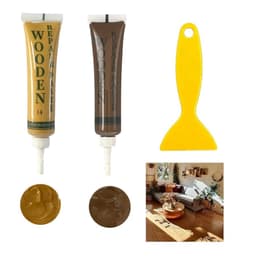
For a white or pale hairline that does not catch your nail, apply a marker with the grain or printed pattern rather than drawing a broad block across it. Use short, light strokes. One dark stroke is harder to correct than several light ones. Soft wax works on a shallow groove or pinhole. Press material into the hollow rather than coating a wide area, and remove residue from the intact surface. Paste or tube filler needs a small applicator or scraper. Mix tiny amounts away from the damage, working from light to dark, then press the blend into the chip. Do not assume every paste can be sanded: ordinary sanding can remove laminate’s printed layer. These listings do not provide one reliable drying time. A review of the aidehuakeji tubes says the pack contains no sealant. For the material trade-offs, see wax sticks versus wood filler on laminate.
Lifreer Lifreer 12-colour filler

Testsieger

Lifreer Lifreer 12-colour filler
8.8/10about £16.99

Melted hard wax

Read the heating tool instructions before charging or switching it on. With the SZ-KARIDGE pen, the listing says to charge fully, tighten the nozzle and hold the control to heat. Do not improvise with a flame, kitchen appliance or unregulated soldering iron. Start with the lightest wax that belongs in the floor’s colour family. Melt a small amount into the chip, then add a second tone if needed to break up a flat patch. Allow the wax to cool before levelling it. Quick-Step guidance for its own QSREPAIR system uses an overfill-and-scrape method. That is not a universal cure time for every wax. Keep the scraper nearly flat and remove only the proud material. Inspect the repair from standing height rather than chasing perfection from ten centimetres away. UK reviews of heated kits also report wax lifting where it receives repeated contact.

When the kit is the wrong tool

Stop if the board edge is swollen, rough or raised after water exposure. The fibre core does not reliably return to its original dimensions, and wax over the top is not a waterproof membrane. A broken click joint, a loose plank or damage spread across several boards also exceeds a spot kit. Do not sand a laminate scratch as though the plank were solid timber. The visible grain is a printed décor layer, and once that picture is removed it does not grow back. For claw marks, chair scratches and chipped edges, our laminate floor scratch repair page helps decide whether disguise or replacement is realistic. If the kit type is still uncertain, use the wood floor repair kit buying guide.

Common questions

Do I clean with water or just wipe?
Remove grit first, then use the floor manufacturer’s approved cleaner sparingly. The defect must be clean, grease-free and completely dry before filling. Do not soak an exposed laminate core or joint, because absorbed water can swell the board and turn a cosmetic repair into a replacement job.
Should I sand the scratch first?
Do not sand laminate’s printed surface. You may remove a loose raised fragment only when the product instructions explicitly call for it and you can do so without widening the defect. General sanding risks taking away the décor and creating a pale patch that wax cannot reconstruct.
Do I start with light or dark wax?
Start with the lightest plausible shade, then mix in a little darker wax. It is easier to deepen a blend than to remove an overly dark fill. Test the mixture away from the visible mark and check it under both daylight and the room’s normal lighting.
What if my kit has no heating pen?
Use the cold method intended for its material. A soft stick can be rubbed or pressed into a shallow groove, while paste can be applied with a scraper. Do not melt a product unless the manufacturer says it is designed for heating and supplies suitable safety guidance.
Can I walk on the repair straight away?
Follow the product’s stated setting or curing time. There is no single safe wait for every paste and wax in this category. Walking on a repair before it has hardened can pull material from the chip, flatten the texture or carry colour onto the surrounding floor.
When should I replace the plank?
Replace or professionally assess it when the core is swollen, the click joint is broken, the board moves, or a large section of décor is missing. A repair kit can disguise a stable, minor defect but cannot restore structure, factory wear resistance or water-damaged fibreboard.

Related pages

Sources

Public UK sources used for the safety and repair limits on this page. Prices, stars and review counts are the amazon.co.uk listing lines used for this comparison.

  1. Consumer Rights Act 2015, section 9 (retrieved 17 October 2026)
  2. General Product Safety Regulations 2005, Great Britain (retrieved 17 October 2026)
  3. Quick-Step — how to repair a damaged laminate board (retrieved 17 October 2026)
  4. EPLF care bulletin, November 2024 (retrieved 17 October 2026)
  5. Kent Flooring Warehouse — laminate maintenance and repair (retrieved 17 October 2026)
  6. Wiltshire Wood Flooring Supplies — which repair product to use (retrieved 17 October 2026)
  7. HSE — formaldehyde releasers (retrieved 17 October 2026)
  8. BS EN 13329:2023 laminate floor coverings (retrieved 17 October 2026)