Independent comparisons. We may earn from shop links. More info

Best emulsion paint for walls UK: a practical buying guide

Updated: October 2026

You have measured the room, chosen a colour family and opened several tins online, but the labels still make unlike products look interchangeable. The best emulsion paint for walls in the UK is not simply the biggest tin or the best-known brand: it is the finish that suits the room, in enough litres for the stated coverage and number of coats. Start with how often the wall will be touched, wiped or exposed to moisture, then check the coverage figure on that exact tin. Our [wall paint comparison](/hub/paints-and-varnishes/wall-paint) ranks eight amazon.co.uk listings; this guide explains the buying order to use before you pick one.

You have measured the room, chosen a colour family and opened several tins online, but the labels still make unlike products look interchangeable.

Our top picks

On this page

Start with the room, not the brand

A quiet adult bedroom and a narrow family hallway ask different things of emulsion. Standard matt gives a low-sheen appearance that can make minor surface irregularities less obvious, so it is a sensible starting point for ceilings and lower-traffic rooms. Washable or durable matt is the more useful trade-off for busy halls, stairs and children’s rooms. If you are choosing between low sheen, easier wiping and how much texture the finish reveals, the matt or soft sheen guide deals with that decision directly. Steam and grease create demands that a general-purpose matt may not address. Read the kitchen and bathroom wall paint guide before using an ordinary matt in a wet or frequently steamy space.

Turn the wall area into litres

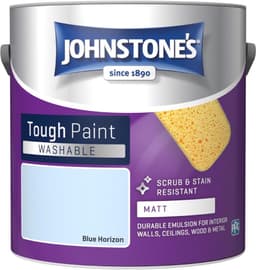
Calculate paint from the usable wall area, the planned coats and the coverage printed for the particular product. For example, suppose the paintable area is 32 m² after subtracting openings. At 12 m² per litre and two coats, the calculation is 32 × 2 ÷ 12, or 5.33 litres. A 5-litre tin would leave no allowance; 7 litres gives some margin. If the chosen listing states 10–12 m² per litre, calculate with 10 for a cautious budget. Several Johnstone’s retail matt products state 12 m² per litre, while the Dulux 7-litre listing states 10–12 m² per litre.

What the prices in this set actually buy

Compare the total usable quantity before treating a lower shelf price as better value. In the captured amazon.co.uk listing data, a 2.5-litre washable matt was £21.99 and a 7-litre Dulux white was £27.05. These are snapshots rather than promised current prices. On those figures, the washable matt works out at about £8.80 per litre, while £27.05 for 7 litres is about £3.86 per litre. Use the best wall paint shortlist when you are ready to compare named tins from this set.

Labels that are weaker than they sound

A bathroom named in a generic use list is not automatically evidence that the paint resists mould growth. A 30 ml touch-up bottle listed at £8.79 is only 0.03 litres. It is not an economical route to painting a wall. For interior matt wall and ceiling paint, the UK rules implementing limits on volatile organic compounds set a maximum of 30 g/l for the relevant product category. The label should state the product’s maximum VOC content, not merely use a vague low-VOC phrase.

Common questions

How much emulsion do I need for one room?
Add the paintable wall areas, subtract large openings, multiply by the planned coats and divide by the coverage rate on your chosen tin. A room with 32 m² of wall, two coats and 12 m²/litre needs about 5.33 litres before allowing for waste or absorbent patches. Round up to a practical tin size rather than assuming one coat.
Is washable matt worth more than standard matt?
Washable matt can justify its higher price in halls, stairs and children’s rooms where marks are likely to be wiped repeatedly. Standard matt may be better value in a quiet bedroom or on a ceiling. Check whether “washable” is supported by a defined durability claim, because the word alone does not establish equal scrub resistance across products.
Should I buy 2.5, 5 or 7 litres?
Let the two-coat calculation decide. A 2.5-litre tin can cover roughly 30 m² for one coat at 12 m²/litre, but only 15 m² for two. Five or seven litres suits larger totals, with the larger size offering a useful margin only if you will use the same colour and finish.
Does brilliant white mean the same colour across brands?
No. Brilliant white is a colour name used by multiple manufacturers, not a universal measured shade. Sheen, formulation, lighting and the existing surface can alter its appearance. Avoid switching products halfway across a wall, and retain labelled paint from the job if you expect to make small repairs later.
Can I use ordinary matt emulsion in a bathroom?
Only if the manufacturer clearly permits that use and the room conditions fit the claim. A generic bullet mentioning bathrooms is weaker than a formulation specifically described for moisture, grease or mould resistance. In a steamy room, suitable paint does not replace extraction, drying and proper treatment of an existing mould problem.
What should the VOC label say?
For the relevant interior matt wall-and-ceiling category, the legal maximum is 30 g/l. The packaging should state the VOC limit for the category and the maximum content of the ready-to-use product. This is a compliance check, not proof that one paint covers better, smells less or is safer in every circumstance.
Is a small touch-up bottle a cheap way to paint a wall?
No. A 30 ml bottle is intended for a very small repair, not broad coverage. Even at a nominal 12 m²/litre, it represents only about 0.36 m² for one coat before application losses. It can also leave a visible patch if the colour, sheen, batch or age of the existing coating differs.

Related pages

Sources

Public UK sources used for VOC limits, lead in old paint, new plaster and finish advice. Prices, stars and review counts are from the amazon.co.uk listings in this set. No BS EN 13300 class is claimed for these tins.

  1. VOC Regulations 2012 (SI 2012/1715) (retrieved 17 October 2026)
  2. HSE CIS79 — old lead paint (retrieved 17 October 2026)
  3. GOV.UK — lead information for the public (retrieved 17 October 2026)
  4. BSI BS EN 13300:2022 — interior wall paint classification (retrieved 17 October 2026)
  5. Dulux UK — painting new plaster (retrieved 17 October 2026)
  6. Dulux UK — how much paint you need (retrieved 17 October 2026)
  7. Dulux UK — paint finishes explained (retrieved 17 October 2026)
  8. Wickes — paint buying guide (retrieved 17 October 2026)